
How to Change Speed on a Ryobi Drill Press
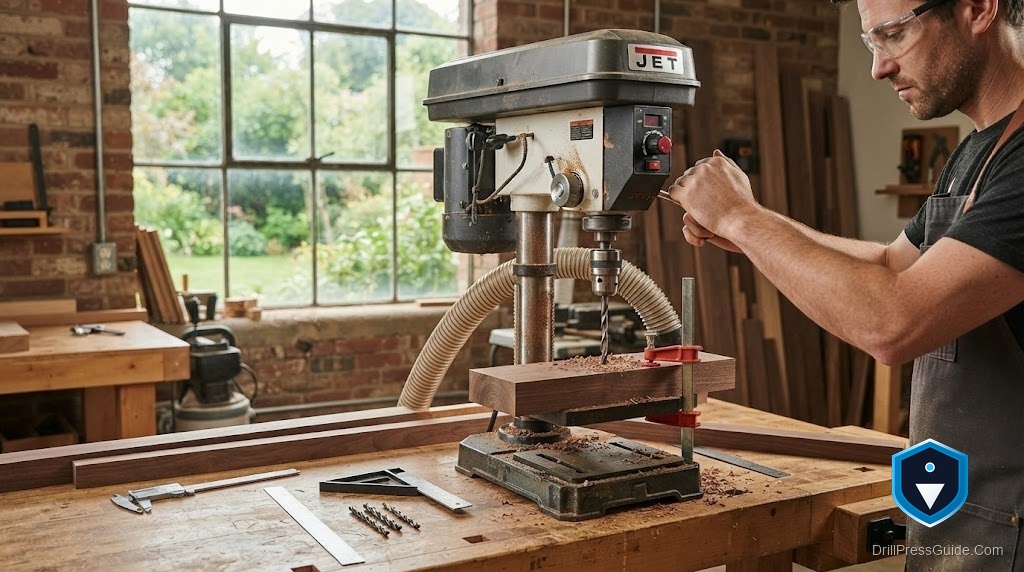
The first time I could not figure out why my Ryobi drill press was leaving burn marks on oak, I was running too fast. The bit looked fine. The drill press looked fine. I had just never moved the belt, and the factory setting suited plywood, not hardwood with a 1-inch bit. Ten minutes later the marks were gone. That is the power of using the right speed, and this guide shows you how to find it and set it.
Changing speed on a Ryobi drill press means moving the V-belt across the stepped pulleys inside the head. There is no knob to turn, no digital dial to set. You open the cover, release the belt tension, slide the belt to the pulley combination that matches the speed you need, reset tension, and close the cover. The whole process takes under five minutes once you have done it twice.
Why speed matters
Bits and materials want different speeds. A small twist bit in wood works best at high RPM. A large bit in metal wants slow RPM to stay cool. Running too fast burns wood and dulls bits in metal. Running too slow wastes time and can chatter in thin material.
The speed chart on your Ryobi press gives you starting points. It is usually on a sticker inside the guard or printed in the manual. Use it until you develop a feel for the right sound and cut quality.
Before you start
Unplug the drill press. This is the one step that has no shortcut. The pulleys are inside the head, and a belt that shifts when power is on will hurt you.
Open the belt cover. On most Ryobi benchtop presses, this is a hinged plastic cover on top of or on the side of the head. It lifts, swings, or latches open depending on your model.
How to move the belt: step by step
Step 1: Find your target speed. Check the speed chart on the machine or in the manual. Match the bit size and material to a recommended RPM range, then find which pulley combination gives you that speed. The head and column label on the inside of the guard usually shows pulley positions for each speed.
Step 2: Release belt tension. Most Ryobi drill presses use a motor bracket or a tilting motor plate to maintain tension. Loosen the locking fastener on the motor bracket (usually a bolt or a wing nut) to let the motor slide closer to the driven pulley. This creates slack in the belt so you can move it.
Step 3: Slide the belt. Lift the belt off the current pulley groove and walk it to the correct groove on both the upper (spindle) pulley and the lower (motor) pulley. Move both ends in the same direction. Some belt positions are tight, so work the belt around gradually rather than forcing it in one pull.
Step 4: Reset tension. Push the motor bracket or plate away from the driven pulley until there is slight resistance in the belt midspan, roughly a small deflection under finger pressure, and tighten the locking fastener.
Step 5: Check the belt tracking. Spin the spindle by hand and confirm the belt sits centered in the grooves on both pulleys. A belt that rides to one side will wear quickly.
Step 6: Close the cover and plug in. Run the press at the new speed for a moment before you drill. Listen for a steady hum. A belt that squeals or the press that vibrates more than usual means the belt is too tight or misaligned.
Speed chart quick-reference
Speeds vary by model, but these are typical starting points for a five-speed Ryobi benchtop press. Always confirm against your machine’s chart.
| Material and bit | Starting RPM |
|---|---|
| Small twist bit in wood (under 1/4”) | 2,000 to 3,000 |
| Larger twist bit in wood (1/4” to 1/2”) | 1,000 to 2,000 |
| Forstner bit in hardwood (up to 1”) | 500 to 1,000 |
| Twist bit in soft metals (aluminum) | 1,000 to 2,000 |
| Twist bit in steel | 300 to 700 |
| Hole saw in wood | 500 to 1,000 |
These are entry points. If the bit runs hot or leaves burn marks, slow down. If it chatters in thin material, try a faster setting.
Common problems and fixes
Belt squeals on startup. The belt is too loose or glazed from slipping. Re-tension it, and if it continues, replace the belt.
Press vibrates more at the new speed. The belt may be riding a bad groove or the pulleys are slightly out of alignment. Check that the belt sits centered in both grooves and that the motor is not angled too far.
Belt slips under load. Too loose. Re-tension until deflection is minimal but the belt still bends slightly under a fingernail push.
Hard to move the belt to a new groove. The tension is still on. Loosen the motor bracket further, or move the motor closer by hand while shifting the belt.
When the belt wears out
Belts stretch and crack over time. A cracked belt will slip and cause the press to lose RPM under even light load. When yours shows cracks or glaze, replace it before the problem gets worse. The correct belt for most Ryobi benchtop drill presses is a standard V-belt matched to the length and width printed on the old belt’s side.
A replacement V-belt for Ryobi drill press models fits the common benchtop presses and installs in the same way the old belt came off. Match your belt size before ordering, since belt length varies between different Ryobi presses, and confirm the part number against your model if you have it.
The verdict
Changing speed on a Ryobi drill press is a five-minute job that directly affects the quality of every hole you drill. Unplug first, release the tension, move the belt to the right pulley combination, reset tension, and confirm tracking. Do it every time the material or bit size changes significantly, and your bits will last longer and your work will look better.
Three things to hold:
- Always unplug before opening the belt cover.
- Match the speed to the bit diameter and material using the chart on the machine.
- A little belt deflection under finger pressure is right. A floppy belt slips and a rigid belt wears bearings.
FAQ
How do I change the speed on a Ryobi drill press? Open the belt cover, release the motor bracket tension, move the belt to the correct pulley groove combination for your target RPM, reset tension, and close the cover. Always unplug first.
What speeds does a Ryobi drill press have? Most Ryobi benchtop presses have five speeds, typically ranging from around 620 RPM up to 3,100 RPM. Your machine’s chart shows the specific speeds.
What speed should I use for wood? Small bits in soft wood work at 2,000 to 3,000 RPM. Larger bits and harder wood drop to 1,000 RPM or below. Forstner bits in hardwood often work best at 500 to 1,000 RPM.
What speed should I use for steel? Twist bits in mild steel generally do best at 300 to 700 RPM on a small benchtop press. Slow and steady, with cutting oil, preserves the bit and keeps the hole clean.
Why does my Ryobi drill press belt squeal? Either the belt is too loose, glazed from slipping, or misaligned. Re-tension first. If it continues to squeal after correct tensioning, replace the belt.
How tight should the belt be on a Ryobi drill press? There should be a small deflection under moderate finger pressure at the midspan, roughly the width of a fingernail. Tighter than that loads the bearings. Looser than that causes slipping.
Where is the speed chart on a Ryobi drill press? Usually on a sticker inside the belt guard or printed on the head near the pulley diagram. It is also in the owner’s manual, searchable by model number on Ryobi’s website.
Can I change the belt myself? Yes. Remove the old belt the same way you move it for a speed change, stretch the new belt over the pulleys starting at the smallest step, and set tension. Match the belt size printed on the old belt’s side.
References
- Ryobi DP100, DP102L, and DP121VS drill press owner’s manuals, Ryobi Tools: https://www.ryobitools.com/power-tools/products/details/DP121VS
- Ryobi support and manuals library: https://help.ryobitools.com/hc/en-us/categories/200291023-Manuals


