Delta Drill Press 11-990 Belt: Size, Replacement, and What to Watch For
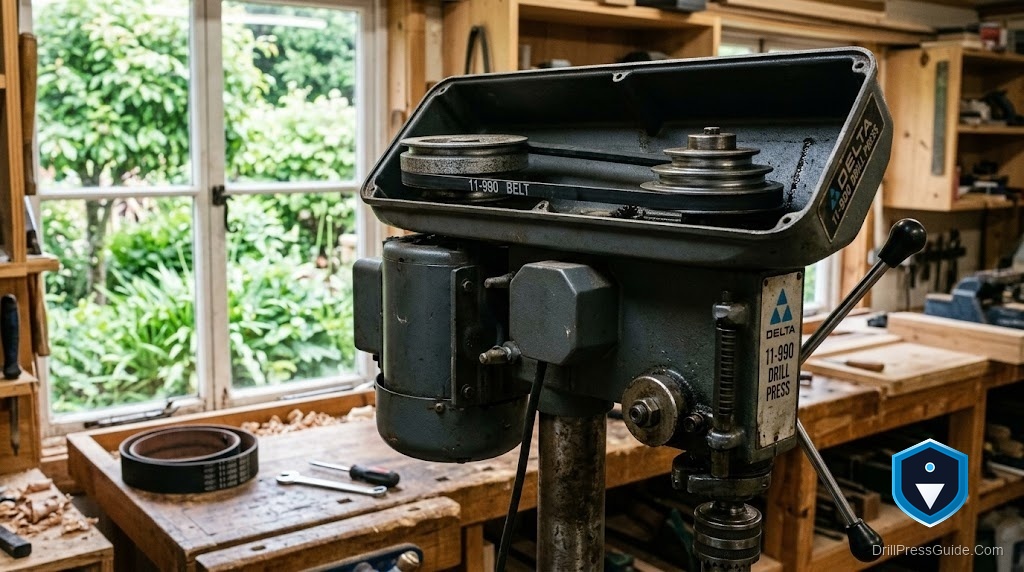
If you own a Delta 11-990 and the spindle is slowing under load or you hear a squealing sound from under the head cover, the belt is almost certainly the culprit. The 11-990 is a 12-inch benchtop drill press running eight speeds between 620 and 3,100 RPM, and the V-belt that connects the motor pulley to the step-pulley stack is a wear item that most owners never think about until it fails.
What Belt Does the Delta 11-990 Use?
The 11-990 uses a standard V-belt in the A-section (also written 4L in fractional horsepower sizing). The OEM part was listed under Delta Part No. 903709 and related service documentation, but Delta’s supply of original 11-990 belts has been inconsistent for years. If your local dealer cannot source it, you need two measurements: the cross-section width and the belt’s outer circumference (or “outside length”).
The A-section belt has a top width of approximately 1/2 inch and a depth of 5/16 inch. The outside circumference you need depends on the pulley center-to-center distance in the head housing, which on the 11-990 is typically in the range that calls for an A28 or A30 belt (28 or 30 inches outside circumference). Measure your old belt before discarding it, or measure the pulley spacing directly if the old belt has already snapped. When in doubt, cross-reference with suppliers such as eReplacementParts.com using the model number 11-990 and the original Delta part number.
Generic A-section V-belts from Gates, Goodyear, or Dayco are interchangeable with OEM and are widely available at farm supply stores, bearing suppliers, and online retailers.
Signs Your Belt Needs Replacement
You do not need to wait for a complete break. Replace the belt when you notice any of the following:
Slipping under load. If the spindle visibly slows or stops when you push a bit into material, the belt is glazed or stretched.
Squealing or chirping. A high-pitched noise at startup or during drilling almost always points to a worn or glazed belt surface.
Visible cracking. Inspect the inner (V-groove) surface. Any cracking, chunking, or fraying means immediate replacement.
Speed inconsistency. If the press runs fine at low speed but bogs at high speed, the belt may have enough slack to slip on the smaller-diameter pulley step.
Annual inspection is good practice even when nothing seems wrong. The 11-990 is typically used in hobby and light shop environments where belts can sit for months without use, and rubber degrades from ozone and dry-rot even when idle.
How to Change the Belt: Step-by-Step
These steps follow the procedure outlined in the Delta 11-990 owner’s manual (Part No. 903709, available through mikestools.com and artisansasylum.com).
Step 1: Disconnect power. Unplug the drill press from the wall. Do not rely on the switch alone.
Step 2: Remove the head cover. The top cover on the 11-990 is held by two or four screws depending on production run. Set the screws aside where they will not roll off the bench.
Step 3: Release belt tension. The motor on the 11-990 mounts on a pivoting plate that uses its own weight to maintain belt tension. Lift the motor plate upward (toward you) to create slack. Some units have a locking screw on the motor plate; back it off before lifting.
Step 4: Remove the old belt. With slack in the system, slip the belt off the motor pulley first, then off the step-pulley stack.
Step 5: Route the new belt. Confirm the correct pulley groove for your desired speed range. Slip the belt onto the step-pulley first, then work it over the motor pulley. Never use a screwdriver to pry the belt on; this can crack the belt and damage pulley edges.
Step 6: Restore tension. Lower the motor plate back to its resting position. The weight of the motor provides the correct tension. If your unit has a motor plate locking screw, snug it back down.
Step 7: Check tracking. Before replacing the cover, plug in the press, set it to the lowest speed, and run it for 10 seconds while watching the belt track. It should ride centered on both pulleys without walking to either edge.
Step 8: Replace the head cover. Reinstall the cover screws and you are done.
The Honest Flaw
The biggest frustration with the Delta 11-990 belt situation is parts availability. Delta’s OEM part number for this belt is effectively discontinued in most channels, so you will often put more time into tracking down the correct cross-reference (A28 or A30, A-section) than actually doing the swap. Write the replacement size on a piece of tape and stick it inside the head cover so the next person who services the press does not have to research it again.
Who Should Skip This Repair?
If the spindle itself has excessive runout, the chuck is damaged, or the motor shows signs of bearing failure (grinding noise, heat, wobble), replacing the belt will not fix the underlying problem. The belt is only one part of the drive train. Also, if you have no experience working around rotating machinery, review OSHA’s lockout/tagout guidelines (OSHA 29 CFR 1910.147) and CCOHS belt-drive safety recommendations before opening the head cover. The procedure itself is simple, but the habit of disconnecting power before any internal access is non-negotiable.
Comparison: Replacing the Belt vs. Replacing the Press
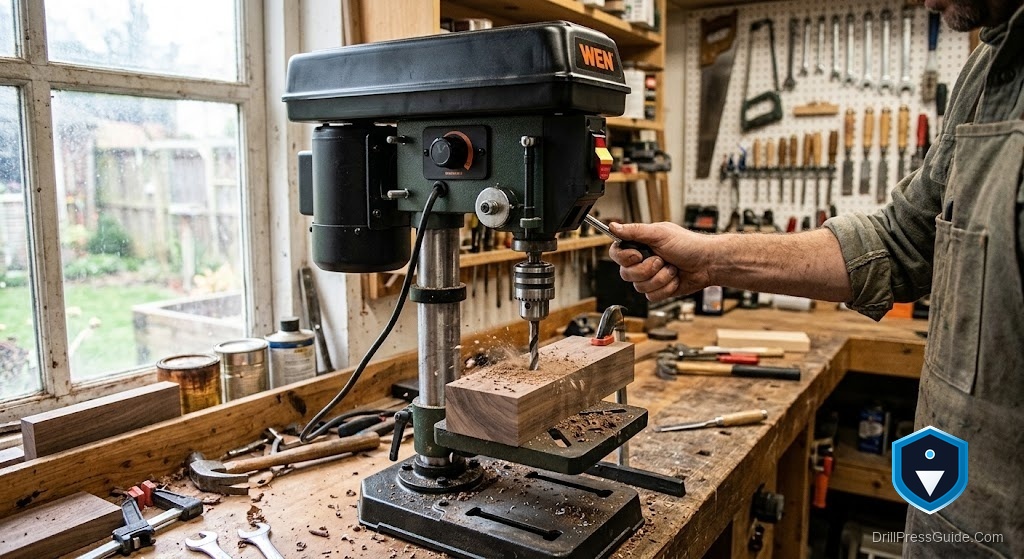
If the 11-990 is otherwise in good shape, a replacement A-section V-belt is an obvious repair rather than a replacement. If you are also dealing with a worn chuck, a damaged table, or a motor that struggles to reach speed, you may be better served by moving to a current-production benchtop press. The WEN 4208T is a widely available 8-speed benchtop press often compared to older entry-level Delta and Craftsman machines.
Comparison Table
| Factor | Delta 11-990 (with new belt) | Generic benchtop replacement |
|---|---|---|
| Belt size | A28 or A30, A-section | Varies by model |
| OEM belt availability | Mostly discontinued | N/A |
| Speeds | 8 (620-3,100 RPM) | Varies |
| Best case | Runs like new | Known specs, warranty |
Conclusion
The Delta 11-990 belt is a standard A-section V-belt, most likely an A28 or A30 depending on your specific machine’s pulley spacing. The OEM Delta part is usually discontinued, but any quality A-section belt from Gates, Dayco, or Goodyear in the right circumference will work. The swap takes under 20 minutes if you follow the motor-plate tension release procedure from the manual. Check the belt annually, replace it at the first sign of glazing or cracking, and write the correct replacement size inside the head cover.
FAQ
What size belt does the Delta 11-990 take? An A-section V-belt, typically A28 or A30. Measure your old belt or the pulley center spacing to confirm before ordering.
Where can I buy a replacement belt for the Delta 11-990? eReplacementParts.com (search model 11-990), local bearing supply houses, or any store that stocks Gates or Dayco A-section V-belts.
Is the OEM Delta 11-990 belt still available? It is largely discontinued through Delta’s parts network. Cross-referencing to a standard A-section generic belt is the practical solution.
Can I use a B-section belt instead of A-section? No. The pulleys on the 11-990 are machined for A-section groove geometry. A B-section belt will not seat correctly.
How long does a drill press belt last? In a hobby shop with moderate use, a V-belt can last five to ten years. Belts degrade faster in dusty environments or when left under tension during long storage.
What does it mean when my drill press slows under load? Most commonly it means the belt is slipping: glazed, stretched, or the motor plate tension has been disturbed.
How do I know if my Delta 11-990 belt is an A28 or A30? Measure the belt’s outer circumference with a cloth tape. A28 = 28 inches outside; A30 = 30 inches outside.
Do I need special tools to change the 11-990 belt? No. You need a screwdriver for the head cover and, on some units, to back off the motor plate lock screw.
Should I lubricate the new belt? No. V-belts run dry. Belt dressings reduce friction and make slipping worse.
What safety steps matter most during belt replacement? Unplug the press before removing the cover. Do not reach into the pulley area with the press running.
References
- Delta 11-990 Owner’s Manual, Part No. 903709 (mikestools.com, artisansasylum.com)
- eReplacementParts.com, model search “Delta 11-990”
- WEN Products Drill Press FAQs: wenproducts.com
- OSHA 29 CFR 1910.147, The Control of Hazardous Energy (Lockout/Tagout)
- CCOHS, “Belt Drives” safety guidelines: ccohs.ca