Delta 16-1/2 Drill Press Parts: Model Numbers, Fit, and Buying Checks
You are standing at the bench with a Delta floor drill press that has run clean for years, and now the quill will not spring back, or the on/off toggle feels mushy, or the table clamp no longer bites. You go looking for Delta 16-1/2 drill press parts and hit a wall of similar-looking model numbers, obsolete tags, and part diagrams that almost match your machine. Order the wrong piece and you wait a week to learn it does not fit.
Delta 16-1/2 inch drill presses are floor model machines built around a 16-1/2 inch swing, meaning the distance across a full circle you can drill is 16-1/2 inches. The best known members of this family are the 17-900 and the 17-965, both floor presses with a 3/4 HP motor and a 5/8 inch drilling capacity.
The direct answer: there is no single “16-1/2 parts kit.” You match parts to a specific model number and, on Delta machines, a specific Type. Pull the nameplate number and Type, then buy against the exact exploded diagram for that number.
Which Delta models are actually 16-1/2 inch?
Read the metal nameplate on the head, not the box or the seller listing. The 17-900 is a 12-speed floor press with a 16-1/2 inch swing, 3/4 HP motor, No. 2 Morse taper spindle, 3-3/8 inch quill travel, a 12 by 12 inch table, and a 3 inch column, running 250 to 3000 RPM across twelve steps. The 17-965 is also a 16-1/2 inch floor model, 3/4 HP, 120/240V, with a 5/8 inch keyed chuck, a cast iron tilting table, and a rack and pinion table elevation crank.
Here is the trap. Delta reused the “17-” prefix across related presses and assigns a Type number to each production run. A 17-965 Type 1 and a 17-965 Type 2 can carry different part numbers for the same visible piece. You want the model and the Type stamped together before you order anything internal. My verdict on identification: treat the nameplate as law and the internet photos as suggestions. Who should skip this step: nobody. Even a belt can vary by production run.
What actually wears out on these presses
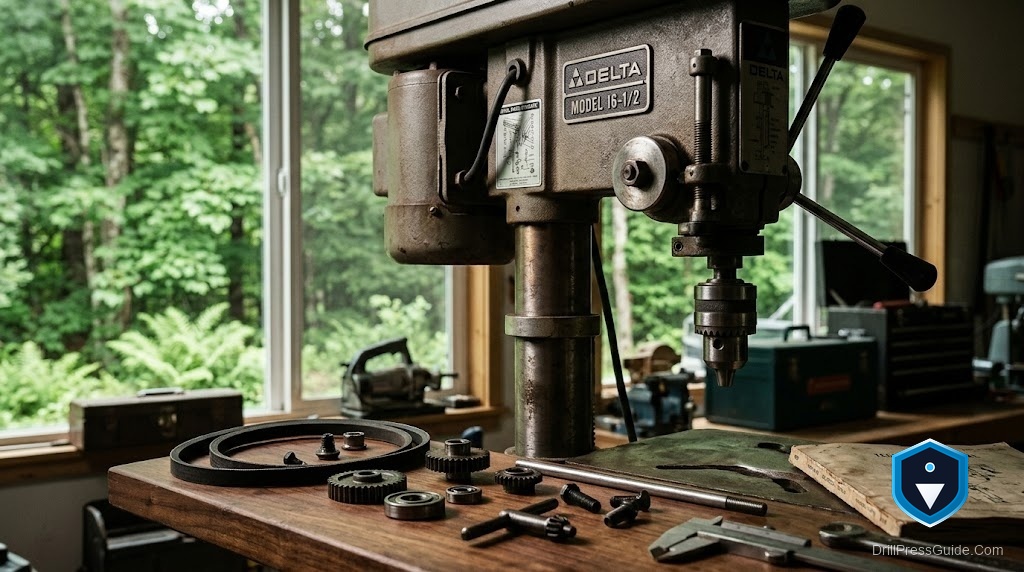
On a Delta 16-1/2 that has seen decades of shop use, the repeat offenders are the spindle return spring, the drive belt, the on/off switch or toggle, the table raising and clamp handles, and the chuck.
- Spindle return spring: when the quill drops and stays, this is usually the culprit. Match the spring dimensions to your model rather than trusting a generic “fits Delta” tag.
- Drive belt: belts stretch and glaze. A fresh belt often cures a vibration people blame on bearings.
- Switch or toggle: a dead switch is a common no-start.
- Table clamp and raising handle: the rack and pinion elevation parts strip or seize on neglected columns.
- Chuck: a chuck that will not hold a bit true is often worn jaws, not the spindle.
An honest flaw: the 17-900 gives you only about a 3-3/8 inch quill stroke, which is short. Compared to the 17-965, which owners report closer to a 4-7/8 inch stroke, the 17-900 is the more limited machine to sink money into. Who should skip a full parts rebuild: if the column is pitted, the spindle bearings are gone, and the switch is dead all at once, look for a modern replacement.
Where the real diagrams and part numbers live
The Delta 17-900 instruction manual is hosted for free reading at ManualsOnline: https://powertool.manualsonline.com/manuals/mfg/delta/17900.html
For exploded diagrams and current part numbers, the reliable sources are eReplacementParts, PartSelect, Sears PartsDirect, and Repair Clinic, all of which index Delta drill press models by Type with clickable diagrams. Keep your model and Type handy for every search.
Vintage Delta versus buying new today
A clean used Delta 16-1/2 floor press is heavy cast iron with a real No. 2 Morse taper spindle, which is a genuine strength, and parts are still findable through the distributors above. The tradeoff is time. You are hunting, cross-referencing, and sometimes settling for aftermarket.
If you would rather drill than restore, the WEN 4214T 12-inch variable-speed cast iron press is one I would keep on the short list: WEN 4214T. You get a warranty and immediate part availability. Who should skip the new press: anyone who already owns a structurally sound Delta and only needs a spring, a belt, and a switch.
A safe ordering and repair sequence
- Unplug the press. Read and photograph the nameplate (model and Type).
- Confirm swing, pulley step count, and quill travel against the specs above.
- Open the factory manual for belt tension and assembly reference.
- Match your failed part on the correct model and Type diagram before adding to cart.
- For springs and belts, verify the physical dimensions, not just the “fits Delta” label.
OSHA guidance stresses guarding, secure workholding, and never leaving the chuck key in the chuck. CCOHS echoes clamping the work and keeping guards in place.
Conclusion
A Delta 16-1/2 press is worth keeping running, and the parts are out there if you order against the exact model and Type.
- The nameplate model and Type decide fit. Photograph it before you shop.
- The 17-900 and 17-965 are the core 16-1/2 inch floor models, both 3/4 HP with 5/8 inch capacity.
- Spring, belt, switch, handles, and chuck are the parts that actually fail.
- If the column and bearings are also gone, a current benchtop press is the saner move.
FAQ
How do I tell a 16-1/2 inch Delta from a 15 inch or 17 inch model? Measure the swing, which is twice the distance from spindle center to the column. A 16-1/2 inch reading, paired with the nameplate number, confirms the family.
Is the 17-900 the same as the 17-965? No. Both are 16-1/2 inch floor presses, but they use different part diagrams and the 17-965 offers a longer quill stroke.
Why does my quill not return to the top? The spindle return spring has lost tension or broken. It is a common wear part and is replaceable.
Where can I read the factory manual for free? The Delta 17-900 instruction manual is readable at ManualsOnline.
Are parts still available for discontinued Delta presses? Yes, through parts distributors like eReplacementParts, PartSelect, Sears PartsDirect, and Repair Clinic.
What is the “Type” number and where is it? Type marks the production run and appears on the nameplate alongside the model number.
Can I put a keyless chuck on it? The spindle uses a No. 2 Morse taper on the 17-900, so a replacement chuck and arbor must match that taper.
Is it worth restoring versus replacing? If the column, spindle, and bearings are sound, a spring, belt, and switch bring it back at reasonable effort.
References
- Delta 17-900 Instruction Manual, ManualsOnline: https://powertool.manualsonline.com/manuals/mfg/delta/17900.html
- WEN Drill Press FAQs: https://wenproducts.com/pages/drill-press-faqs
- OSHA Woodworking eTool, drill press: https://www.osha.gov/etools/woodworking/production/machines-tools/drill-press
- CCOHS, drill press safety: https://www.ccohs.ca/oshanswers/safety_haz/metalworking/drillpresses.html