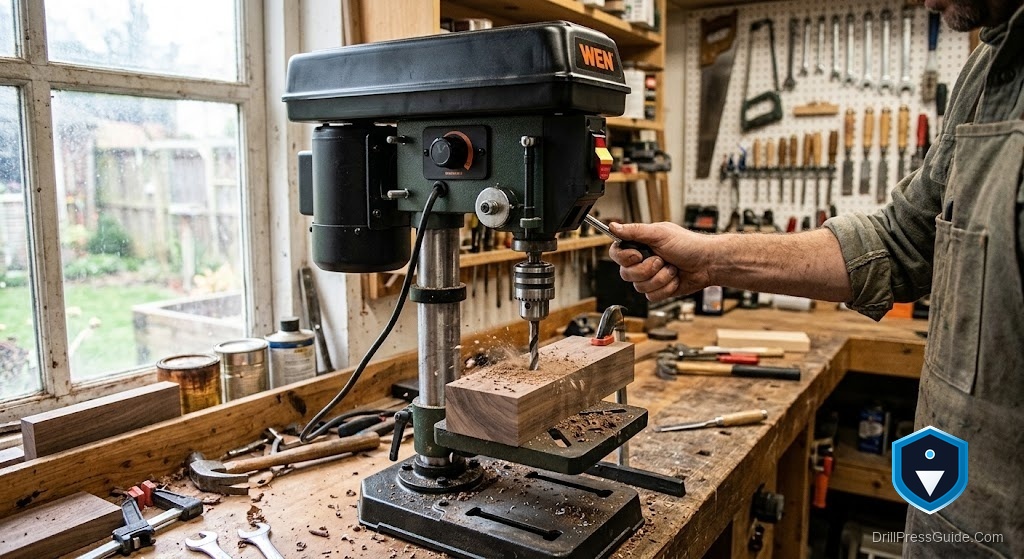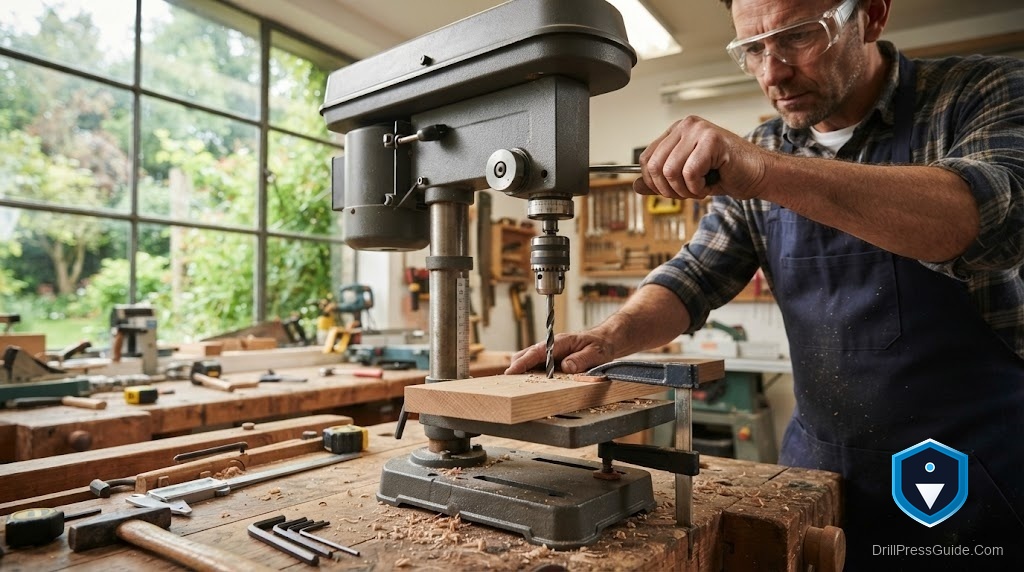
Central Machinery 5-Speed Drill Press Replacement Parts: Matching Them Without Guessing at Compatibility
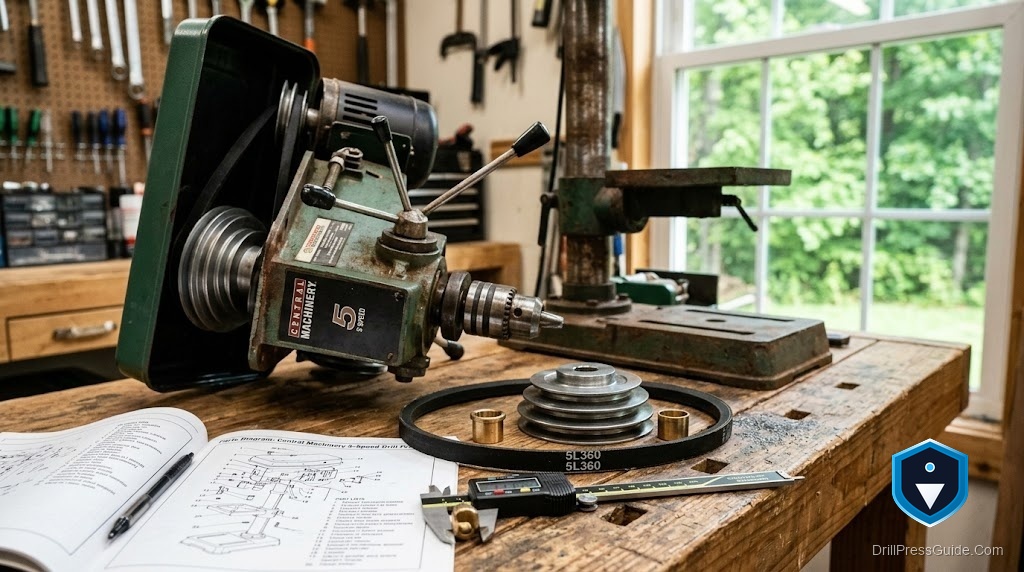
You are standing over your Central Machinery 5-speed drill press with a stretched, glazed belt in one hand and a parts diagram you half trust in the other. The chuck still spins, but the belt slips under any real load, and you want the right central machinery 5 speed drill press replacement parts the first time, not a box of near-misses. Here is the part most people get wrong before they ever measure anything: they order for the wrong machine.
A Central Machinery 5-speed drill press is Harbor Freight’s small benchtop press: an 8-inch swing, a 1/2-inch keyed chuck, about 2 inches of spindle travel, and five belt positions you shift by hand to change speed. It is an import value tool, so factory parts are limited and you often source common wear items by dimension rather than by a proprietary number.
Here is the direct answer. First, read the exact item number off the plate on the head. The 8-inch 5-speed is item 60238 (older runs read 38119, and the same tool also shipped as 44506, 62390, and 62520). Do not confuse it with item 38142, which is a larger 13-inch, 16-speed press with a 3/4 HP motor and a different belt, pulley, and quill. Once you know you have the 8-inch 5-speed, most repairs come down to a handful of parts: the V-belt, the spindle and motor pulleys with the pulley nut, the quill return spring and its cap, the feed handle, the keyed chuck with its wedge drift, the switch and switch box, and the table support and rack.
Which item number is your Central Machinery 5-speed, really?
Check the plate before you touch a parts list. The 8-inch 5-speed benchtop press is item 60238, and its earliest manual carries model 38119. If your plate reads 38142, stop: that is the 13-inch 16-speed press, and its parts will not drop into your machine. Reading the number wrong is the single most common reason a “compatible” belt or pulley arrives too wide or too long.
Owners of the 60238 and 38119 see five belt driven speeds in the roughly 600 to 3100 rpm band, a 1/3 HP class motor, and a formed steel base and head. That RPM spread is set entirely by where the belt rides on the stepped pulleys, so a worn or wrong-length belt does not just slip, it also throws your speed selection off.
Which parts actually wear out first?
The belt goes first, then the return spring, then the switch. On a press used a few times a month, the flat, glazed V-belt is the usual first failure, followed by a quill return spring that no longer snaps the spindle back up, and a power switch that gets flaky after dust works into it. The feed handles and their rubber tips loosen next, and the chuck earns replacement only if it drops bits or shows heavy runout.
Think about a small scene you have probably lived: you pull the feed handle, drill your hole, and the quill just hangs there instead of returning. That is the spring or its cap, not the motor. Fixing the right thing saves you from tearing the whole head apart.
How do you size a replacement V-belt for this press?
Measure the old belt, do not guess from a photo. Pull the failed belt and read its top width and outside length. These presses use a light, fractional-horsepower V-belt (commonly a 3L-profile fractional belt about 3/8 inch across the top), so once you have the length you can cross reference a standard 3L belt from any hardware aisle instead of hunting a proprietary Harbor Freight number. If the old belt is missing, run a flexible tape around the two pulleys in the middle speed position and match that outside length.
The same measure-then-match logic covers the pulleys. If a step is chipped, note the bore diameter, the outside diameter, and the number of steps before you buy, because the spindle pulley and the motor pulley are not the same part.
Where can you still get factory parts?
Start with Harbor Freight’s own In-Stock Replacement Parts list. Harbor Freight publishes a live parts catalog (the In-Stock Replacement Parts PDF) and states plainly that the exploded diagrams in the printed manual are for reference only, and that only the items shown on the website are actually available. So the workflow is: find your part on the exploded view in the 38119 manual to learn what it is called, then check the In-Stock list for what is currently stocked, and cross-source anything that is not (belt, spring, switch, chuck) by dimension.
For everything the factory no longer stocks, generic sizing wins. A 1/2-inch keyed chuck with a matching arbor, a standard fractional V-belt, a torsion-style return spring, and a common no-volt paddle switch are all sold by size, not by brand.
If the machine is too far gone, what replaces it today?
If the head casting is cracked or the column is bent, replace the press rather than chase parts. Harbor Freight has largely retired the Central Machinery 8-inch 5-speed and now sells the Bauer 8-inch 5-Speed Bench Drill Press (item 58780) in that slot, and it is the closest current sibling. If you would rather buy something available with one click, the WEN 4208T 8-inch 5-speed is a live equivalent.
Here is how I would choose between the two, and I have set both up on a bench.
The Bauer 8-inch 5-speed is my pick if you already run to Harbor Freight for consumables, because parts and returns live under one roof. It uses a 1/3 HP, 2.3-amp motor, five speeds from 750 to 3200 rpm, a 6-1/2 by 6-1/2-inch cast-iron table, and a 1/2-inch keyed chuck. Honest flaw, in physical terms: the 6-1/2-inch table is small and its single locking bolt lets the table nod slightly under a two-inch Forstner bit, so you will shim or add an auxiliary top for wide stock. Who should skip this: if you have no Harbor Freight nearby, its store-first parts model loses its main advantage. See the Bauer listing at harborfreight.com/8-in-5-speed-bench-drill-press-with-light-58780.html.
The WEN 4208T 8-inch 5-speed is my pick if you want it shipped and want a paper trail of owner reviews before buying. It runs a 2.3-amp motor, five speeds from 740 to 3140 rpm, the same 6-1/2 by 6-1/2-inch beveling table, and a 1/2-inch keyed chuck. Honest flaw: the stock chuck on these small WEN presses often shows visible runout out of the box, enough to wobble a 1/8-inch bit, so plan to check it and re-seat or swap the chuck. Who should skip this: anyone who needs real low-end torque for large metal bits, since a sub-3-amp motor bogs down there. Live listing: amazon.com/dp/?tag=mysuggestions01-20.
Head to head, the Bauer wins on same-day parts and in-person exchange, while the WEN wins on shipping and review depth. Neither out-muscles the other, because they share the same class of small induction motor and the same limitation: light work, small bits, patient feeds.
How do you service one safely?
Unplug it and let the spindle stop fully before any teardown. The OSHA woodworking drill press guidance and the CCOHS drill press safety page both stress isolating power, keeping the chuck key out of the chuck, and clamping the workpiece so it cannot spin. The return spring is under real tension, so wear eye protection and control the spring cap as you release it, because a slipped cap can throw the coil at your face.
Conclusion
The whole compatibility problem solves itself once you read the plate and measure the old part. This is a light-duty import press with a short factory parts list, so your reliable path is: confirm item 60238 or 38119, learn the part name from the 38119 diagram, check Harbor Freight’s In-Stock list, and cross-source the belt, spring, switch, and chuck by dimension.
Concrete takeaways:
- Confirm the item number first, and never treat the 13-inch 16-speed 38142 as this machine.
- Pull and measure the failed belt (a common 3L fractional profile), then match a standard belt by length.
- Use the 38119 manual for names and the Harbor Freight In-Stock list for what is actually stocked.
- If the casting or column is damaged, move to the Bauer 58780 or the WEN 4208T instead of chasing parts.
FAQ
Is the Central Machinery 5-speed the same as item 38142? No. The 5-speed 8-inch press is item 60238 (older 38119). Item 38142 is the larger 13-inch, 16-speed press with a 3/4 HP motor and different belts, pulleys, and quill. Parts do not interchange between them.
What size V-belt does the Central Machinery 8-inch 5-speed use? It uses a light fractional-horsepower V-belt, commonly a 3L-profile belt about 3/8 inch wide. Measure your old belt’s outside length and match a standard 3L belt rather than searching for a proprietary number.
Can I still buy factory parts for the 38119? Some. Harbor Freight lists currently stocked items on its In-Stock Replacement Parts page, and notes that manual diagrams are reference only. Anything not stocked (belt, spring, switch, chuck) is sold generically by size.
Why does my quill not return to the top? That is almost always the quill return spring or its cap, not the motor. The spring is under tension, so unplug the press and control the cap carefully when you re-tension it.
What chuck fits this press? A 1/2-inch keyed chuck on the matching arbor taper. If your old chuck drops bits or shows heavy runout, replace the chuck and arbor together and seat it with a wedge drift.
Is the Central Machinery 5-speed worth repairing or should I replace it? Repair belts, springs, switches, and chucks freely. Replace the whole press if the head casting is cracked or the column is bent, since those are not practical to source.
What replaced the Central Machinery 8-inch 5-speed at Harbor Freight? The Bauer 8-inch 5-Speed Bench Drill Press (item 58780) now fills that slot on Harbor Freight’s site.
Can I use this press for metal? Light metal drilling, yes, at the lower speeds with small bits and a slow feed. The small motor bogs on large bits, so it is not a metalworking press.
References
- Harbor Freight In-Stock Replacement Parts: https://manuals.harborfreight.com/manuals/parts/In_Stock_Replacement_Parts.pdf
- Central Machinery 38119 5-Speed Drill Press Manual: https://nps.edu/documents/111291366/113869380/Central_Drillpress.pdf
- OSHA Woodworking eTool, Drill Press: https://www.osha.gov/etools/woodworking/production/machines-tools/drill-press
- CCOHS, Drill Presses: https://www.ccohs.ca/oshanswers/safety_haz/metalworking/drillpresses.html
- Bauer 8 in. 5-Speed Bench Drill Press (item 58780): https://www.harborfreight.com/8-in-5-speed-bench-drill-press-with-light-58780.html