
Delta Drill Press Replacement Parts: Model Numbers, Fit, and Buying Checks
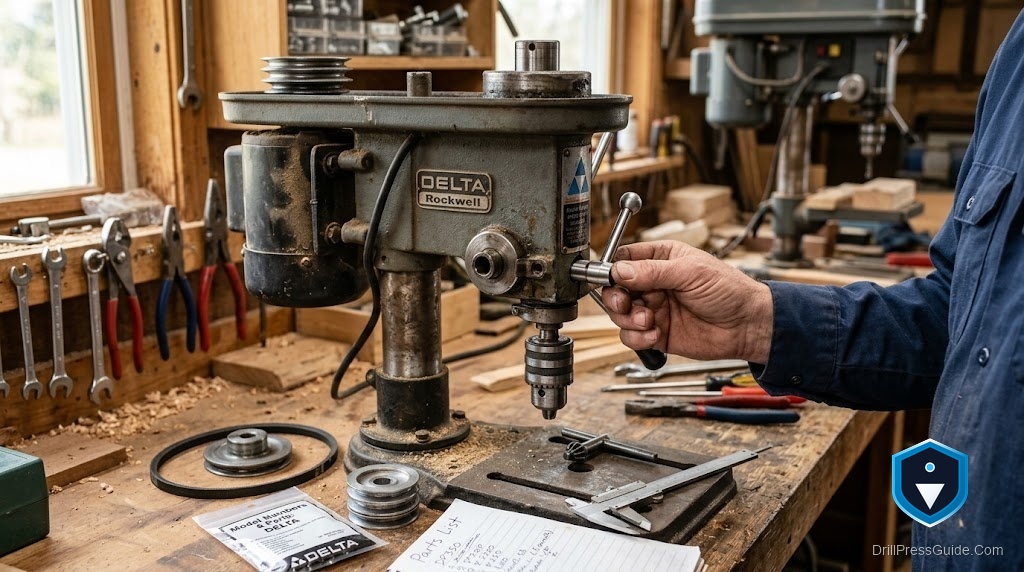
A Delta drill press is one of those tools people keep for decades, which is exactly why the parts question comes up so often. The motor still runs, the cast iron is still flat, but the chuck slips or the depth stop stripped, and now you are staring at a machine that is 90 percent perfect and 10 percent stuck. The good news: most Delta drill press replacement parts are still findable if you know the model number. The trap: ordering by the picture instead of the number, which is how the wrong chuck ends up in your cart.
Delta drill press replacement parts are the individual components (chucks, chuck keys, quill assemblies, belts, switches, tables, depth stops, and springs) sold to repair a specific Delta model rather than replace the whole machine. Because Delta has changed ownership and model lines over the years, the single most important step is matching parts to your exact model and type number, not to the general shape of the tool.
The short version of how to buy: find your model number, note the type number next to it, then order OEM parts through a parts specialist that lists diagrams for that model. Where an original part is discontinued, a correctly sized aftermarket chuck or belt is often a clean substitute. Everything below is about doing that without guessing.
Step one: find the model and type number
Every Delta drill press carries an ID plate, and the number on it is what parts sellers actually search. Look in these spots:
- The head casting, near the motor or belt cover
- The column, on the rear or side
- The base, along a side or rear edge
- Near the switch box or the power cord entry
You are looking for something like 17-900, 11-990, or 18-900L, usually followed by a Type number (Type 1, Type 2). The type matters more than people expect. Two machines can share a model number but use different switches, springs, or chucks between Type 1 and Type 2, so a part that fits one type can be wrong for the other.
The parts that fail most, and what to check
Chuck. The most common complaint on older Delta presses is a chuck that will not hold a bit true. On the popular 17-900, the factory chuck is a 5/8-inch keyed unit, and it is a frequent upgrade even on working machines. A correctly sized replacement, such as a 5/8-inch chuck and arbor made to fit the Delta 17-900, restores clean, wobble-free drilling. If your machine uses Delta part 1312022, a 5/8-inch chuck that replaces the 1312022 is the direct match, and there is a version that replaces the 17-968 chuck as well.
Before you buy a chuck, confirm two things: the mount (does it thread on, or seat on a tapered arbor) and the capacity (1/2-inch versus 5/8-inch). A tapered-arbor chuck is removed by wedging it off, not unscrewing it, and installing the wrong mount type is the most common ordering mistake.
Chuck key. Small, cheap, and endlessly lost. Delta keys carry their own part numbers (the 17-900 uses key 1313105), and a genuine key seats better than a generic one that rounds off the pinion over time.
Belt and springs. A glazed or cracked belt shows up as a machine that bogs under load or squeals on startup. The quill return spring is the part that snaps the quill back up; when it weakens, the quill drifts or feels rough. Both are model-specific.
Switch and depth stop. A toggle switch that has to be jiggled and a depth stop that will not hold are both wear items with OEM replacements listed by model.
OEM versus aftermarket: when each makes sense
Buy OEM (original Delta) for anything that has to index precisely to the casting: quill assemblies, table brackets, alignment pins, and internal hardware. These are engineered to the exact dimensions, and a close-enough substitute can leave you with slop you cannot dial out.
Aftermarket is fine, and sometimes better, for consumables and wear items where the size spec is all that matters: chucks, chuck keys, and belts. A quality aftermarket 5/8-inch chuck often outperforms a tired factory one. The rule is simple: match the spec exactly, and prefer OEM anytime the fit is about how the part mates to the machine rather than just its outer dimensions.
Where parts get hard to find
The honest drawback of owning a vintage Delta is that some parts are simply out of production. Older bench models can leave you hunting used quills or switches through secondhand listings, and that is slower and less certain than ordering a current chuck. If you are weighing a repair on a very old machine, price the parts first. When a chuck, belt, and switch add up to more than the machine is worth, a running replacement can be the smarter call, especially since Delta’s current line still sells alongside plenty of used inventory.
The verdict
Keeping a Delta drill press alive is usually worth it, because the heavy castings and induction motors that make these machines desirable are rarely the parts that fail. Match repairs to your exact model and type number, buy OEM for anything that indexes to the casting, and use correctly sized aftermarket chucks and belts for wear items. Find the ID plate before you shop, confirm chuck mount and capacity before you click, and price a full repair against a used replacement when the machine is genuinely old. Do that, and most Delta presses come back to life for a fraction of a new machine.
Frequently asked questions
Where is the model number on a Delta drill press? Check the head casting near the belt cover, the column, the base, and the area around the switch or cord entry. Record the full model number and the Type number beside it, because parts fit is often type-specific.
Are Delta drill press replacement parts still available? Many are, especially chucks, keys, belts, and switches for common models like the 17-900. Some parts for older bench models are discontinued and may only be found used, so check availability before committing to a repair.
What chuck fits a Delta 17-900 drill press? The 17-900 uses a 5/8-inch keyed chuck. Replacements made to fit the 17-900, or to replace Delta chuck part 1312022, are direct matches. Confirm whether yours mounts on a threaded arbor or a tapered arbor first.
How do I remove the chuck on a Delta drill press? Most Delta chucks seat on a tapered arbor and are removed by wedging them off with a tapered tool, not by unscrewing. Support the chuck so it does not drop when it releases.
Can I replace a 1/2-inch Delta chuck with a 5/8-inch one? Often yes, if the arbor and mount match. Moving to a 5/8-inch chuck lets you hold larger bit shanks, but the arbor taper or thread has to be correct for your model.
What does the Type number mean? The Type number identifies a production variant of the same model. Switches, springs, and some assemblies differ between Type 1 and Type 2, so always match parts to your type.
Is it worth repairing an old Delta drill press? Usually, since the motor and castings rarely fail. Price the specific parts you need first; if the total approaches the value of a running used machine, replacement may make more sense.
References
- Delta Machinery, official parts and manuals resource: https://deltamachinery.com
- Sears PartsDirect, Delta 17-900 drill press parts, diagrams, and manuals: https://www.searspartsdirect.com/model/9yg55p20tm-001667/delta-17-900-drill-press-parts
- eReplacementParts, Delta 17-900 Type 1 OEM parts and diagrams


