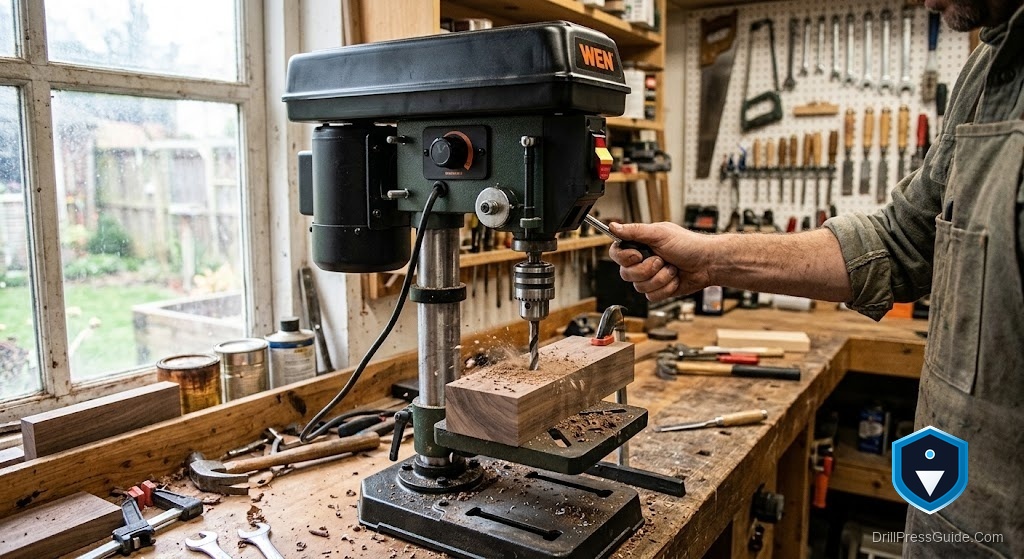
WEN 5-Speed Drill Press: What Owners Should Check Before Buying or Repairing
The WEN 5-speed drill press (most often the 8-inch 4208) is the machine that gets a lot of people their first real drill press. It is compact, simple, and does exactly what a small bench press should. But “5-speed” tells you something important about how it works, and knowing that up front helps you decide whether it fits your work and how to keep it running. Here is what owners should check before buying or repairing one.
What “5-speed” actually means
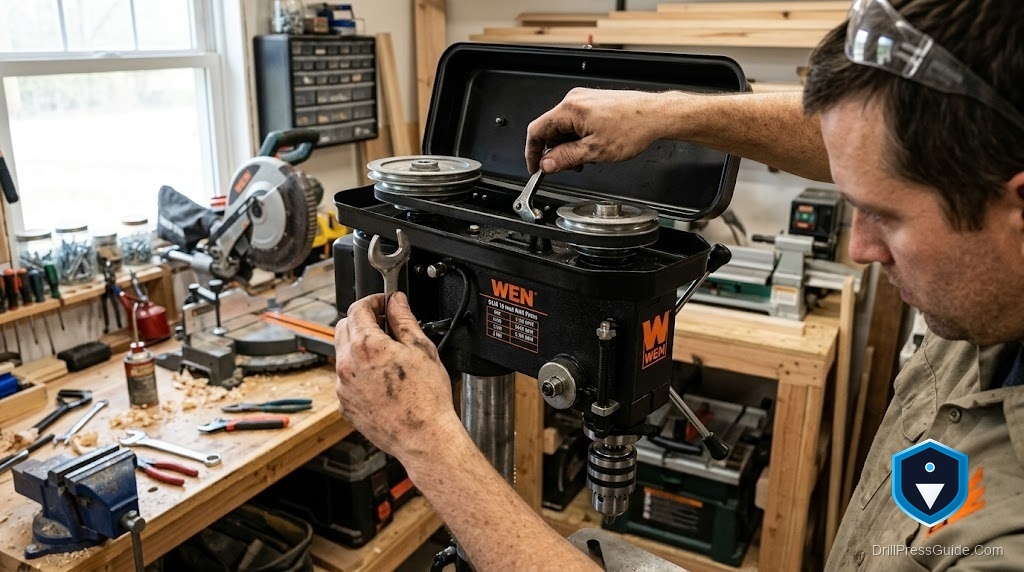
The 5-speed refers to five spindle speeds you set by moving the belt across stepped pulleys inside the head. There is no dial and no variable drive: you open the pulley cover, shift the belt to the step for the speed you want, and close it back up. That is not a drawback, it is just how a simple, reliable bench press works. The five speeds cover the common range: slower for larger bits and metal, faster for small bits in wood.
The short answer to “is the WEN 5-speed right for me?” is this: if your work is small and you do not mind moving a belt to change speed, yes, it is a capable little press. If you change bit sizes constantly and want to turn a dial instead, look at WEN’s variable-speed models like the 4214.
Before you buy: what to check
- Size versus your work. The 5-speed is usually an 8-inch (4208), which reaches the center of an 8-inch workpiece. Confirm that covers your realistic jobs; step up to a 10 or 12-inch if not.
- The speed range. Five belt positions is plenty for general work but is a manual change each time. Be honest about how often you switch bit sizes.
- Table and travel. Check the table size and the spindle travel suit your work; small presses have modest travel.
- Included chuck and key. Confirm it comes with the keyed chuck and key, and that the chuck seats cleanly.
Changing speed the right way
The most common owner question is how to change speed on a WEN 5-speed. With the machine off and unplugged: open the pulley cover, release the belt tension (usually by loosening the motor-mount knobs and sliding the motor forward), move the belt to the pulley step for your target speed using the belt chart inside the cover, then re-tension by sliding the motor back and locking it so the belt deflects slightly but does not slip. Close the cover before running. Never change the belt with the machine plugged in.
Repair and maintenance checks
- Belt. A glazed, cracked, or stretched belt causes slipping and vibration. Match a replacement by size and keep a spare.
- Chuck and taper. If the chuck slips or drops, clean and dry the taper; it holds by friction and hates oil. Replace a chuck with worn jaws.
- Quill return spring. If the quill does not retract smoothly, the return spring or its cap needs adjustment or replacement.
- Switch. A flaky switch is a common wear item and a straightforward swap; match the rating.
- Runout. Spin the chuck and watch for wobble; excessive runout points to a bent arbor or a tired chuck.
WEN supports these presses by model number, so read the number off the label and match parts (belt, chuck, key, spring, switch) to it.
The verdict
The WEN 5-speed drill press is a solid, simple bench machine for small work, as long as you are comfortable moving a belt across five pulley steps to change speed. Before buying, match the 8-inch swing to your work and be honest about how often you change bit sizes; if that is constant, a variable-speed WEN suits you better. For repairs, most complaints trace to the belt, chuck taper, return spring, or switch, all standard parts you match by the model number. Change speed with the machine unplugged, keep a spare belt, and it will serve a small shop well.
Takeaways:
- “5-speed” means five belt-set spindle speeds; there is no dial or variable drive.
- The WEN 5-speed is usually the 8-inch 4208, best for small work on a tight bench.
- Change speed only with the machine off and unplugged, using the belt chart inside the cover.
- Most repairs trace to the belt, chuck taper, return spring, or switch, all standard parts.
- If you change bit sizes constantly, a variable-speed WEN like the 4214 fits better.
Tooling and replacement parts
Keep a WEN 5-speed running with good tooling. Fit a quality keyed drill chuck with the matching arbor if the original wears, keep a fresh drill press V-belt on the shelf, and add a set of brad-point drill bits for clean holes in wood. A drill press vise makes work-holding safe, and a spare drill press chuck key saves a stalled job. Confirm the belt size and chuck taper before ordering.
FAQ
How do I change the speed on a WEN 5-speed drill press? With the machine off and unplugged, open the pulley cover, loosen the motor mount to release belt tension, move the belt to the pulley step for your target speed using the belt chart, then re-tension and close the cover.
What model is the WEN 5-speed drill press? Most commonly the 8-inch 4208, though WEN uses the 5-speed belt system on other small presses too. Check the model number on the label.
How many speeds is enough on a bench drill press? Five covers general work well. The trade-off is that you move a belt to change speed; variable-speed models change RPM by dial.
Why does my WEN 5-speed belt slip? Usually a glazed, cracked, or under-tensioned belt. Re-tension with the motor mount and replace a worn belt.
My chuck keeps falling off. What is wrong? The taper is dirty or oily. Clean and dry both the spindle taper and the chuck arbor so it holds by friction.
Should I buy the WEN 5-speed or a variable-speed model? Choose the 5-speed for simple small work and value. Choose a variable-speed WEN like the 4214 if you change bit sizes constantly.
References
- WEN Products, drill presses: https://wenproducts.com/collections/drill-presses
- WEN Products, product manuals: https://wenproducts.com/pages/product-manuals