
Parts of a Drill Press: What Each One Does and What to Measure
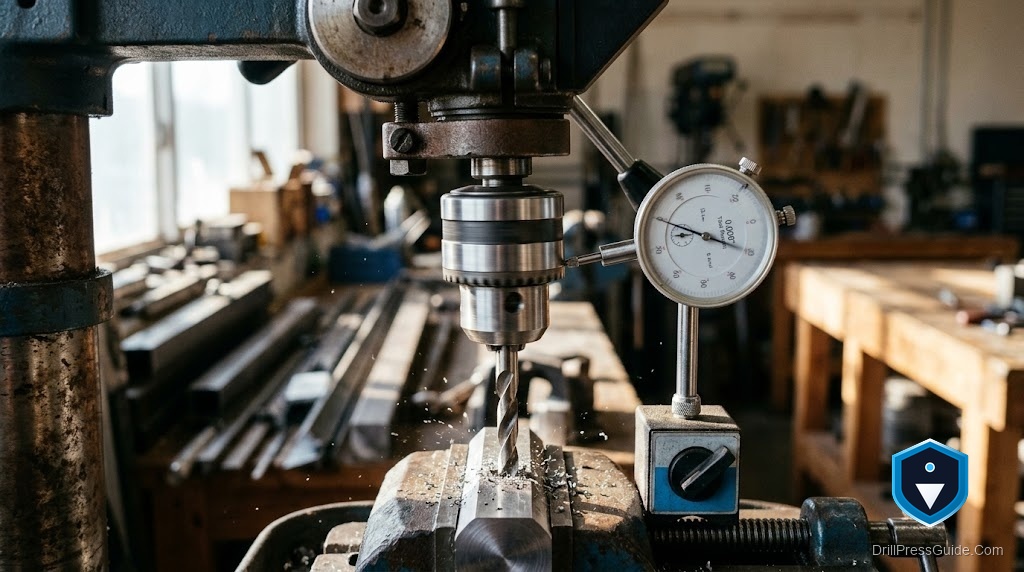
Most people can name the chuck and the table on a drill press and stop there. But when something needs adjusting, replacing, or buying, that vocabulary runs out fast, and a repair or a purchase turns into pointing at a photo and hoping. Knowing the parts of a drill press by name, understanding what each does, and knowing what to measure on it turns you from a bystander into someone who can maintain, adjust, and shop for the machine with confidence. This guide walks the machine from top to bottom.
A drill press is a stationary drilling machine with a motor that spins a spindle through a drive system, a quill that feeds the spinning chuck and bit down into the work, and a table and base that support everything. Every part serves that basic job, and understanding the chain from motor to bit is what makes the rest of the machine make sense.
The drive system
At the top sits the motor, which provides the power, rated for a voltage and a duty and mounted so it can be moved to tension the belt. From the motor, power passes through the drive belt, a V-belt whose job is to transmit rotation to the spindle. The belt runs over the pulleys, stepped cones that let you change speed by moving the belt to different step pairings; heavier machines add a countershaft pulley for a wider range. To measure here: the belt by profile and length, and the pulleys by bore and step count.
The spindle and quill
The heart of the machine is the spindle, the rotating shaft that carries the chuck, and the quill, the sleeve the spindle rides in that slides up and down to feed the bit into the work. The quill is moved by the feed lever, the handle you pull to lower the bit, and returned by the quill return spring, a coiled spring in a housing that pulls the quill back up when you release the lever. The depth stop, usually a threaded rod or a collar, limits how far the quill travels so you can drill to a repeatable depth. To measure here: the quill travel, the spring housing diameter and spring width if replacing it, and the spindle taper.
The chuck
At the bottom of the spindle is the chuck, the clamping device that grips the drill bit in its three jaws, tightened by a chuck key that engages a ring gear. The chuck mounts on an arbor with a taper, commonly JT33 on mid-size machines, that presses into or onto the spindle. The taper, not the brand, is what you measure, because it determines which chuck fits. When a chuck wears and drills off center, confirm the taper and fit a matching replacement; a standard JT33 keyed chuck fits any JT33 arbor once the old chuck is driven off. To measure here: the arbor taper and the chuck’s capacity range.
The table and base
Below the chuck is the table, the surface that supports the work, which usually raises, lowers, tilts, and locks, mounted to the column by a bracket and often a rack-and-pinion for raising. The table has slots or holes for clamping work and a center hole for drill clearance. The column is the vertical steel tube that ties the head and table together and sets the machine’s rigidity, and the base anchors everything to the bench or floor. To measure here: the column diameter, which every table and bracket must match, and the table’s slot spacing for fixtures.
The part most machines are missing
One part that belongs on every drill press but ships with few is proper work-holding. The table’s slots exist to bolt down a vise, and a cast-iron drill press vise clamps metal against the drilling torque so a bit that grabs cannot spin the workpiece into a blade. Measure the table slot spacing and size the vise to the table, since a heavy vise crowds a small machine.
Conclusion
The parts of a drill press form a simple chain: the motor drives a belt over pulleys to spin the spindle, the quill feeds the spinning chuck and bit into work supported by the table and column, and the return spring and depth stop control the feed. Learn the names, understand what each does, and know the key measurements, belt profile and length, spindle taper, spring housing, column diameter, table slots, and you can maintain, adjust, and shop for any drill press with confidence rather than pointing at a photo.
Three takeaways: the machine is a chain from motor through belt and pulleys to spindle, quill, and chuck; the arbor taper and column diameter are the measurements that decide what fits; and the slotted table exists to hold a vise.
Frequently Asked Questions
What are the main parts of a drill press? The motor, drive belt, and pulleys make up the drive; the spindle, quill, feed lever, return spring, and depth stop feed the bit; the chuck grips the bit; and the table, column, and base support the work.
What does the quill do? The quill is the sleeve the spindle rides in. Pulling the feed lever slides the quill down to feed the spinning bit into the work, and the return spring pulls it back up when released.
What is the arbor taper and why does it matter? The arbor taper is the tapered mount the chuck presses onto, commonly JT33. It, not the brand, determines which chuck fits, so it is the measurement to confirm before buying a chuck.
What measurements matter most on a drill press? The belt profile and length, the spindle arbor taper, the return spring housing, the column diameter (which tables and brackets must match), and the table slot spacing for fixtures.
What is the depth stop for? The depth stop limits how far the quill travels, so you can drill every hole to the same repeatable depth rather than judging it by eye each time.
Why does the table have slots? The slots exist to bolt down a vise or fixture so work is clamped against the drilling torque. Using them for a proper vise is both a safety and an accuracy improvement.
References
- Jacobs Chuck Manufacturing, Mounting and Removing Chucks. http://www.jacobschuck.com/uploads/ueditor/file/20200604/1591240204146153.pdf
- VintageMachinery.org, machine tool references and literature. http://vintagemachinery.org


