Vintage Belt-Driven Drill Press: Dating, Inspecting, and Restoring
There is a particular pleasure in a belt-driven drill press that no gear-head machine quite matches. You move a V-belt from one pulley step to another, feel the machine settle into a new speed, and understand exactly how the power gets from the motor to the bit, because you can see every part of it. Vintage belt-driven presses from the mid-century era are simple, quiet, and endlessly repairable for precisely this reason, and a well-restored one is a joy to use. The catch is that the belt-drive system has its own set of things to date, inspect, and restore, and knowing them makes the difference between a smooth machine and one that squeals and slips.
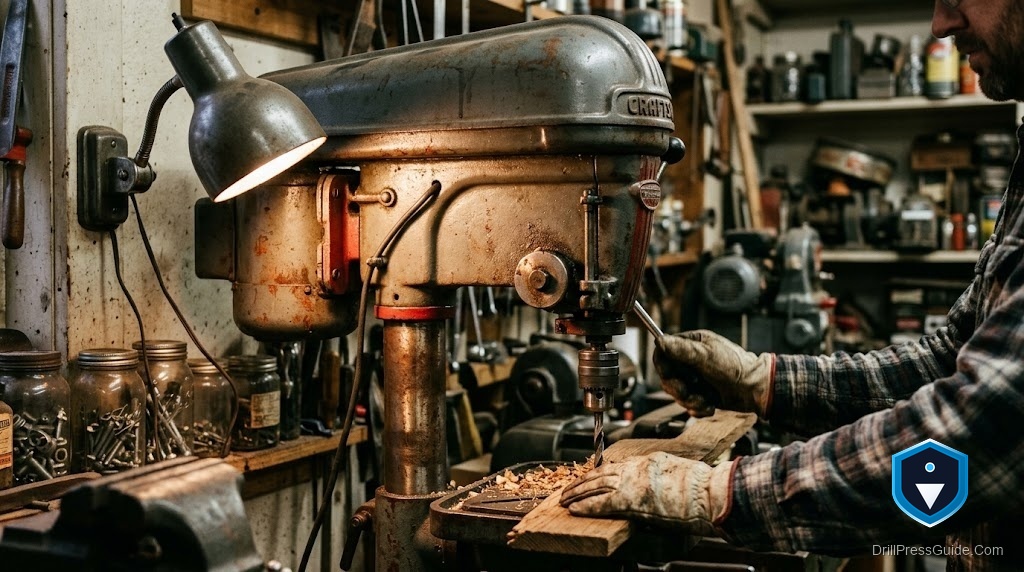
A vintage belt-driven drill press is a mid-century machine that transmits power through a V-belt running over stepped pulleys, changing speed by moving the belt from one step pairing to another. Delta, Craftsman, Walker-Turner, Atlas, and Powermatic all built them this way. The design’s whole appeal is its simplicity: no gearbox to fail, just a motor, two or three pulleys, and a belt, all serviceable with hand tools.
Dating a belt-driven press
Date the machine the same way you would any vintage press, through the maker and model, but the drive itself also offers clues. Find the maker’s name and model number, and where possible the era: a Delta serial number dates the machine through the registries, a Craftsman prefix names the builder, and heavy castings with no modern markings suggest a prewar antique.
The drive style narrows it further. The earliest machines often used flat belts and line-shaft or early motor drives; the classic mid-century presses use a single V-belt over two stepped pulleys; heavier models add a countershaft and a second belt for a wider speed range. Reading which arrangement you have, alongside the maker’s numbers and the archives, places the machine and tells you how the speed change is meant to work.
Inspecting the drive and the machine
Inspect the whole machine, with particular attention to the drive.
Castings first, as always, checking the head, base, column, and table for cracks. Spindle and quill second, feeding the quill through full travel and feeling for smooth motion and minimal play.
Then the drive itself. Check the V-belt for glazing, cracks, and stretch, all of which cause slip and squeal, though a belt is a cheap standard replacement. Inspect the pulley steps for chips, cracks, and wobble; a bent or cracked pulley throws vibration into every hole and is a model-specific part to replace. Spin the motor and countershaft, if fitted, and feel their bearings for roughness. Confirm the belt-tensioning mechanism, usually a hinged motor mount or a sliding bracket, moves and locks, since without proper tension the belt slips under load.
Complete the inspection by confirming the motor runs, the chuck closes concentrically, and the table and its lock are present and sound.
Restoring the machine and its drive
Work the standard sequence with the drive in mind. Disassemble and document, then free seized parts with penetrating oil and patience rather than force. Remove rust from hardware and machined parts with a chelating remover like Evapo-Rust, which strips rust without harming the parent steel or the pulley grooves, leaving a gray film that buffs off; dry parts immediately.
The drive is where a belt-driven restoration earns its smoothness. Fit a fresh V-belt matched by profile and length, measuring the old belt or the pulley path, since a new belt cures most slip and squeal at once. Clean the pulley grooves so the belt seats properly, replace any rough motor or countershaft bearing, and set the tensioning mechanism so the belt deflects slightly under thumb pressure, tight enough not to slip, loose enough not to load the bearings. If the chuck is worn, confirm the arbor taper, usually JT33, and fit a standard JT33 keyed chuck once the old one is off.
Protect the cleaned table and column with a film of Boeshield T-9, buffed before use, then reassemble with fresh grease, rewire safely, and test on scrap through the full speed range to confirm the belt tracks and holds at each pulley step.
Conclusion
A vintage belt-driven drill press is one of the most satisfying machines to own precisely because you can see and service every part of how it works. Date it by maker, model, and drive style, inspect the castings, spindle, and especially the belt, pulleys, and tensioning mechanism, then restore it with fresh consumables and a properly set belt tension. Get the drive right and the machine runs smooth and quiet at every speed, which is the whole reason to choose belt drive in the first place.
Three takeaways: the drive style helps date the machine, the belt, pulleys, and tensioner are the drive-specific things to check, and a fresh belt at correct tension cures most slip and squeal.
Frequently Asked Questions
What is a vintage belt-driven drill press? A mid-century machine that transmits power through a V-belt over stepped pulleys, changing speed by moving the belt between step pairings. It has no gearbox, making it simple and easy to service.
How do I change speed on a belt-driven drill press? Move the V-belt from one pulley step pairing to another, following the machine’s speed chart. Lower steps give lower speeds for large bits and metal, higher steps for small bits and wood.
Why does my belt-driven drill press slip or squeal? Usually a glazed, cracked, or stretched belt, or insufficient tension. A fresh V-belt matched by profile and length, set to proper tension, cures most slip and squeal.
How do I date a vintage belt-driven drill press? Use the maker and model, with a Delta serial number or Craftsman prefix where present, and read the drive style, since flat-belt, single V-belt, and countershaft arrangements suggest different eras.
Are drill press pulleys hard to replace? Pulleys are model-specific castings, so a cracked or bent one must be matched to your model from a donor or diagram. The belt itself is a cheap standard part matched by measurement.
How tight should the belt be? Tight enough not to slip under load and loose enough not to strain the bearings. Set the tensioner so the belt deflects slightly under thumb pressure at the midpoint of its span.
References
- VintageMachinery.org, manufacturer histories and publication archive. http://vintagemachinery.org
- CRC Industries, Evapo-Rust Rust Remover product information. https://www.crcindustries.com/evapo-rust/