
Finding Antique Drill Press Parts Without Guessing at Compatibility
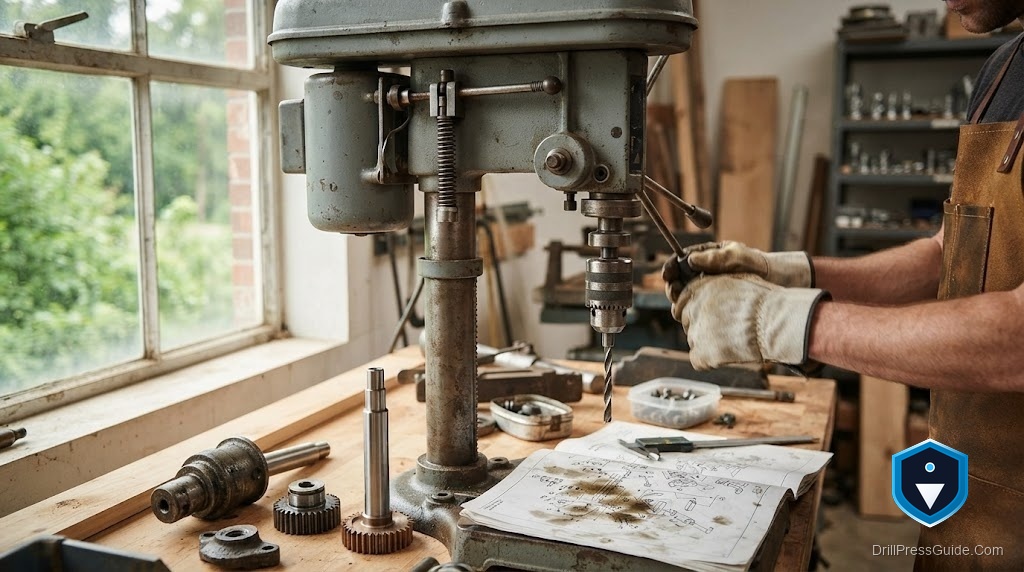
The hardest part of restoring an antique drill press is almost never the wrenching. It is finding the one part you need and knowing, before you spend the money, that it will actually fit. Antique parts do not come with tidy catalog numbers. They come off donor machines, out of coffee cans at flea markets, and from sellers who know only that it is old and made of iron. Buying antique drill press parts well is a matter of method, not luck, and the method is the same whether you are chasing a chuck, a pulley, or a gear.
Antique drill press parts come from pre-modern machines built by Delta, Atlas, Walker-Turner, and the many post-drill makers like Buffalo Forge and Champion. They fall into the same two groups that govern every old machine. Standard parts are defined by a measurement, a taper, a belt profile, a bearing number, and fit anything of the right size. Proprietary parts are cast or machined for one design, pulleys, gears, castings, handles, and fit only within a narrow family. Knowing which kind you need is the whole game.
So how do you find antique parts without guessing? Identify the machine, classify the part, then match by number and measurement rather than appearance.
Identify the machine before you shop
Antique parts hunting starts with knowing exactly what you own. Identify the maker and, where possible, the model and era, because on antique machines the maker is often not the name on the badge. A pre-1946 Craftsman is really an Atlas or Walker-Turner; a Buffalo drill press is a Buffalo Forge only if the iron says so. Photograph the castings and numbers and compare them against the VintageMachinery.org archives to pin down the true manufacturer. Once you know it is, say, an Atlas-built press, you research Atlas parts, not a Craftsman model that never existed.
Standard parts: match by measurement
These are the easy wins, because they fit by dimension regardless of maker.
Chuck and arbor. Match the taper. Many antique presses use JT33; some use JT2 or a Morse taper spindle. Confirm yours, then a standard JT33 keyed chuck fits any JT33 arbor once the old chuck is driven off. A JT33 chuck will not seat on a smaller taper, so measure first.
Ball bearings. Read the numbers stamped on the old bearing and cross-reference them at any bearing supplier. Antique presses often use standard bearing sizes despite their age.
Belts. On antique machines the drive may be flat-belt or early V-belt. For V-belt machines, measure the pulley path and match a standard belt.
Return spring. Where an antique press has a quill return spring, a generic return spring assembly can replace a broken one, but measure the housing and width first, since fit is not universal.
Proprietary parts: work the network
The castings, pulleys, and gears are where antique parts hunting takes patience. These fit only within a confirmed model family, and there is no catalog. Your sources are donor machines of the same maker and model, the vintage tool community and its forums, and swap meets. When you find a candidate, get a measurement, the bore of a pulley, the tooth count of a gear, the mounting spacing of a bracket, and match it to your machine rather than trusting that it looks right. For a broken gear or a cracked casting with no donor in sight, a machine shop can sometimes cut a replacement, which is worth pricing before you give up on the machine.
The habit that prevents mistakes
Every antique part purchase should clear the same checks: you know the true maker and model, you know whether the part is standard or proprietary, you have the exact measurement or taper for standard parts, and you have confirmed the donor family for proprietary ones. A part that clears those checks fits. One that does not is a gamble dressed up as a bargain.
Conclusion
Finding antique drill press parts without guessing is a discipline anyone can learn. Identify the true maker first, since the badge often lies on antique machines, then classify each part as standard or proprietary. Match standard parts by taper, bearing number, and belt profile from any supplier, and work the donor-machine network for proprietary castings and gears, always confirming by measurement. Do that and the part that arrives will be the part that fits.
Three takeaways: identify the real maker before shopping, standard parts fit by measurement regardless of age, and proprietary castings need a confirmed same-family donor and a measurement.
Frequently Asked Questions
Where do I find parts for an antique drill press? Standard parts like chucks, bearings, and belts come from any supplier by measurement. Proprietary castings and gears come from donor machines of the same maker, the vintage tool community, and swap meets.
How do I know if an antique part will fit before buying? Identify the true maker and model, classify the part as standard or proprietary, and match by measurement or taper. Ask the seller for a measurement rather than trusting a photo.
My antique Craftsman needs parts. Where do I look? Identify the real builder first, since pre-1946 Craftsman presses were made by Atlas, Walker-Turner, or Dunlap. Research that maker’s parts, not a Craftsman model number.
Can a machine shop make antique drill press parts? Often, yes. A shop can cut a replacement gear or fabricate a bracket, which is worth pricing before abandoning a machine with an irreplaceable broken part.
What taper do antique drill press chucks use? Many use JT33, some use JT2, and larger machines may use a Morse taper spindle. Confirm the taper on your machine before buying a chuck.
Are antique drill press bearings still available? Usually. Antique presses often used standard bearing sizes, so reading the numbers off the old bearing lets any supplier cross-reference a modern equivalent.
References
- VintageMachinery.org, manufacturer histories and publication archive. http://vintagemachinery.org
- Jacobs Chuck Manufacturing, Mounting and Removing Chucks. http://www.jacobschuck.com/uploads/ueditor/file/20200604/1591240204146153.pdf


