
How to Make a Drill Press DIY: Setup, Checks, and Common Mistakes
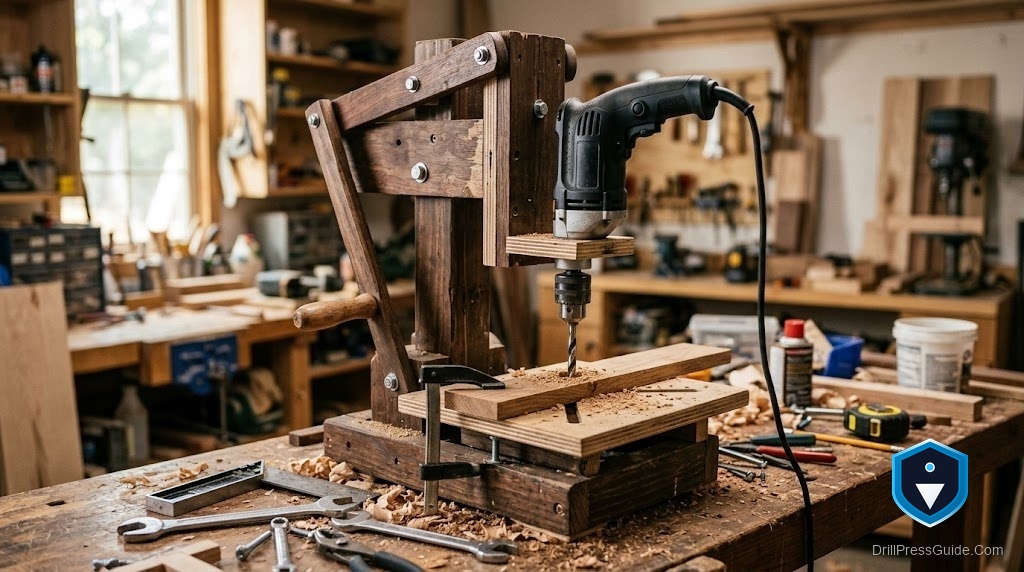
A proper drill press earns its keep by drilling perfectly straight, square holes and by holding the work steady while it does. A DIY drill press, usually built around a handheld drill held in a shop-made stand, can approach that, but only if you are honest about what a homemade setup can and cannot do. The goal is to guide the drill straight and steady, and the whole project lives or dies on rigidity and alignment. Here is how to set one up, what to check, and the mistakes that undermine it.
Making a DIY drill press means building a stand that holds a handheld drill and feeds it straight down into the work, replicating a drill press’s controlled, perpendicular plunge. Doing it means securing the drill rigidly, guiding it on a straight vertical travel, providing a flat table square to the drill’s axis, and holding the workpiece so nothing moves.
Short answer: build a rigid stand that clamps the drill securely, guide it on a straight, play-free vertical slide, mount a flat table square to the drill axis, and clamp the workpiece. The accuracy comes entirely from rigidity and true vertical alignment, so be realistic that a homemade stand around a handheld drill will not match a real drill press for precision or heavy work.
Set an honest expectation first
Before building, be clear about what a DIY drill press can do, because that shapes the whole project and keeps it safe. A handheld drill in a shop-made stand can give you far straighter, steadier holes than freehand drilling, which is genuinely useful for light woodworking and hobby work. It will not match a real drill press for rigidity, runout, or the ability to handle large bits or metal, and pushing it there is where things break or get dangerous. Setting this expectation up front means you build for the work it suits and do not trust it with jobs that need a real machine, which is the most important judgment in the whole project.
Build for rigidity and true vertical travel
Everything about accuracy comes down to two things: the stand must be rigid, and the drill must travel straight down. Build a stout base and a stiff vertical column or frame that does not flex when you feed the drill, because any flex becomes an angled or wandering hole. Guide the drill on a straight, play-free slide, linear rails or a close-fitting mechanism, so it moves only up and down, exactly perpendicular to the table. Clamp the drill body securely so it cannot rotate or shift in the holder. Rigidity and true vertical travel are the entire game, so spend your effort here, since a wobbly or misaligned stand produces holes no better than freehand.
Add a square table and hold the work
Mount a flat table below the drill, set square to the drill’s axis, so holes come out perpendicular to the work surface. Check the squareness with a reliable square and adjust or shim until true, then confirm with a test hole. Provide a way to clamp the workpiece to the table, a fence and clamps, so it cannot spin or shift when the bit bites, which is both an accuracy and a safety essential given that a handheld drill can grab. A square, flat table plus a clamped workpiece is what turns the guided drill into something that drills accurate, repeatable holes rather than merely straight-ish ones.
Checks and common mistakes
Before using it, check that the stand does not flex under feed pressure, that the slide has no play, that the table is square to the axis, and that the drill is clamped so it cannot rotate. Drill a test hole and confirm it is straight and square. The common mistakes are a flimsy stand that flexes, a sloppy slide that lets the drill wander, a table that is not square, not clamping the workpiece, and, above all, expecting the setup to do heavy or metal drilling it was never rigid enough for. Keep bits sharp, feed gently, guard moving parts, and keep hands clear. Avoid those and a DIY drill press serves light work well within its honest limits.
Conclusion
Making a DIY drill press is a worthwhile project if you build it for rigidity and true vertical travel and stay honest about its limits. Set the expectation that a handheld drill in a shop-made stand suits light woodworking and hobby work, not heavy or metal drilling, then build a rigid stand, a play-free vertical slide, a flat table square to the drill axis, and a way to clamp the work. Check for flex, play, squareness, and a secure drill before trusting it, and avoid the mistakes that reduce it to freehand accuracy. Built and used within its limits, a DIY drill press gives straighter, steadier holes than drilling by hand, which is exactly what it is for.
Frequently asked questions
Can a DIY drill press match a real one? No. A handheld drill in a shop-made stand gives far straighter holes than freehand drilling and suits light woodworking and hobby work, but it will not match a real drill press for rigidity, runout, or heavy and metal drilling.
What matters most when building one? Rigidity and true vertical travel. The stand must not flex under feed pressure, and the drill must move straight down on a play-free slide, exactly perpendicular to the table.
How do I make holes come out square? Mount a flat table set square to the drill’s axis, check it with a reliable square, adjust or shim until true, and confirm with a test hole before real work.
Do I need to clamp the workpiece? Yes. A handheld drill can grab and spin the work, so clamp it to the table with a fence and clamps. This is both an accuracy and a safety essential.
What are the common mistakes? A flimsy stand that flexes, a sloppy slide that lets the drill wander, a table that is not square, not clamping the work, and expecting heavy or metal drilling the setup was never rigid enough for.
Is a DIY drill press safe? Within its limits, if built rigid, with moving parts guarded, the work clamped, and hands kept clear. Pushing it into heavy work it cannot handle is where things break or become dangerous.
References
- OSHA, portable power tool and machine guarding guidance, osha.gov
- Forest Products Laboratory, wood machining references, fpl.fs.usda.gov


