
How to Make a Cribbage Board Without a Drill Press Without Losing Accuracy
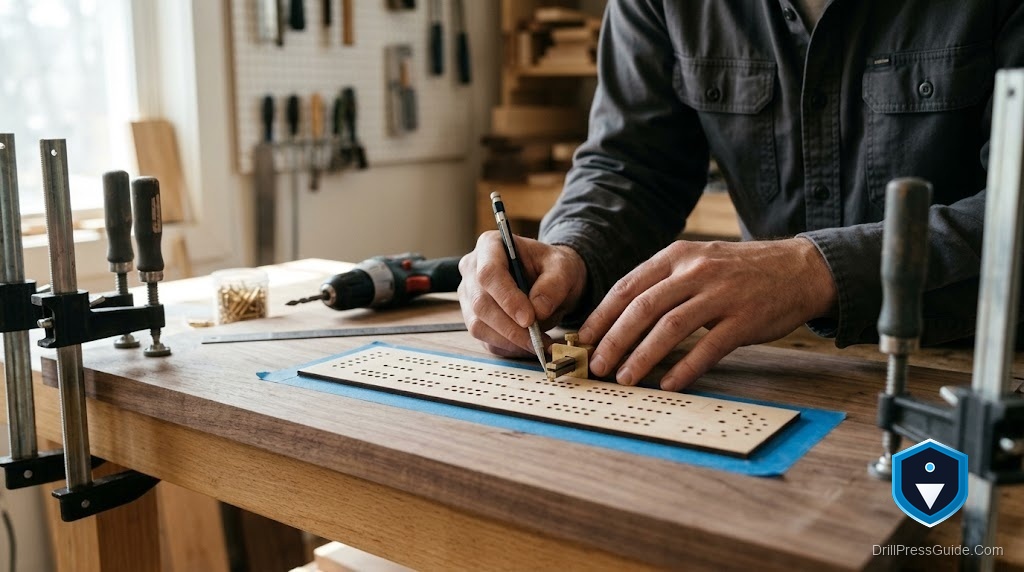
A cribbage board is mostly one thing: rows of tiny, evenly spaced holes drilled to a consistent depth. That is exactly the kind of repetitive precision a drill press makes easy, which is why so many people assume you need one. You do not. With a simple jig and a handheld drill, you can make a cribbage board whose holes are just as straight, evenly spaced, and consistent as a machine would produce. The trick is letting a template do the work your eye and hand cannot.
Making a cribbage board without a drill press means drilling the peg holes with a handheld drill guided by a jig or template, plus a depth stop, so the holes come out straight, correctly spaced, and all the same depth. The jig replaces the drill press by controlling position and squareness, and a depth collar or stop replaces the press’s depth control.
Short answer: use a drilling template or jig to fix the hole positions and keep the bit square, and a depth stop on the bit to keep every hole the same depth. Do that and a handheld drill produces cribbage holes indistinguishable from press-drilled ones. The accuracy comes from the template and depth stop, not from the machine.
Why a template solves the accuracy problem
The two things a drill press gives you here are consistent hole spacing and squareness, and a template delivers both. A drilling template is a thin guide with holes pre-positioned in the exact cribbage pattern; you clamp it over your board and drill through each guide hole, so every peg hole lands precisely where it should. Because the guide hole surrounds the bit, it also keeps the bit from wandering and helps it enter square. You can buy a cribbage template or make one carefully from a stiff sheet. Either way, the pattern is captured once in the template and then repeated perfectly, which is exactly what a press would do.
Controlling depth by hand
Peg holes need to be a consistent depth, deep enough to hold a peg, not so deep you go through the board. Without a press’s depth stop, use a depth collar clamped on the bit, or the low-tech version, a piece of tape wrapped on the bit at the right depth, so you stop at the same point every time. A brad-point or a suitably sized bit gives clean holes in most cribbage hardwoods. Set the depth on scrap first and confirm a peg seats correctly before drilling the real board. Consistent depth is entirely achievable by hand once the bit tells you where to stop.
Keeping the bit square without a press
Squareness is the other thing people worry about. The template does most of the work by guiding the bit, but you help it by keeping the drill upright. A small handheld drill guide or drill-guide block adds a perpendicular reference if you want extra insurance, and even a simple square stood beside the bit as a sight line helps. Keep the board clamped flat and drill straight down without leaning the drill. For the shallow, small holes a cribbage board needs, a good template plus a steady, upright drill produces holes square enough that no one will ever tell they were not machine-drilled.
A clean, repeatable process
Mark and prepare your board, then clamp the template firmly in place so it cannot shift, because a moving template ruins the spacing. Fit the bit with a depth stop or tape and test on scrap. Drill each guide hole with the drill held upright, clearing dust as you go, and work through the pattern methodically so you do not miss or double a hole. Remove the template, sand off any fuzz, and check the pegs fit. Because the template holds the whole pattern, the process is really just careful, repeated drilling, and it scales perfectly whether you make one board or a dozen.
Conclusion
You do not need a drill press to make a clean cribbage board; you need to move the precision from the machine to a jig. A drilling template fixes the hole positions and keeps the bit square, and a depth stop or tape on the bit keeps every hole the same depth. Clamp the template so it cannot move, test depth on scrap, keep the drill upright, and work the pattern methodically. Do that and a handheld drill turns out cribbage holes as straight, even, and consistent as any press would, proving that the accuracy was always in the setup, not the machine.
Frequently asked questions
Can I really make a cribbage board without a drill press? Yes. A drilling template fixes the hole positions and guides the bit square, and a depth stop keeps the holes consistent, so a handheld drill produces results as clean as a press.
How do I keep the hole spacing even? Use a cribbage drilling template with the peg pattern pre-positioned, clamped firmly over the board. You drill through each guide hole, so the spacing is captured once and repeated exactly.
How do I control the hole depth by hand? Clamp a depth collar on the bit, or wrap tape at the correct depth, so you stop at the same point every hole. Set the depth on scrap and confirm a peg seats before drilling the board.
How do I keep the holes square without a press? The template guides the bit, and you keep the drill upright. A handheld drill guide block or even a square used as a sight line adds insurance for the shallow holes a cribbage board needs.
What drill bit works best? A brad-point or suitably sized bit matched to your pegs gives clean, round holes in typical cribbage hardwoods. Test the fit on scrap before committing to the board.
Do I need to buy a template or can I make one? Either works. You can buy a cribbage template or make one carefully from a stiff sheet. The key is that the pattern is accurate and the template is clamped so it cannot shift.
References
- Forest Products Laboratory, wood machining references, fpl.fs.usda.gov
- OSHA, portable power tool safety guidance, osha.gov


