Benchtop Drill Press Parts: Model Numbers, Fit, and Buying Checks
A benchtop drill press is a simple machine right up until a part quits. A switch stops working, a belt cracks, the quill spring loses tension and the chuck no longer springs back, and the whole thing sits idle. The good news is that most of what breaks on these machines is a wear item you can replace in an afternoon. The trick is buying the right piece the first time, because a part that is nearly right on a drill press is a part that drills crooked.
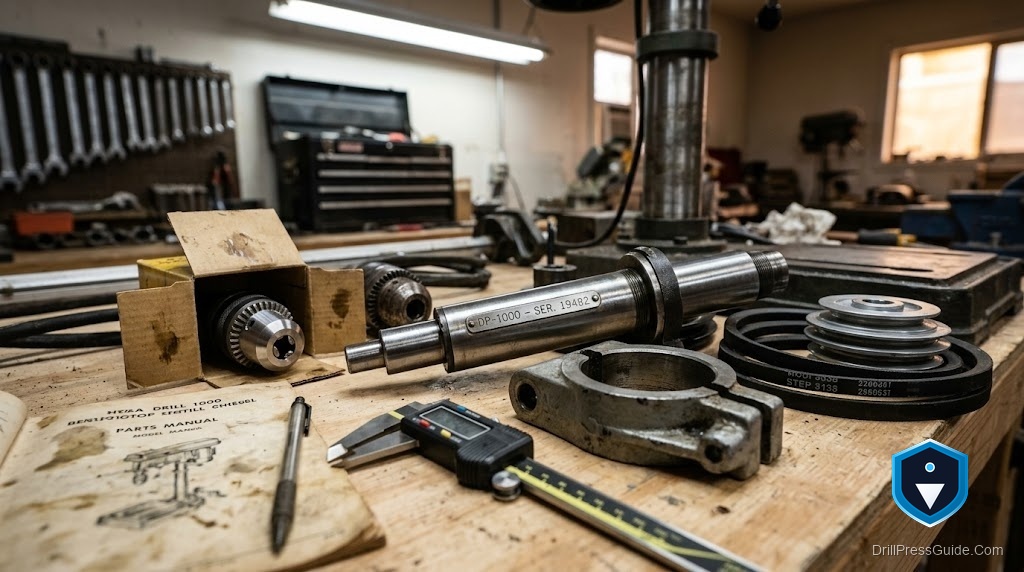
Benchtop drill press parts are the replacement components for bench-mounted drilling machines: switches, V-belts, chucks, quill return springs, pulleys, bearings, depth-stop hardware, and the small castings and brackets that hold it all together. Some are specific to one model, and some are standard items you match by size across any brand.
Here is the short version. Find the model number on the machine’s ID label first. Order model-specific parts, switches, springs, brackets, by that number. For belts, chucks, and bearings, measure the specification and buy the right size from any maker. And on an inexpensive machine, always weigh the cost of parts against simply replacing the whole press.
Start at the ID label
The metal label on the head or column carries the model number and often a serial or version code. Write all of it down. Manufacturers revise machines between production runs, so the version code can be the difference between a part that seats and one that does not. A part search without the model number is guessing, and guessing is how you end up with a drawer of things that almost fit. Once you have the model, find the parts diagram; it assigns each component a part number, and that number is what you order against, not a description.
Which parts are model-specific
The on/off switch, the quill return spring, the depth-stop assembly, the table bracket and its rack, and any casting are built around one machine’s geometry. Order these by the exact part number for your model. A switch that is physically close may not fit the housing, and a return spring of the wrong strength will not pull the quill back properly. These are the parts where brand and model matter, and where a substitute usually disappoints.
Which parts are standard and cross-reference by size
Wear items follow common standards, and this is where you save money. A V-belt is defined by its length and V-profile; measure the old belt or read the printing on it and buy any brand of the same size. A drill chuck is defined by its capacity, such as 1/2 inch, and by the arbor taper, commonly a Jacobs taper or an MT2 spindle taper; a matching chuck from any maker will fit. Bearings carry a standard code stamped on the race that any bearing supplier can match. For these, you are matching a specification, not chasing a brand.
How to measure so it fits
For a belt, note length, width, and profile, or copy the numbers off the old one. For a chuck, confirm the capacity and, crucially, the spindle taper, because a chuck built for the wrong taper never runs true. For a bearing, read the code on the old race. For pulleys, match the bore, the belt profile, and the number of steps. Measure twice and order once, because return shipping cancels any savings from a hopeful guess.
When a repair is not worth it
This is the honest part most parts guides skip. Small benchtop drill presses are inexpensive, and a stack of shipped parts plus your time can approach the cost of a new machine. If a machine needs a motor, a major casting, or several parts at once, replacement often wins. A capable new benchtop like the WEN 4208T 8-inch five-speed drill press or the larger WEN 4214T 12-inch variable speed model can be less than the sum of a big repair, and you get a fresh motor and warranty instead of an old machine with one new part. Fix wear items on a machine you like. Do not pour money into a cheap press that needs everything.
Conclusion
Most benchtop drill press repairs are quick wins once you buy the right part. Start at the ID label, order model-specific components by part number, and cross-reference belts, chucks, and bearings by measured specification. Keep the tape measure honest, because fit is everything on a machine that lives or dies on running true. And when the repair bill on a cheap press starts stacking up, be willing to replace instead of rebuild. A well-chosen new machine often beats nursing an old one back to life one part at a time.
Frequently asked questions
Where is the model number on a benchtop drill press? On the metal ID label attached to the head or column. Record the model number, serial number, and any version code before shopping for parts.
Are drill press belts universal? Belts are not universal, but they are standard. Match the length and V-profile of your old belt and any brand of that size will fit.
Can I put any chuck on my benchtop drill press? Only a chuck that matches the spindle taper and the capacity you need. Confirm whether the spindle uses a Jacobs or MT2 taper before ordering.
How do I fix a drill press quill that will not return? Usually the quill return spring has lost tension or broken. Replace it with the model-specific spring, since strength and size are matched to the machine.
Is it worth repairing a cheap benchtop drill press? For a single wear item, yes. For a motor, a major casting, or several parts at once, replacing the machine is often cheaper and gives you a new motor and warranty.
What bearings does a benchtop drill press use? Standard sealed ball bearings identified by the code stamped on the race. Read that code and match it at any bearing supplier.
References
- WEN Products, benchtop drill press specifications and part manuals, wenproducts.com
- OSHA, Machine Guarding eTool: Drill Presses, osha.gov