
How to Set Drill Press Belt Tension Without Overloading the Bearings
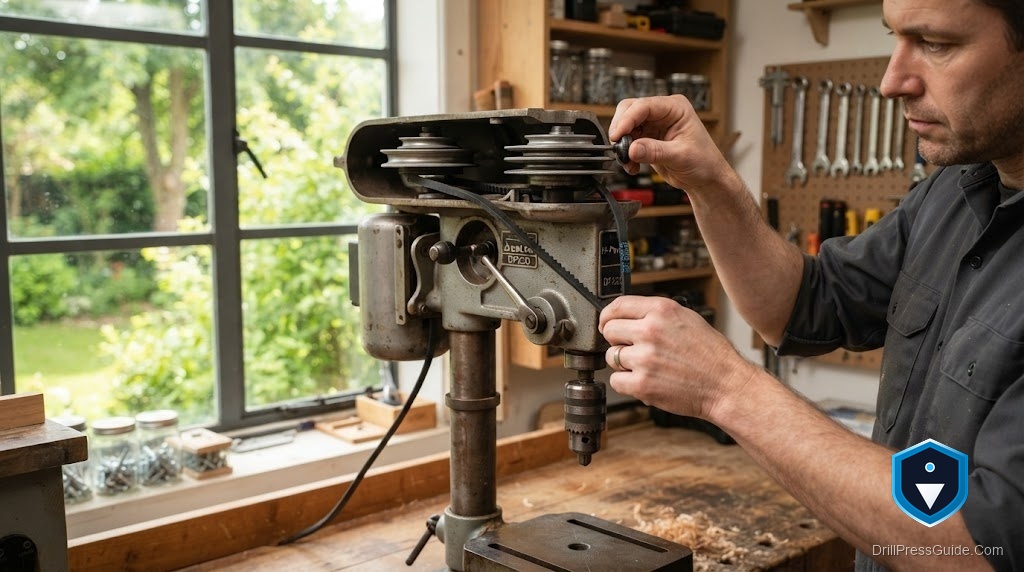
You fire up the drill press, feed a bit into hardwood, and the motor groans. The belt slips. The smell of burnt rubber fills the shop. You tighten the motor mount bolts another half turn, and the next time you run it, the bearings sound like gravel in a coffee can. That is the wrong kind of tight.
Belt tension is one of those adjustments that separates a smooth-running drill press from a machine that eats itself. Too loose, and the belt slips under load. Too tight, and the extra load lands on the motor and spindle bearings, shortening their life and adding vibration you cannot dial out. Getting it right takes about five minutes and a little feel.
A drill press uses a V-belt running between stepped pulleys on the motor and the spindle. The motor sits on a hinged plate that slides up and down on a track. Loosening the lock nuts or bolts on that plate lets you push the motor away from the spindle to tighten the belt, or pull it closer to loosen it. Most benchtop and floor presses use this same arrangement, though the exact bolt locations vary by brand.
The goal is tension that lets you press the belt firmly with one finger and feel about a half inch of deflection. On a typical 2-inch wide V-belt, that means you can push it inward roughly halfway between the pulleys without straining. If the belt feels rock solid or you can barely move it, it is too tight. If it flaps or you can push it more than three-quarters of an inch, it is too loose.
Where to Start
Unplug the machine. Always. A drill press switch can get bumped while you are working around the belt housing, and the last thing you want is a spinning chuck while your hands are inside the cover.
Remove the belt guard. Most guards attach with two or three screws. Set them aside where they will not roll under the bench. Look at the belt path. Note which step each pulley is on, because you may need to shift the belt to change speed later, and the tension will change slightly with each step.
Loosen the motor mount bolts. On most presses, there are two bolts on the motor plate that lock it to the sliding track. Turn them counterclockwise two or three turns. You do not need to remove them entirely. The motor should now slide up and down with hand pressure.
Push the motor away from the spindle until the belt feels snug. Not piano-wire tight. Snug. You want to feel resistance when you press the belt with moderate finger pressure, but you should still be able to deflect it. Tighten the motor bolts in that position. Run the machine at medium speed for thirty seconds and listen. A smooth hum is good. A high whine or rattle means the bearings are fighting the load, and you should back the tension off a hair.
The Feel Test That Saves Bearings
After the first run, shut the machine down and press the belt again. If it deflects more than three-quarters of an inch, loosen the motor and push it out a little more. If it barely moves, bring the motor in slightly. The sweet spot is usually between three-eighths and five-eighths of an inch of deflection on the open span.
Do not use a ruler like you are tuning a guitar. Press the belt with the same pressure you would use to check a car tire. You are looking for firm but yielding, not stiff. The belt should not bottom out against the pulley when you press it, but it should not feel like a steel cable either.
What Happens When You Get It Wrong
An overtightened belt puts constant radial load on the motor shaft and the spindle bearings. Over months, that load turns into heat, noise, and eventual failure. You will notice the press running hotter than usual, or the chuck will start to wobble because the spindle bearings have developed play. The fix is usually a new set of bearings, which costs more than the time it takes to set tension correctly the first time.
A loose belt is less destructive but more annoying. It slips under load, especially in low speed or high torque situations like large Forstner bits or metal drilling. The bit stops cutting, the motor keeps spinning, and the friction burns the belt. You can smell it before you see it. If the belt is glazed or cracked, replace it. A new belt is cheap insurance.
When to Check Tension Again
Check the belt every time you change speeds by moving the belt to a different pulley step. The motor position usually needs a small adjustment to compensate for the different belt length. Also check after moving the press, since vibration can shift the motor plate over time. And check if you notice slipping, squealing, or a change in the machine’s sound.
New belts stretch slightly during the first few hours of use. If you install a fresh belt, check the tension again after the first real project. It will almost always need a slight tightening as the belt seats.
FAQ
How do I know if my belt is worn out? Look for cracks on the inner V surface, glazing that makes it look shiny and hard, or fraying along the edges. A worn belt will slip even at correct tension and may squeal on startup. Replace it when you see any of those signs.
Can I use any V-belt, or does it need to be a specific size? Match the original width and length. A belt that is too narrow will sit too deep in the pulley and lose grip. A belt that is too wide will ride high and wear unevenly. Check the manual for the part number, or bring the old belt to a hardware store and match the profile.
Why does my belt keep loosening after I set it? The motor plate bolts may not be tight enough, or the plate may be binding in the track. Clean the sliding surfaces and make sure the bolts lock evenly. If the plate is worn or the track is bent, the motor can creep under vibration. A washer under the bolt head sometimes helps distribute the clamping force.
Should I tension the belt differently for metal vs. wood drilling? Not really. The correct tension is the same for any material. What changes is the speed and feed pressure you use. Metal drilling usually calls for lower speed and steady feed, which is exactly when a loose belt will slip. Good tension is good for everything.
Do I need a special tool to check tension? No. Your finger and a calm approach are enough. If you want to be more precise, a belt tension gauge exists, but it is overkill for a home shop drill press. The finger test, done honestly, will get you within the range that protects the bearings.
What if the motor hums but the chuck barely turns? The belt is probably very loose or has jumped a step. Unplug the machine, open the guard, and look. The belt may be riding on top of the pulley instead of in the groove. Reset it and tension properly.
Can I over-tighten the motor bolts and warp the plate? Yes. The motor plate is usually cast aluminum or stamped steel. If you torque the bolts like a car wheel, you can distort the plate or strip the threads. Snug is enough. The motor does not need to be locked down with gorilla force.
Why does the press vibrate more after I changed the belt? Either the belt is unevenly tensioned, the pulleys are not aligned, or the new belt is not seated correctly. Check that the motor pulley and spindle pulley are in the same plane. A misaligned belt will wear on one edge and cause vibration. Loosen the motor, align the pulleys by eye or with a straightedge, and retension.
How long does a typical drill press belt last? In a home shop with moderate use, five to seven years is common. In a busy shop where the press runs daily, three to four years. Heat, dust, and overtightening all shorten the life. When the belt starts to look hard and polished instead of matte and flexible, it is time.
Should I replace both pulleys when I replace the belt? Only if the pulleys are damaged. Grooves that are worn smooth, chipped, or cracked will destroy a new belt quickly. If the pulleys look good, just replace the belt and clean the grooves with a brush to remove any embedded rubber.


