
How to Mill Steel on a Drill Press: Setup, Checks, and Common Mistakes
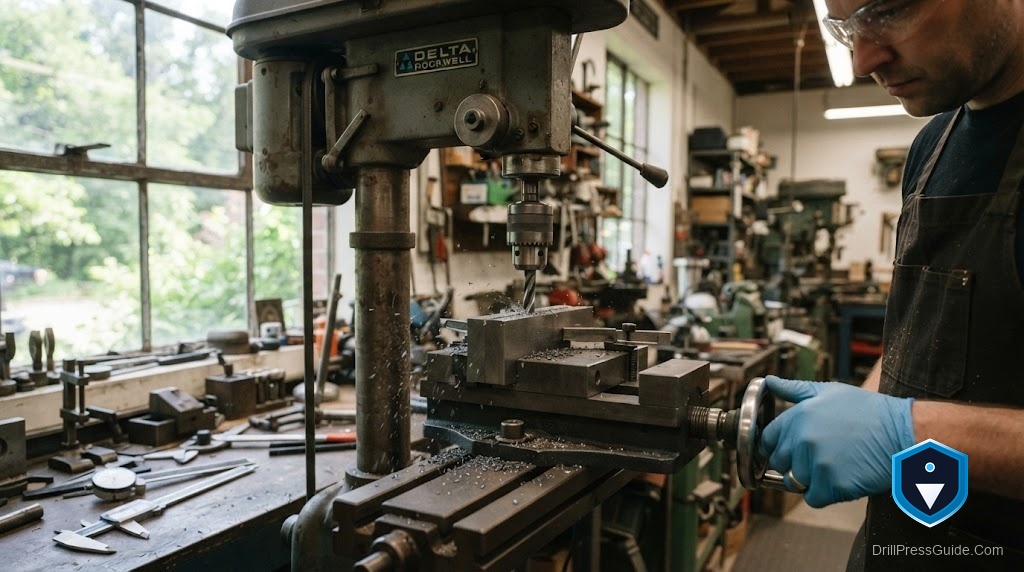
Milling aluminum on a drill press is a stretch. Milling steel on one is a different order of trouble, because steel adds hardness and heat to a machine that was already fighting the wrong kind of load. People try it to save the cost of a mill, and the results, torn finishes, snapped end mills, work-hardened surfaces the cutter skates across, teach an expensive lesson. Knowing how to mill steel on a drill press is really knowing how little of it is possible, and how to do that little without ruining tools, the machine, or your hands.
Milling steel on a drill press means removing steel from the sides of a workpiece with a rotating cutter, cutting a slot, pocket, or edge, rather than drilling. Steel makes the job far harder than soft metal because it is hard, it work-hardens, and it demands cutting forces a drill press spindle and quill were never built to take sideways.
The short answer: only the very lightest steel milling is realistic, using a collet-held end mill, a locked quill, a hard-clamped part, a low speed, cutting fluid, and cuts measured in thousandths. For anything real, a drill press cannot mill steel, and trying invites broken cutters and a worn machine. A mill is the honest answer.
Why steel is worse than aluminum here
Steel compounds every weakness of milling on a drill press. The spindle’s bearings take thrust down the axis and its quill slides with play, so sideways milling force already causes chatter and wear. Steel’s hardness multiplies the cutting force needed, which multiplies that side load and the chatter with it.
Worse, many steels work-harden: if the cutter rubs instead of cutting cleanly, the surface hardens and the end mill skates, unable to bite. Steel also builds heat fast, and heat kills end mills. So where aluminum forgives a light drill-press cut, steel punishes hesitation, chatter, and heat, all of which a drill press is prone to. The margin for success is razor-thin.
What is realistic, and what is not
Be honest about the ceiling. On mild steel, with perfect setup, a drill press can take a tiny cleanup cut, a shallow spot-face, or ease an edge, at glacial pace. That is the whole realistic range. Hardened steel, tool steel, deep slots, pockets, tight tolerances, or any real material removal are simply out of reach, and attempting them breaks end mills and wears the spindle.
The reason is rigidity. Milling steel demands a machine that does not flex under heavy side load, and a drill press flexes exactly there. No accessory changes that fundamental fact, so the only safe steel milling on a drill press is the kind so light it barely counts as milling.
Setup and the checks that keep it safe
If you attempt a light cut, the setup must be right or it turns dangerous. Hold the end mill in a collet, never the drill chuck, because side loads can pull a cutter out of a drill chuck mid-cut, and in steel the loads are higher. Lock the quill at depth so it cannot creep down and grab. Clamp the work in a vise bolted or clamped hard to the table; a cross-slide compound vise both holds firmly and lets you feed the work in measured amounts, though its honest limit is that it adds positioning and not rigidity, so the cut still must stay tiny. Skip it if you expect rigidity from it.
Then the cutting checks. Run a low speed suited to steel, because steel wants slow surface speeds and heat is the enemy. Keep cutting fluid on the cut throughout to carry heat away and stop the surface work-hardening. Take a feather-light depth of cut and feed slowly and steadily, never letting the cutter dwell and rub, which is what work-hardens the steel. If the tool chatters hard, screeches, or the surface glazes, stop; the cut exceeds what the machine can hold.
Drill press versus a mill for steel
The comparison is not close. A drill press mills steel only in the lightest cleanup cuts, slowly, with a poor finish, a high risk of broken end mills, and real wear on the spindle. A benchtop or larger mill has the rigid spindle, proper toolholding, and controlled feed that steel milling demands, and it removes steel steadily and safely. The cost and frustration of forcing a drill press to mill steel, counting broken cutters and a worn machine, generally exceed the value of just using a mill. For a single tiny cleanup on mild steel, the drill press can limp through. For steel milling as a task, a mill is the only tool that does it properly.
Where this leaves you
Milling steel on a drill press is realistic only for the lightest cleanup on mild steel, and only with a collet-held cutter, a locked quill, a hard-clamped part, a low speed, cutting fluid, and cuts measured in thousandths. Steel’s hardness, work-hardening, and heat make it far less forgiving than aluminum, and the machine’s flex under side load caps what is possible at nearly nothing. Take the tiny cut if you must, watch for chatter and glazing, and buy a mill the moment steel milling becomes a real need.
- Steel’s hardness and work-hardening make drill-press milling far harder than aluminum.
- Use a collet, never a drill chuck; steel’s higher side loads pull cutters loose.
- Run low speed with constant cutting fluid, and take only whisper-light cuts.
- For any real steel milling, a mill is the correct and far safer tool.
A drill press can nibble at mild steel on its best day. Ask it to mill steel for real and it will break cutters proving it cannot.
Frequently asked questions
Can a drill press mill steel? Only the lightest cleanup cuts on mild steel, with perfect setup. Steel is hard, work-hardens, and builds heat, and a drill press flexes under the side loads milling creates. Real steel milling, deep cuts or hard steel, is out of reach and breaks cutters.
Why do my end mills break milling steel on a drill press? Usually from chatter and flex under side load, cuts that are too deep, or the cutter rubbing and work-hardening the steel until it skates and snaps. The machine lacks the rigidity steel milling needs, so only tiny cuts survive.
What speed should I use to mill steel? Low, because steel wants slow surface speeds and heat destroys end mills. Match the speed to the cutter diameter and the steel grade, keep cutting fluid on the cut, and feed steadily so the cutter never dwells and rubs.
Does steel work-harden when milling? Many steels do. If the cutter rubs instead of cutting cleanly, the surface hardens and the end mill skates across it, unable to bite. Steady feed, a sharp cutter, and cutting fluid prevent the rubbing that causes it.
Do I need a collet to mill steel on a drill press? Yes. A drill chuck can let an end mill pull loose under side load, and steel’s higher cutting forces make that more likely and more dangerous. A collet grips the cutter positively, which is the minimum requirement for any attempt.
When should I use a milling machine for steel? For any steel milling beyond a single tiny cleanup cut. A mill has the rigidity, toolholding, and feed control steel demands, removing material steadily and safely where a drill press only breaks cutters trying.
References
- Carbide Depot, machining speeds and feeds formulas: https://www.carbidedepot.com/formulas-drills-speeds.htm
- Viking Drill and Tool, feed and speed reference: http://www.vikingdrill.com/viking-Drill-FeedandSpeed.php
- OSHA, machine guarding and point-of-operation safety: https://www.osha.gov/machine-guarding


