
How to Mill Metal with a Drill Press Without Losing Accuracy
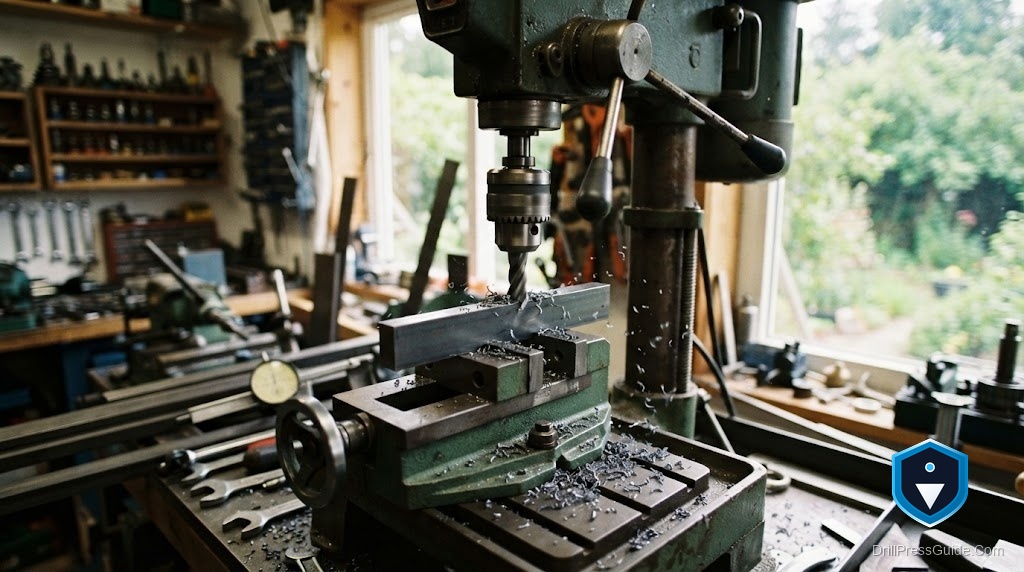
Somewhere online, someone is milling an aluminum bracket on a drill press and it looks like it works. What the video does not show is the end mill slowly pulling out of the drill chuck, the spindle bearings taking a beating they were never designed for, and the finish that looks fine on camera and rough in the hand. Milling metal with a drill press sits in a narrow band between what is genuinely possible and what wrecks tools and machines, and the single biggest trap, how the cutter is held, is the one most people never hear about until it fails.
Milling metal with a drill press means using a cutter to remove metal from the sides of a workpiece, cutting slots, pockets, or edges, rather than boring straight down. The problem is twofold: a drill press spindle is built for downward thrust, not sideways milling loads, and a standard drill chuck cannot hold an end mill securely against those loads.
The short answer: only the lightest milling is possible, and only if you hold the end mill in a collet rather than a drill chuck, lock the quill, clamp the work hard, run slow, and take tiny cuts. Even then a drill press cannot mill like a mill, and pushing it there is how bits pull loose and spindles die.
Two problems, not one
Most warnings about milling on a drill press mention side loads. There are actually two separate problems, and the second is the sneaky one. The first is the spindle: its bearings take thrust down the axis, and its quill slides in a sleeve with play, so sideways cutting force causes chatter, poor finish, and rapid wear. That much is well known.
The second problem is the toolholding. A standard drill chuck grips a bit by its smooth shank for straight-down drilling. Side loads from milling try to work the cutter sideways and downward, and a drill chuck can let an end mill slip and slowly pull out of the chuck mid-cut, which ruins the work and is dangerous. This is why serious light milling on a drill press requires a collet that grips the end mill positively, not the drill chuck the machine came with. Ignore this and the cutter will eventually walk out on you.
What is genuinely possible
Inside the limits, a little milling is real. On soft metal like aluminum or brass, you can cut a shallow slot, clean up an edge, or spot-face around a hole, taking light passes. It is slow and the finish will not match a mill, but for a hobby part where precision is forgiving, it can work.
What is not possible is production milling: deep cuts, hard steel, tight tolerances, or large amounts of material. The machine simply is not rigid enough, and forcing it produces chatter, wandering cuts, and wear that shortens the press’s life. The honest rule is to treat drill-press milling as occasional, light, soft-metal work and nothing more.
Setup that makes it survivable
If you attempt it, the setup is everything. Hold the end mill in a collet that fits the spindle, not the drill chuck, so the cutter cannot pull out. Lock the quill at the cutting depth so it cannot creep down, since an unlocked quill diving into a side cut is how tools grab. Clamp the work in a vise that is itself bolted or clamped hard to the table, because a part that shifts under a side load becomes a projectile.
A cross-slide compound vise is what makes controlled milling possible at all, moving the work in two axes so you feed the cutter by small, measured amounts. Its honest and central limit is that it adds positioning, not rigidity, so cuts still must stay tiny and the spindle still wears. Skip it if you expect it to turn the press into a mill; it does not. Pair it with a sharp end mill, a low speed, and cutting fluid on anything ferrous.
Drill press versus a benchtop mill
The comparison settles the question for most people. A drill press, rigged with a collet and a cross-slide vise, mills only soft metal, lightly, slowly, with a rough finish and steady wear on the spindle. A benchtop mill has the rigid spindle, the proper toolholding, and the controlled table feed that milling actually needs, and it does the job quickly, cleanly, and safely. The money and effort spent rigging a drill press for milling usually approaches the cost of an entry-level mill, and you still end up with a worn drill press. For a one-off light cut in aluminum, the rigged press can serve. For anything beyond that, a mill is both the safer and the smarter buy.
Where this leaves you
Milling metal with a drill press is possible only at the margins, and only if you respect both problems: hold the end mill in a collet so it cannot pull out, and keep every cut tiny because the spindle was never built for side loads. Lock the quill, clamp the work hard, run slow, and stick to soft metal. Do that and you can manage the occasional light cut. Ask for more and the tool pulls loose, the finish tears, and the machine wears out early. When milling becomes routine, buy a mill.
- A drill press spindle takes thrust, not the sideways loads milling creates.
- Hold the end mill in a collet, never a drill chuck, or it can pull loose mid-cut.
- Limit work to light cuts in soft metal, with the quill locked and the part clamped hard.
- For real milling, a benchtop mill is the correct, safer, and ultimately cheaper tool.
The press mills only what it can barely manage. The moment you need more, it is the wrong machine.
Frequently asked questions
Can you mill metal with a drill press? Only lightly, and only on soft metal like aluminum or brass. A drill press spindle is built for downward thrust, not sideways milling loads, and it cannot mill like a milling machine. Deep cuts, hard steel, and tight tolerances are out of reach.
Why can’t I use a drill chuck for milling? A drill chuck grips a bit for straight-down drilling. The sideways loads of milling can work an end mill loose, and it can slowly pull out of the chuck mid-cut, ruining the work and creating a hazard. Use a collet that grips the end mill positively.
What holds an end mill in a drill press? A collet that fits the spindle taper and grips the end mill’s shank securely, resisting the side loads that would pull a cutter out of a standard drill chuck. Proper toolholding is the single most important requirement for any milling attempt.
How light do the cuts need to be? Very light, a few thousandths of an inch per pass, in soft metal only. The drill press lacks a mill’s rigidity, so anything more causes chatter, wandering cuts, and accelerated spindle wear. Multiple tiny passes are the only safe approach.
Does a cross-slide vise make milling possible? It makes controlled positioning possible by moving the work in two axes, which is necessary for milling. But it adds no rigidity, so cuts must still stay tiny and the spindle still wears. It helps, but it does not turn a press into a mill.
When should I buy a milling machine instead? As soon as milling becomes more than a rare, light cut in aluminum. A benchtop mill has the rigidity, toolholding, and feed control the job needs, and its cost is close to what you would spend rigging and wearing out a drill press.
References
- Carbide Depot, machining speeds and feeds formulas: https://www.carbidedepot.com/formulas-drills-speeds.htm
- Norseman Drill and Tool, drilling feeds and speeds chart: http://www.norsemandrill.com/feeds-speeds-drill.php
- OSHA, machine guarding and point-of-operation safety: https://www.osha.gov/machine-guarding


