
How to Face Metal with a Drill Press: A Clear, Shop-Ready Method
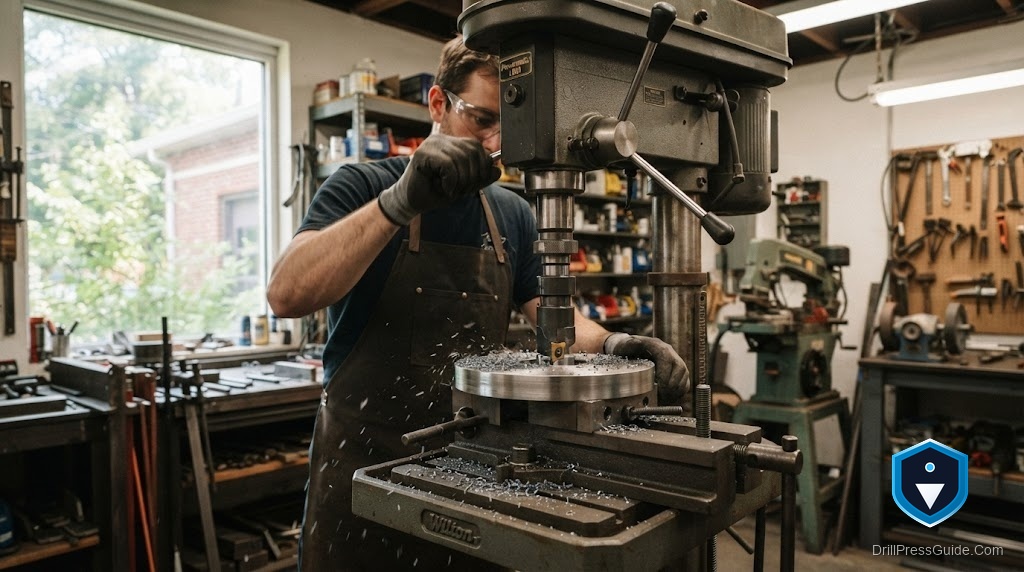
Facing metal, taking a rough or uneven surface and cutting it flat, is one of those jobs people assume a drill press can do because it already spins a cutter over a clamped part. It can, barely, and the way it usually goes wrong is dramatic: a fly cutter loaded into a machine never built for side loads, a part that shifts, and a heavy steel bar swinging at head height. Facing metal on a drill press is possible only within tight limits and with real caution, and understanding those limits is what keeps the job safe and the machine alive.
Facing metal with a drill press means cutting a flat, even surface on metal by passing a rotating cutter across it, rather than boring a hole. The catch is that a drill press spindle is built for downward thrust, not the sideways cutting loads facing creates, so only light facing on small parts is safe.
The short answer: for light facing, use an end mill or a fly cutter at a low speed, lock the quill, clamp the part immovably, and take whisper-light cuts, accepting that a drill press cannot face like a mill. A fly cutter especially demands respect, because its swinging arc is dangerous on a machine without a mill’s rigidity.
Why facing strains a drill press
Everything about facing runs against how a drill press is built. The machine rotates a cutter in a spindle whose bearings take thrust straight down the axis, and its quill slides in a sleeve with a little play so it can plunge. Facing pushes a cutter sideways across the work, applying exactly the radial load the spindle handles worst.
That mismatch shows up as chatter, a poor finish, accelerated bearing wear, and, with an aggressive cut, a real chance the tool grabs or the work breaks free. A milling machine faces easily because its heavy spindle and solid table resist side load. A drill press has none of that, so facing on one is always a compromise limited to light work, never a substitute for a mill.
The tools, and the fly-cutter warning
Two tools face metal on a drill press, and one carries a warning. An end mill, held so it cannot pull out, can take a light facing pass across a small area. A fly cutter, a single tool bit swung on an arm, covers a wider face in one pass, which is why people reach for it, but that spinning arc is the most dangerous accessory you can put in a drill press: it is unbalanced, nearly invisible while turning, and unforgiving if the work shifts or the cut is too deep.
If you use a fly cutter, run the lowest speed, take the lightest cut, clamp everything twice, and keep hands and face well clear of the swing. Never hand-hold work under a fly cutter. A cross-slide compound vise lets you feed the work under the cutter by measured amounts and holds it firmly, which makes light facing controllable. Its honest limit is that it adds positioning, not rigidity, so cuts still must stay tiny; skip the idea that it makes a drill press behave like a mill.
Setup and technique for a safe pass
With the right expectations, the method is all about control. Clamp the workpiece in a vise bolted or clamped hard to the table, because any movement under a side-cutting tool is dangerous. Lock the quill at the cutting depth so it cannot creep down mid-pass, since an unlocked quill diving into the work is how tools grab.
Run a low spindle speed, lower for a fly cutter’s wide swing than for a small end mill. Take a very light depth of cut, measured in thousandths, and let the tool skim rather than dig. Feed the work slowly and evenly, using the cross-slide rather than muscling the head. Keep the cut clear of chips and, on steel, add cutting fluid. If the tool chatters hard, grabs, or the finish tears, stop; those are the machine telling you the cut exceeds what it can hold. Several feather-light passes beat one ambitious cut every time.
Drill-press facing versus a milling machine
The honest comparison is stark. A drill press faces only small parts, lightly, slowly, and with a mediocre finish, while wearing its spindle and asking real caution with a fly cutter. A milling machine faces quickly, flatly, and safely because it was built for exactly this side-loaded work, with the rigidity and controlled feed the job needs. For a one-time light cleanup on a small part, the drill press can serve if you respect the limits. For any real facing, repeated work, larger surfaces, or a fine finish, a mill is the correct tool, and forcing a drill press to do a mill’s job risks both the machine and your safety. Know which situation you are in before you load a fly cutter.
Where this leaves you
Facing metal with a drill press is a narrow, cautious operation: light cuts, low speed, a locked quill, a hard-clamped part, and extreme respect for a fly cutter’s swing. It cannot replace a mill, because the spindle is built for thrust, not the sideways load facing creates. Use it for the occasional light cleanup on a small part, keep every cut tiny, and reach for a milling machine the moment the job grows beyond that.
- A drill press spindle takes downward thrust, not the sideways load facing creates.
- Use an end mill or fly cutter at low speed with the quill locked and the part clamped hard.
- Treat a fly cutter as the most dangerous accessory on the machine; take the lightest cuts and stay clear of the swing.
- For real facing, a milling machine is the correct and far safer tool.
The press that bores a perfect hole is not the machine that faces a block. Respect the difference and keep the cuts light.
Frequently asked questions
Can you face metal with a drill press? Only lightly, on small parts. A drill press spindle is built for downward thrust, not the sideways load facing creates, so it can take whisper-light facing passes with an end mill or fly cutter but cannot face like a milling machine.
Is it safe to use a fly cutter in a drill press? Only with great caution. A fly cutter’s swinging arc is unbalanced and nearly invisible while turning, and it is unforgiving if the work shifts. Use the lowest speed, the lightest cut, clamp everything hard, and keep well clear. Never hand-hold the work.
Why does facing chatter on a drill press? Because the quill slides with some play and the bearings are built for thrust, not side load. Sideways cutting force makes the spindle chatter, which ruins the finish. Lighter cuts, a locked quill, and a lower speed reduce it, but cannot eliminate it.
What speed should I use to face metal? Low, and lower still for a wide fly cutter than for a small end mill. High speed builds heat and worsens chatter and danger. Match the speed to the cutter’s diameter and the metal, and keep cutting fluid on steel.
Do I need a cross-slide vise to face metal? It helps by feeding the work under the cutter in measured amounts and holding it firmly, which makes light facing controllable. It does not add rigidity, though, so cuts must still stay tiny regardless of the vise.
When should I use a milling machine instead? For any real facing: larger surfaces, repeated work, or a fine finish. A mill is built for the side-loaded cutting facing requires and does the job quickly and safely, where a drill press only manages a light, compromised cut.
References
- Carbide Depot, machining speeds and feeds formulas: https://www.carbidedepot.com/formulas-drills-speeds.htm
- Viking Drill and Tool, feed and speed reference: http://www.vikingdrill.com/viking-Drill-FeedandSpeed.php
- OSHA, machine guarding and point-of-operation safety: https://www.osha.gov/machine-guarding


