
How to Choose a Drill Press for Woodworking: What to Check Before You Start
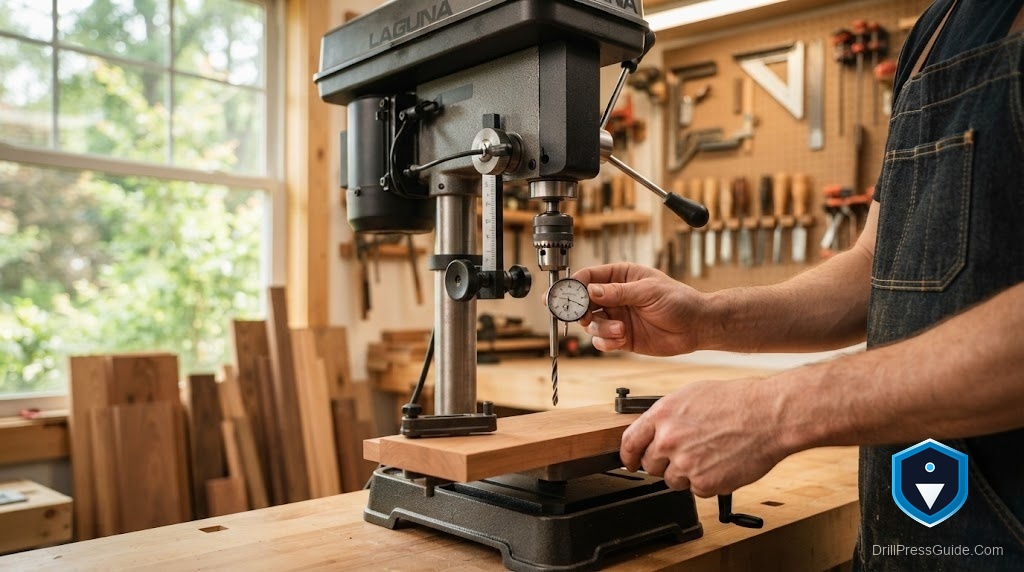
The drill press is the tool woodworkers buy last and use more than they expected. It bores the shelf-pin rows, the hinge cups, the dowel joints, and the angled holes that a hand drill can only approximate, and the difference between a press that makes those jobs easy and one that fights you comes down to a handful of specs most buyers never look at. Knowing how to choose a drill press for woodworking means knowing which numbers matter for wood specifically, because the press that is perfect for a metal shop can be the wrong tool for a furniture maker.
Choosing a drill press for woodworking means matching the machine’s speed range, swing, spindle travel, table, and power to the way wood is actually drilled, which favors a wide speed range and a good table over the low-end grunt a metal shop prioritizes. The right press bores clean, square, repeatable holes without scorching or tearing the wood.
The short answer: for woodworking, prioritize a speed range that drops low enough for big Forstner bits, enough swing and spindle travel for your work, and a solid, tilting table you can add a fence to. Motor power matters far less in wood than in metal, so do not overpay for horsepower you will never use.
The spec that matters most in wood: speed range
Wood drilling spans a huge speed range, and the low end is where woodworkers get burned, literally. Small twist and brad-point bits want to spin fast, often 1,500 to 3,000 RPM, but a large Forstner bit or a hole saw needs to crawl near 500 RPM or it scorches the wood and dulls itself. A press whose slowest speed is too high will burn every big hole you drill.
This is where variable-speed and stepped-pulley machines differ. A WEN 4214T 12-inch variable-speed drill press dials any speed with a digital readout, which is genuinely convenient when you jump from a small bit to a big Forstner in one project. Its honest limit is that some variable-speed machines do not drop as low as a stepped-pulley press for the very largest bits, so check the slowest speed against the bits you own. Skip a variable-speed press if your work leans on oversized Forstners and hole saws that need the lowest possible RPM, where a stepped-pulley machine may reach lower.
Swing, travel, and the table
After speed, three physical specs decide what you can actually do. Swing, the distance from the column to the bit, sets how far into a panel you can reach; a larger swing lets you center a hole on a wider board. Spindle travel, how far the bit descends in one pull, decides how deep you can bore in a single stroke, which matters for dowels and deep stopped holes. And the table, a flat cast surface that tilts, lets you drill angled holes and, crucially for wood, take an auxiliary top and fence.
That fence is the woodworker’s secret weapon: it turns the press into a repeat-drilling station for rows of identical holes. A compact machine like the WEN 4208T 8-inch drill press fits a crowded bench and handles shelf pins and light joinery well, though its honest drawbacks are modest spindle travel and a small table, so deep boring and large panels get awkward. Skip the smallest presses if you build furniture or bore big holes; you will outgrow the travel.
How much power do you really need?
Here is where woodworkers routinely overspend. Metal drilling needs torque to push big bits through steel, so horsepower and cast-iron mass matter there. Wood is far easier to cut, and a modest motor drives any bit a woodworker uses without complaint. A machine in the range of half a horsepower to three-quarters is plenty for a home wood shop, and chasing a big motor buys grunt you will never call on while adding weight and cost.
A well-built benchtop press with a good speed range and a solid table serves most woodworkers better than a heavier machine bought for its motor. The JET JWDP-12 variable-speed benchtop drill press pairs a wide speed range with a work light and a laser, and its honest drawback is that it costs more than the value-brand machines for similar core capability, so you are partly paying for fit and finish. Skip it if a simpler press covers your work and you would rather spend the difference on bits and a good fence.
Benchtop versus floor for a wood shop
The last decision is size and stance. A benchtop press saves floor space, costs less, and handles the shelf pins, dowels, and joinery most woodworkers do, at the cost of smaller capacity and shorter travel. A floor-standing press gives more swing, more travel, and more mass for big work and large panels, at the cost of space and money a small shop may not have. For most home woodworkers, a solid benchtop machine with a wide speed range and a good table is the right call, and the floor press earns its footprint only if you build large furniture or bore deep, oversized holes regularly. Match the machine to the work, not to the biggest one on the shelf.
Where this leaves you
Choosing a drill press for woodworking is about the right specs, not the biggest ones: a speed range that drops low for Forstners, enough swing and travel for your work, and a solid tilting table you can fence. Power barely matters in wood, so redirect that money toward a good table, a fence, and quality bits. Pick on those terms and the press quietly becomes one of the most-used machines in the shop, boring holes a hand drill never could.
- Prioritize a low-reaching speed range; big Forstner bits scorch at high RPM.
- Match swing and spindle travel to the size and depth of the holes you drill.
- Choose a solid tilting table you can add a fence to for repeatable holes.
- Do not overpay for horsepower; wood needs far less motor than metal does.
The best woodworking drill press is the one whose specs fit your bits and your bench, not the one with the biggest motor.
Frequently asked questions
What speed range do I need in a woodworking drill press? One that reaches low, ideally near 500 RPM, for large Forstner bits and hole saws, while still going fast, up toward 3,000 RPM, for small bits. A wide range that drops low matters more than any other spec for wood.
How much horsepower does a woodworking drill press need? Far less than a metal shop needs. Half a horsepower to three-quarters drives any bit a woodworker uses. Wood cuts easily, so chasing a big motor buys grunt you will never use while adding weight and cost.
Should I buy a benchtop or floor drill press for woodworking? A benchtop press suits most home woodworkers, handling shelf pins, dowels, and joinery while saving space and money. A floor press earns its footprint only if you build large furniture or bore deep, oversized holes regularly.
Do I need a variable-speed drill press for wood? It is convenient if you switch often between small and large bits, since you dial the speed rather than moving a belt. A stepped-pulley press works fine too and sometimes reaches lower speeds for the biggest bits. Check the slowest speed either way.
What is swing on a drill press? Swing is twice the distance from the column to the bit’s center, describing how wide a board you can drill to its center. A larger swing lets you reach farther into a panel, which matters for centering holes on wider stock.
What accessory should I add first for woodworking? An auxiliary table with a fence. It backs up the cut to prevent blowout and gives a repeatable stop for drilling rows of identical holes, which is exactly the kind of work a woodworker uses a drill press for most.
References
- Fine Woodworking, drill bit speed chart (PDF): https://images.finewoodworking.com/app/uploads/2020/01/22111726/drill-bit-speed-chart.pdf
- WOOD Magazine, drill press tables and setup: https://www.woodmagazine.com/woodworking-tools/reviews/drill/drill-press-tables
- OSHA, machine guarding and point-of-operation safety: https://www.osha.gov/machine-guarding


