How to Drill Through Steel Without a Drill Press Without Losing Accuracy
Most people who say steel is impossible to drill are really saying their bit is dull, their speed is too high, or both. Steel does not need a drill press to drill through cleanly, but it is far less forgiving of a handheld drill than wood or aluminum, and the mistakes that pass unnoticed on soft materials, wrong bit, wrong speed, no lubricant, will stop you dead in steel. Knowing how to drill through steel without a drill press is mostly knowing why steel resists, and setting up so it does not.
Drilling through steel without a drill press means boring through steel stock with a handheld drill by using the right bit, the correct low speed, cutting fluid, and firm setup, so the bit cuts rather than rubs and overheats. Steel is hard and builds heat fast, so the bit and the speed matter more than raw pressure.
The short answer: use a sharp cobalt or quality high-speed steel bit, center-punch and pilot the hole, run a low speed with steady pressure, keep the cut wet with cutting fluid, and clamp the work. If a drill will not go through steel, the cause is almost always too much speed and a dull bit, not too little power.
Why steel stops a bit that sails through wood
Steel is hard, and hardness means heat. A bit spinning fast in steel does not cut faster, it just rubs, and the friction turns the cutting edge blue and dead in seconds. Once the edge is gone, the bit skates on the surface and nothing you do with pressure will make it bite. This is the single most common reason a handheld drill, or even a drill press, seems unable to get through steel.
The fix runs opposite to instinct. Steel wants low speed, not high, so the edge cuts a chip instead of rubbing. It wants a sharp, hard bit that keeps its edge. And it wants cutting fluid to carry heat away. Give it those and mild steel drills easily by hand; deny them and the hardest bit in the world will glaze over and quit.
The right bit for steel
Bit choice decides the job. For mild steel, a sharp high-speed steel bit with a proper point works. For anything harder, stainless, tool steel, or thick plate, step up to cobalt, which keeps cutting when standard bits glaze and rub. A cobalt drill bit set holds its edge in stainless far better than black-oxide HSS, and its honest drawback is that cobalt is more brittle, so it chips if the bit chatters or the work flexes, which is really an argument for clamping and a guided, steady start. Skip cobalt if you only ever drill mild steel, where good HSS is tougher and cheaper.
Whatever the bit, keep it sharp. A sharp bit under moderate pressure throws two curling chips and drills clean; a dull bit produces dust, heat, and a hole that will not start.
Start it right and keep it straight
Steel punishes a sloppy start. Center-punch the mark to make a divot so the bit cannot skate across the smooth surface, and drill a small pilot hole first for anything but the smallest bit, so the larger bit follows the pilot instead of wandering. For a hole that has to come out square without a press, a guide earns its place. A pocket Big Gator Tools V-DrillGuide holds the bit perpendicular on flat or round stock, and its honest limit is that it guides the angle but does not feed the bit, so you still control speed and pressure, and it only covers the sizes machined into it. For a guide that also clamps the drill and sets depth, the Milescraft 1318 DrillMate constrains the whole drill in a frame, at the cost of more bulk. Either keeps a handheld hole far straighter than wrist and eye alone.
Speed, fluid, and feed
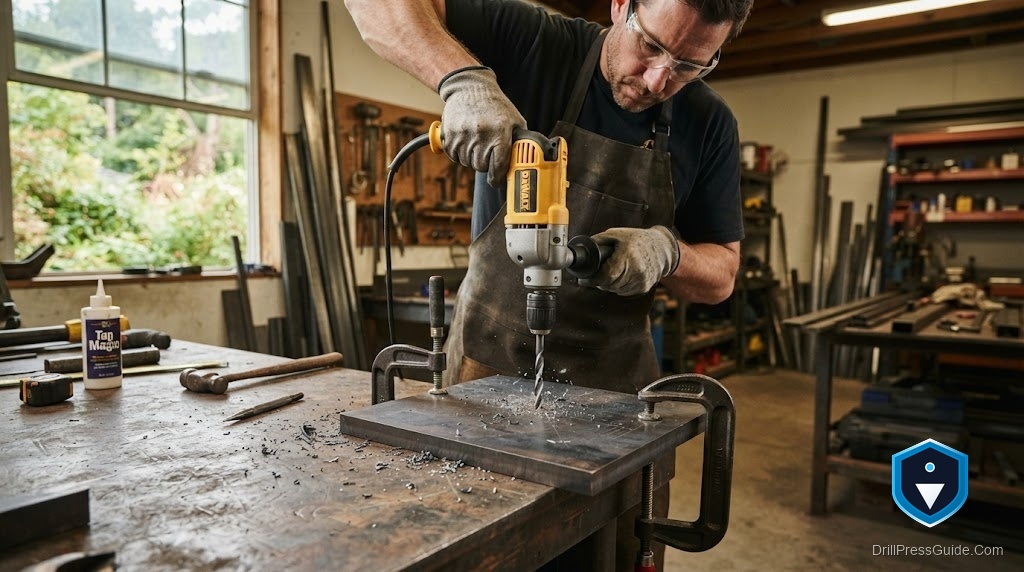
With the right bit and a fixed start, technique finishes the job. Run the drill slow, matching speed to the bit size and the steel, slower for bigger bits and harder steel. Keep cutting fluid on the cut the whole time to carry heat away and extend the edge. Feed with steady, firm pressure, enough that the bit cuts a chip rather than rubbing, but not so much that you stall it or snap a cobalt bit. Ease off as the bit breaks through so it does not grab. And clamp the work, always, because a drill that binds in steel will spin the workpiece hard enough to break a wrist. Peck deep holes, backing the bit out to clear chips so they do not pack and seize the flutes.
Handheld versus a drill press for steel
It is worth being honest about the tradeoff. A handheld drill with a guide, a sharp cobalt bit, and cutting fluid will drill through mild steel and even stainless cleanly, and for holes in place, on a frame, a fence, a car, it is the only option. What it gives up is the press’s rigid squareness and effortless feed, so accuracy and ease drop, and large holes in thick steel are slow and tiring by hand. A drill press wins decisively on big holes, repeated holes, and dead-square accuracy. For getting through steel where it sits, though, the handheld method works fine as long as you respect bit, speed, and fluid. Power was never the missing piece.
The bottom line
Getting through steel without a drill press comes down to fighting heat, not adding force: a sharp cobalt or good HSS bit, a center-punched and piloted start, a guide for squareness, a low speed, cutting fluid throughout, and steady pressure with the work clamped. A drill that will not cut steel is almost always spinning too fast on a dull bit, not lacking power. Fix those and steel drills by hand more easily than most people expect.
- Use a sharp cobalt or quality HSS bit; a dull bit rubs, overheats, and quits.
- Run a low speed, not high, so the edge cuts a chip instead of glazing.
- Center-punch, pilot, and use a guide to start square and keep the hole straight.
- Keep the cut wet with cutting fluid and clamp the work every time.
Steel is not stubborn. It just refuses to be rushed, and a slow bit with a wet edge goes right through.
Frequently asked questions
Why won’t my drill go through steel? Almost always because the speed is too high and the bit is dull. Fast spinning rubs instead of cutting and burns the edge in seconds. Slow the drill, use a sharp cobalt or HSS bit, add cutting fluid, and feed with steady pressure.
What bit drills through hardened steel? Cobalt bits handle stainless and tool steel where standard HSS glazes over. For truly hardened steel, a carbide bit may be needed. Whatever the bit, run it slow and keep it cool, because heat is what kills bits in hard steel.
Can I drill steel with a regular hand drill? Yes. Mild steel and even stainless drill fine with a handheld drill if you use a sharp bit, a low speed, cutting fluid, and a center-punched, piloted start. Clamp the work and keep the bit cool and it will go through.
How do I keep the hole straight without a drill press? Use a portable drill guide that holds the bit perpendicular, and start in a center-punched divot so the bit does not walk. A guide plus a pilot hole keeps a handheld hole far squarer than relying on your wrist and eye.
What speed should I use to drill steel? Low, and lower still for bigger bits and harder steel. Too much speed builds heat that burns the edge. Match the speed to the bit size and material, keep cutting fluid on the cut, and feed steadily.
Do I really need cutting fluid? On steel, yes. Cutting fluid carries heat away from the edge, which is what lets the bit keep cutting instead of glazing. It also cleans the chip and leaves a better hole. It is the cheapest thing that makes steel drilling work.
References
- Norseman Drill and Tool, drilling feeds and speeds chart: http://www.norsemandrill.com/feeds-speeds-drill.php
- Viking Drill and Tool, feed and speed reference: http://www.vikingdrill.com/viking-Drill-FeedandSpeed.php
- OSHA, machine guarding and point-of-operation safety: https://www.osha.gov/machine-guarding