
How to Drill Holes in Aluminum Sheet with a Drill Press: A Clear, Shop-Ready Method
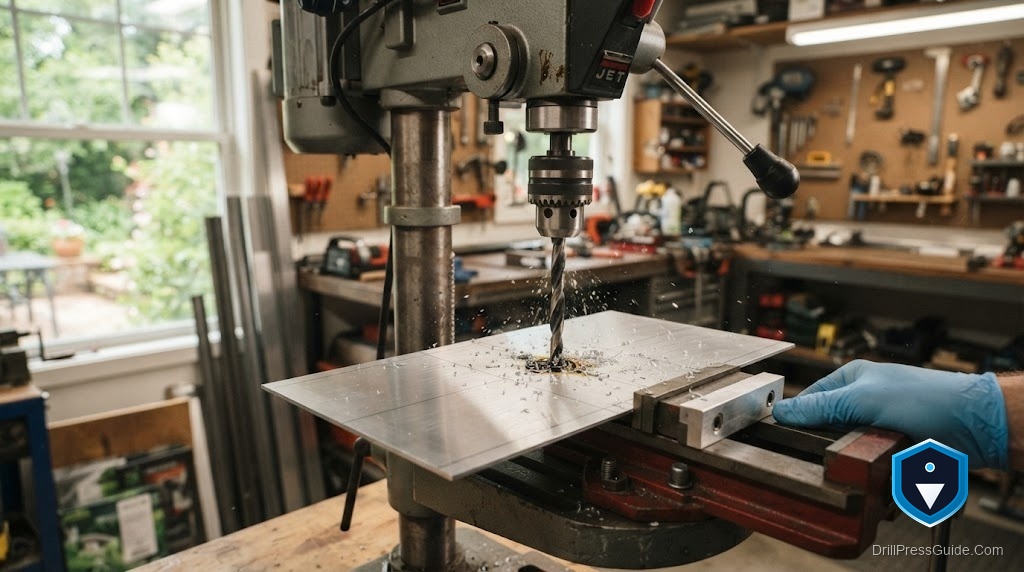
Aluminum sheet looks like the easiest thing in the world to drill, right up until the bit grabs, the sheet spins into a spinning aluminum saw blade, and you are left with an oval hole and a bent piece. Learning how to drill holes in aluminum sheet with a drill press is less about power and more about controlling two things that catch people out: the bit grabbing at breakthrough, and thin sheet flexing or lifting. Get those under control and aluminum drills fast, clean, and almost effortlessly.
Drilling holes in aluminum sheet with a drill press means boring clean holes in thin aluminum stock using the press’s controlled, square feed, with a sharp bit, a backing board, and firm clamping to stop the sheet from grabbing or spinning. Aluminum is soft and gummy, so the danger is not that it resists the bit but that it lets the bit dig in and snatch.
The short answer: back the sheet with a scrap board, clamp it hard, use a sharp high-speed steel bit at a moderate to fast speed, add a little lubricant, and ease off at breakthrough so the bit does not grab. The backing board and the clamp are what turn a dangerous, grabby job into a clean one.
Why aluminum sheet fights back
Aluminum is soft, and that is exactly the problem. A twist bit sinks in easily, which is fine until the sharp flutes catch the thin material and pull, the way a wood screw self-feeds. On sheet, that grab happens right at breakthrough, and if the sheet is not clamped it snatches the metal and spins it around the bit into a whirling blade. This is the top injury on aluminum sheet, and it is entirely preventable.
Aluminum is also gummy. It welds itself to the cutting edge as fine chips, clogging the flutes and leaving a torn, ragged hole with a burr around it. A drill press helps by holding the bit square and letting you feed at a steady rate, but the setup, backing and clamping, is what actually keeps you safe and gets a clean hole.
Set up the sheet before the bit
The setup is most of the job. Put a sacrificial backing board under the sheet, a scrap of wood or MDF, so the bit exits into support instead of open air. Backing kills the grab at breakthrough and prevents the ragged burr on the underside.
Then clamp. A Yost 6D drill press vise in cast ductile iron holds smaller pieces solidly with its replaceable hardened jaws, and its honest drawback is that its mounting holes do not line up with every table, so you often end up clamping the vise itself to the table rather than bolting it, which is a minor annoyance for how securely it grips. Skip a small vise for large sheets it cannot span; there, clamp the sheet and its backing board directly to the table with hold-downs. Whichever you use, the rule never bends: the sheet is fastened, never held by hand, because a spinning sheet is how people lose fingers.
Bit, speed, and lubricant
Aluminum does not need an exotic bit. A sharp high-speed steel twist bit with a standard point cuts it well, and sharp is the operative word, because a dull bit rubs, heats, and grabs worse. For repeated work or larger holes, a cobalt drill bit set holds its edge longer, though its honest flaw is that cobalt is more brittle, so it chips if the thin sheet chatters, which loops back to clamping hard. Skip cobalt for a one-off hole where sharp HSS is simpler.
Run a moderate to fast speed, faster than you would for steel, because aluminum likes surface speed. Add a little lubricant, even a rub of wax or a squirt of cutting fluid, to stop the aluminum welding to the flutes and to leave a cleaner wall. Peck the cut on anything but the thinnest sheet, lifting the bit to clear the gummy chips so they do not pack and tear the hole.
Aluminum versus steel: what changes
It helps to know how aluminum differs from steel on the same machine. Steel wants low speed, real feed pressure, and cutting fluid to fight heat, and it resists the bit rather than grabbing it. Aluminum wants higher speed, a lighter touch, and lubricant to fight gumming, and its danger is grabbing, not resisting. The clamping matters more with aluminum sheet precisely because it is thin and soft enough to snatch and spin, where a thick steel plate is heavy and stiff enough to sit still. If you have only drilled steel, the instinct to bear down hard is exactly what makes aluminum grab. Ease off instead.
The verdict
Drilling aluminum sheet on a drill press is easy once you respect the two failure modes: the grab at breakthrough and the flexing, spinning sheet. Back the sheet with scrap, clamp it hard, run a sharp bit at a moderate to fast speed with a little lubricant, and lighten up as the bit breaks through. Do that and aluminum rewards you with clean, quick holes. Bear down on an unclamped sheet and it will teach you the hard way.
- Always back thin aluminum with a sacrificial board so the bit exits into support.
- Clamp the sheet; never hold it by hand, because soft aluminum grabs and spins.
- Use a sharp bit at a moderate to fast speed with wax or cutting fluid to stop gumming.
- Ease off at breakthrough, where the bit most wants to snatch the sheet.
The soft metal is not the challenge. The grab is, and the backing board and clamp take it away.
Frequently asked questions
What drill bit is best for aluminum sheet? A sharp high-speed steel twist bit works well for aluminum, and cobalt holds its edge longer for repeated or larger holes. Sharpness matters most, because a dull bit rubs and grabs. A standard point angle is fine for sheet.
Why does aluminum grab the drill bit? Aluminum is soft, so the flutes catch and self-feed like a screw, especially at breakthrough. That grab snatches an unclamped sheet and spins it. Clamping the work and easing off pressure near the far side prevents it.
What speed should I drill aluminum at? Moderate to fast, faster than steel, because aluminum likes surface speed. Match the exact speed to the bit diameter, running smaller bits faster. Add lubricant to keep the aluminum from welding to the cutting edge.
Do I need cutting fluid for aluminum? A little lubricant helps a lot. Wax, a squirt of cutting fluid, or even a light oil keeps the gummy aluminum from sticking to the flutes and leaves a cleaner wall with less burr. It is not as critical as on steel, but it helps.
How do I stop the burr on the underside? Back the sheet with a scrap board so the bit exits into support rather than tearing through open air. A backing board plus easing off at breakthrough all but eliminates the underside burr. Any remaining burr wipes off with a deburring tool.
Can I drill thin aluminum without a drill press? Yes, with a handheld drill, but keep the sheet backed and clamped and use a center punch so the bit does not walk. A drill press makes it easier and squarer, but the same backing and clamping rules apply either way.
References
- Norseman Drill and Tool, drilling feeds and speeds chart: http://www.norsemandrill.com/feeds-speeds-drill.php
- Carbide Depot, drill speeds and feeds formulas: https://www.carbidedepot.com/formulas-drills-speeds.htm
- OSHA, machine guarding and point-of-operation safety: https://www.osha.gov/machine-guarding


