How to Cut Holes in Glass with a Drill Press: What to Check Before You Start
Most cracked glass happens before the bit ever touches it. The pane was resting on a hard, uneven surface, or there was no water ready, or the piece could slide, and the crack that ruined it was set up by a rushed setup, not by the drilling itself. Cutting holes in glass with a drill press is far more about preparation than about technique, and the people who never crack a piece are the ones who check a short list before they switch the machine on. Get the setup right and the actual drilling is slow, wet, and almost boring, which is exactly what you want with glass.
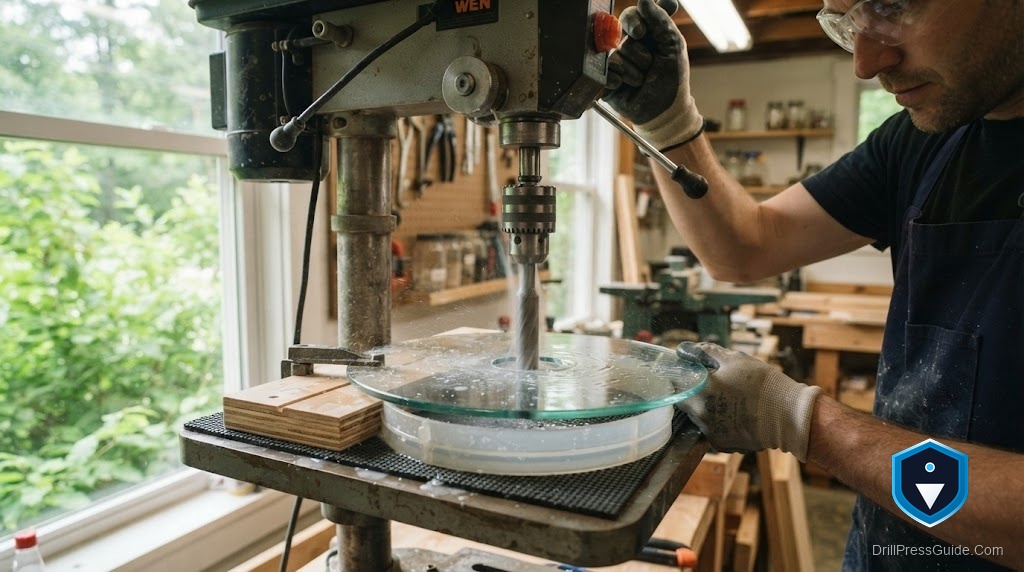
Cutting a hole in glass with a drill press means grinding through the glass with a diamond bit or diamond hole saw while keeping the cut wet, using the press for a square, controlled feed. For larger holes especially, a diamond hole saw grinds only a ring, which removes less glass and builds less heat than grinding out a solid hole.
The short answer to what to check first: confirm you have a diamond bit or hole saw, water at the cut, full support under the glass, and a way to keep the piece from moving, then run a moderate speed and feed with almost no pressure. Heat and stress crack glass, and every item on that checklist is there to control one or the other.
Why preparation decides the outcome
Glass fails from two things: heat and mechanical stress. Grinding builds heat fast, and an unsupported or clamped-wrong pane concentrates stress until it cracks. Almost everything that goes wrong traces back to setup, not to the moment of drilling. That is why the checklist matters more than a steady hand.
Drilling glass is grinding, not cutting. A diamond bit wears away the glass with fine grit while water cools the point and flushes the slurry. There are no cutting edges, so force does not speed it up; force only builds heat and stress, which is to say force is what breaks glass. The whole job is to remove heat and stress from the equation before and during the cut.
The pre-flight checklist
Run through these before the machine turns. First, the right bit: a diamond bit for small holes, or a diamond-coated hole saw (core bit) for larger ones, never a twist bit, which cannot cut glass and will only crack it.
Second, water at the cut: a clay or putty dam around the mark holding a puddle, or a steady drip, so the contact point is wet from the first second. Third, full support: the glass resting flat on a slightly soft backing like wood or rubber, with no gaps under it, so it cannot flex and so the bit exits into support. Fourth, the piece secured so it cannot slide or, for a bottle, roll, using a cradle or gentle clamp that does not itself stress the glass. Fifth, eye protection and a moderate speed set on the press. If any item is missing, stop and fix it; that missing item is the one that cracks the glass.
Cutting the hole
With the checklist done, the drilling is deliberately gentle. Start so the bit does not skate: for a solid diamond bit, begin at a slight angle to grind a small notch, then bring it upright; for a hole saw, a template or guide ring keeps the larger diameter from wandering at the start. Keep the cut flooded the entire time, lifting every few seconds to let water flood back in and to keep heat from building.
Feed with almost no pressure. Let the diamond grind at its own pace, and resist the urge to push, because pushing is what cracks glass. A hole saw needs the same patience: it grinds a ring and leaves a disc, which is why it generates less heat than a solid bit on a large hole, but it still must stay wet and unforced. As the bit or saw nears the far side, ease off even more, because breakthrough is where glass most wants to chip. Let it grind through on its own.
Solid diamond bit versus diamond hole saw
The choice is really about hole size. A solid diamond bit is simplest for small holes, a stringing hole, a small fitting, and starts easily. A diamond hole saw is the tool for larger openings, because grinding out a big solid hole builds far more heat than cutting a thin ring and popping out the disc. The trade is that a hole saw’s larger diameter is more prone to skating at the start, so it needs a guide, and it must be kept wet across its whole cutting rim. For small holes the solid bit wins on simplicity; for anything large the hole saw wins by removing less material and staying cooler. Both fail the same way if the cut goes dry or the feed gets heavy.
The bottom line
Cutting holes in glass with a drill press is a preparation job wearing a drilling costume. Check the list, diamond bit or hole saw, water at the cut, full support, a secured piece, moderate speed, before you start, then feed with a feather touch and keep everything wet and cool. Choose a solid bit for small holes and a hole saw for large ones. Do the setup properly and the drilling is slow, wet, and uneventful, which with glass is the definition of success.
- Most cracks come from setup, not drilling; run the checklist before switching on.
- Use a diamond bit for small holes, a diamond hole saw for large ones, never a twist bit.
- Keep the cut wet the whole time and support the glass fully underneath.
- Feed with almost no pressure and ease off further at breakthrough.
The careful setup does the hard part. The bit just grinds, slowly and wet, the way glass demands.
Frequently asked questions
What do I need to cut a hole in glass with a drill press? A diamond bit or diamond hole saw, water at the cut, a soft flat backing that fully supports the glass, a way to keep the piece from moving, and eye protection. A moderate spindle speed and a very light feed complete the setup.
Should I use a diamond bit or a hole saw for glass? A solid diamond bit for small holes, and a diamond-coated hole saw for larger ones. The hole saw grinds only a ring, removing less glass and building less heat than grinding out a large solid hole, which reduces cracking.
Why does glass crack when I drill it? From heat or mechanical stress, almost always traceable to setup: a dry cut, poor support, a piece that shifted, or too much pressure. Keep it wet, support it fully, secure it, and feed gently to avoid both.
How fast should the drill press run for glass? A moderate speed, not high. Too much speed builds heat the water cannot carry away. A steady moderate speed with constant water and a light feed lets the diamond grind cleanly and cool.
Do I have to keep the glass wet the whole time? Yes. Water cools the contact point and washes away the ground-glass slurry. A diamond bit run dry overheats, glazes, and cracks the glass quickly. Use a clay dam to hold a puddle or set up a steady drip.
How do I stop a hole saw from skating on glass at the start? Use a template or guide ring so the saw’s rim cannot wander across the smooth surface, and start gently with water already flooding the cut. Once it grinds a shallow groove, it tracks and you can continue.
References
- Corning Museum of Glass, glass working resources: https://www.cmog.org/
- Bullseye Glass, working with glass guidance: https://www.bullseyeglass.com/
- OSHA, machine guarding and point-of-operation safety: https://www.osha.gov/machine-guarding