
How to Use a Drill Press as a Metal Lathe: Setup, Checks, and Common Mistakes
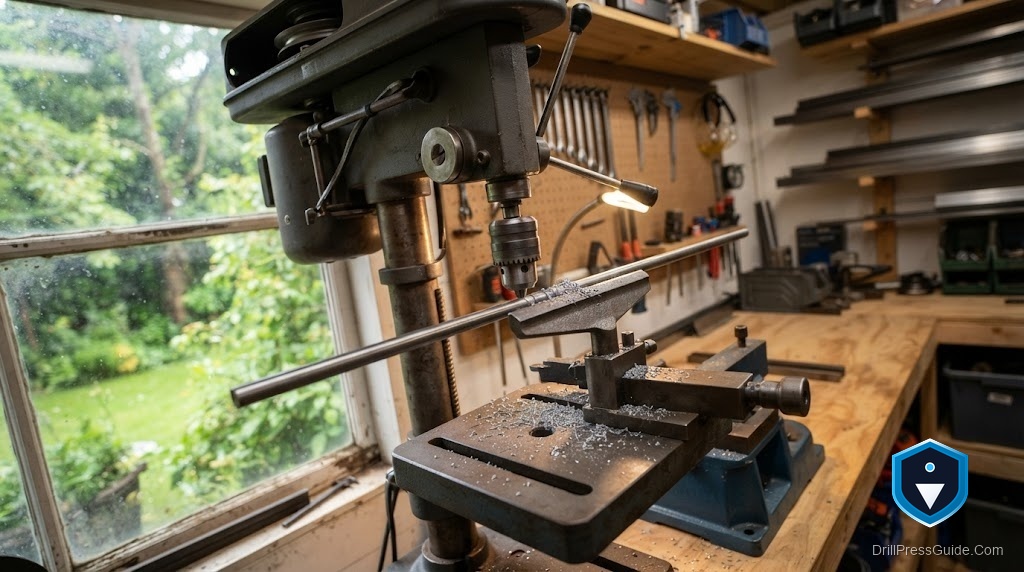
The idea is seductive: a drill press already spins a workpiece, so surely with the right vise and a tool holder it can turn metal like a lathe. Videos make it look plausible. Then you actually try to face the end of a steel rod, feel the whole head shudder, and watch the tool chatter a spiral of scratches instead of a smooth cut. Using a drill press as a metal lathe is possible only inside a very narrow lane, and the difference between the light work it can do and the turning it cannot comes down to how the two machines are built. Knowing that line protects your press and your fingers.
Using a drill press as a metal lathe means chucking a workpiece in the spindle and presenting a cutting tool to it to turn, face, or shape the rotating metal, rather than drilling a hole. The catch is that a drill press spins its tool, not its work, and its spindle is built for downward thrust, not the sideways cutting loads that turning creates.
The honest answer up front: a drill press can do only the lightest turning-style work, sanding, polishing, deburring a rotating part, and the tiniest cleanup cuts on soft metal, and it cannot replace a metal lathe for real turning. The spindle bearings and quill are not designed for radial cutting loads, and pushing them there is how presses die. If you need to turn metal, a small metal lathe is the correct tool.
Why a drill press is not a lathe
The two machines are built around opposite loads. A metal lathe rotates the workpiece in a heavy, rigid headstock designed to take sideways cutting force, and it moves the tool along the work on a solid carriage and tool rest. Everything about it resists the radial load that turning creates.
A drill press does the reverse. It rotates the tool in a spindle whose bearings are set up for downward thrust, and its quill slides in a sleeve so it can plunge, a fit with a little play. Present a cutting tool to a workpiece spinning in a drill press and that force pushes sideways on bearings and quill that were never meant to take it. The result is chatter, a poor finish, rapid bearing wear, and a real risk of the work coming loose. This is not a tuning problem; it is a design mismatch.
What is genuinely possible
Inside the limits, a few operations are fine because they do not load the spindle sideways much. You can chuck a rotating part and sand or polish it, holding abrasive to the turning metal, which is a light radial load the machine tolerates. You can deburr the end of a rod or knock down a sharp edge. You can take the lightest cleanup cut on soft metal like aluminum or brass with a hand-held or rested tool, measured in thousandths, purely to true a surface.
The rules that keep even this safe are strict. Chuck the work solidly and check it cannot slip, because a workpiece thrown from a spinning chuck is dangerous. Support the cutting tool against something rigid rather than holding it loose in your hands, so it cannot dig in and grab. Run a low speed. Take feather-light cuts, never a real depth. And keep fingers and loose clothing well clear of the rotating work and chuck. If the tool ever grabs or the work shifts, stop immediately; that is the machine telling you the load is too high.
The one accessory that helps, and its limit
A compound vise gives you controlled tool positioning, which is the only way to present a tool with any precision. A cross-slide compound vise moves in two axes so you can advance a tool into rotating work by small, measured amounts, which makes the lightest cleanup cuts controllable. Its honest and central limit is that it adds positioning, not rigidity: it does not turn the drill press spindle into a lathe headstock, so the cuts still must stay tiny and the sideways load still wears the bearings. Use it for careful positioning of a light tool, and skip any notion that it converts the press into a lathe. Against a lathe’s solid carriage and tool post, it is a stopgap, not a substitute.
Rigging the press versus buying a lathe
Here is the honest math. Rigging a drill press for turning, with a compound vise and a tool holder, costs something and delivers only feather-light work with a mediocre finish and accelerating wear on your press. A small benchtop metal lathe has the horizontal spindle, heavy bearings, tailstock, and tool rest that turning actually needs, and it will do in minutes, cleanly and safely, what a rigged press does badly in an hour if at all. The money and time spent forcing the press into turning usually approaches the cost of an entry-level lathe, and you still have a worn drill press at the end. For anything past sanding and deburring, the lathe is both the better and the cheaper answer over time.
The bottom line
Using a drill press as a metal lathe works only for sanding, polishing, deburring, and the tiniest cleanup cuts on soft metal, all with the work chucked solidly, the tool supported, the speed low, and the cuts feather-light. It cannot turn metal the way a lathe does, because its spindle is built for downward thrust, not sideways cutting. Use the press for the light rotating jobs it can handle, and buy a small lathe the moment you need real turning.
- A drill press spindle takes downward thrust, not the sideways loads turning creates.
- Only sanding, polishing, deburring, and whisper-light cleanup cuts are genuinely safe.
- Chuck the work solidly, support the tool, run low speed, and stop if anything grabs.
- For real turning, a benchtop metal lathe is the correct, safer, and cheaper long-term tool.
The press that spins a tool beautifully is not the machine that turns a shaft. Respecting that keeps the press alive and your hands intact.
Frequently asked questions
Can you use a drill press as a metal lathe? Only for very light work: sanding, polishing, deburring a rotating part, and tiny cleanup cuts on soft metal. A drill press spindle is built for downward thrust, not the sideways cutting loads real turning creates, so it cannot replace a lathe.
Why can’t a drill press turn metal like a lathe? Its bearings are designed for thrust down the spindle axis, and its quill slides with some play. Turning applies sideways force those parts were not built for, causing chatter, poor finish, rapid wear, and a risk of the work coming loose.
What light turning work can a drill press do safely? Holding abrasive to a rotating part for sanding or polishing, deburring an edge, and taking feather-light cleanup cuts on aluminum or brass with a supported tool. All at low speed, with the work chucked solidly and cuts kept tiny.
Does a cross-slide vise turn my press into a lathe? No. It adds two-axis tool positioning, which helps present a light tool precisely, but it adds no rigidity. The spindle still is not built for turning loads, so cuts must stay tiny and wear still accumulates.
Is it dangerous to turn metal on a drill press? It can be. A workpiece thrown from a spinning chuck or a tool that grabs are real hazards. Chuck the work solidly, support the tool rigidly, keep fingers and clothing clear, run low speed, and stop immediately if anything shifts.
When should I just buy a metal lathe? As soon as you need to turn a shaft, cut a taper, thread, or take real material off. A small benchtop lathe does that safely and quickly, and its cost is close to what you would spend rigging and wearing out a drill press.
References
- Carbide Depot, machining speeds and feeds formulas: https://www.carbidedepot.com/formulas-drills-speeds.htm
- Viking Drill and Tool, feed and speed reference: http://www.vikingdrill.com/viking-Drill-FeedandSpeed.php
- OSHA, machine guarding and point-of-operation safety: https://www.osha.gov/machine-guarding


