
How to Drill a Straight Hole Into Metal Without a Drill Press: A Clear, Shop-Ready Method
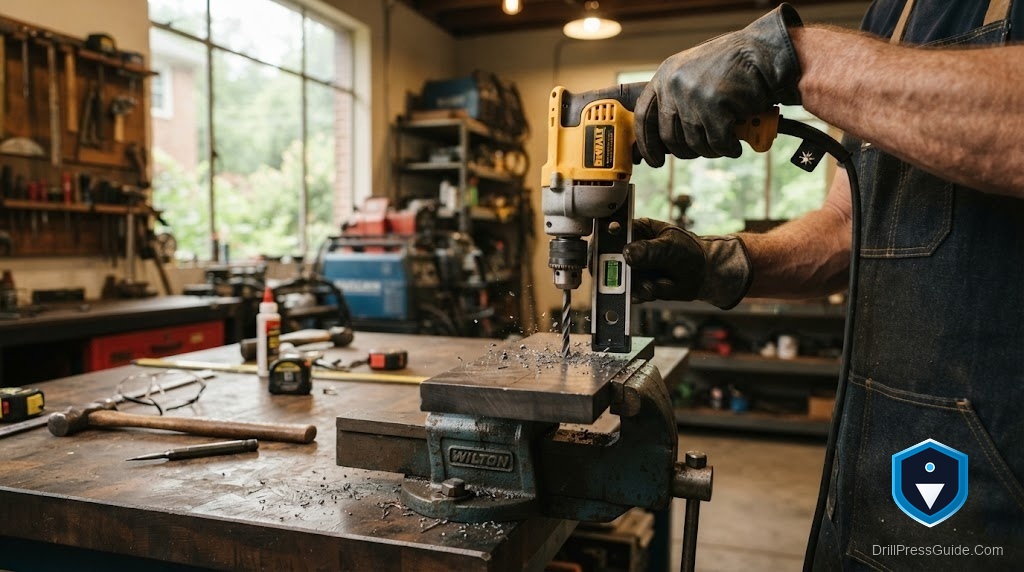
There is a particular frustration to drilling metal by hand: you line the bit up carefully, squeeze the trigger, and the hole comes out leaning, oversize, or wandering off the mark because the bit skated before it bit. On wood you can often fudge it. On steel a crooked hole means a bolt that binds, a part that will not seat, or a tapped thread that strips. Drilling a straight hole into metal without a drill press is a solvable problem, but it takes more than a steady hand. It takes a guide, a proper start, and technique that keeps the bit from wandering in a material that fights back.
Drilling a straight hole into metal without a drill press means using a portable guide or a careful setup to keep a handheld drill perpendicular and on-center while boring into steel, aluminum, or other metal. Because metal is hard and grabs, the start and the angle matter even more than they do in wood.
The short answer: center-punch the mark so the bit cannot walk, use a portable drill guide to hold the bit square, run the correct low speed with cutting fluid, and feed steadily. A punch and a guide replace the two things a press gives you, an exact start and a true vertical, which is what a straight hole in metal requires.
Why metal makes a straight hole harder
Metal punishes every weakness of handheld drilling. A smooth steel surface offers nothing for the bit to bite, so it skates away from the mark at the start. The material is hard, so the bit needs real pressure, and pressure applied at even a slight angle pushes the hole off true. And metal grabs at breakthrough, snatching the drill and twisting it just as the hole finishes, which throws the angle off right at the end.
A drill press beats all of this with rigidity and a square, controlled descent. Without one, you have to recreate those conditions. That means giving the bit a defined starting point it cannot escape, constraining its angle so your wrist is not the only thing keeping it vertical, and controlling speed and feed so the bit cuts instead of skating and grabbing.
Start it right: the center punch
The single most important step in metal is the center punch, and it costs nothing. Set the punch on your marked center and strike it once to make a small cone-shaped divot. That divot gives the drill tip a place to sit so it cannot wander at the start, which is where most crooked metal holes go wrong.
For larger holes, drill a small pilot hole first. A small bit started in the punch mark makes an accurate guide hole, and the larger bit then follows it exactly instead of skating on the flat. This two-step start, punch then pilot, does more for accuracy in metal than any amount of careful aiming, because it removes the skating problem entirely before the real hole begins.
Constrain the angle: guides and blocks
With the start fixed, the remaining job is keeping the bit vertical, and that is where a guide earns its place. A portable drill guide clamps the drill into a frame that only travels straight down, so the angle is set by the tool, not your wrist.
The Big Gator Tools V-DrillGuide is a pocket-sized steel block with graduated holes and a V-groove underneath, and you simply hold it on the work and drill through the correct-size hole to keep the bit square, on flat stock, round bar, or a corner. Its honest limit is that it guides the bit’s angle but does not feed it, so you still control speed and pressure by hand, and it only covers the bit sizes machined into it. Skip it if you need holes larger than its biggest guide hole. For straight holes up to that size, it is close to foolproof and it fits in a pocket. The smaller Big Gator SDGMINI mini V-Drill Guide covers finer sizes for small work. For a guide that also constrains depth and handles angles, the Milescraft 1318 DrillMate clamps the whole drill into a spring-loaded frame, though it is bulkier than a pocket block.
Speed, fluid, and feed
A guide keeps the hole straight, but speed and feed keep it clean and keep the bit alive. Metal wants low speed: match RPM to the material and bit size, with steel and stainless running slow and aluminum faster. Too much speed overheats the bit, and in stainless it work-hardens the surface so the bit stops cutting.
Use cutting fluid on anything ferrous to carry heat away and extend the bit’s life. Feed steadily, with enough pressure to keep the bit cutting a chip rather than rubbing, but not so much that you force the angle off. And ease off as the bit nears breakthrough so it does not grab and twist the drill at the last moment. Clamp the workpiece down, because a hand-held part in one hand and a drill in the other is how metal spins into a blade.
Guide block versus clamped drill guide
Two approaches, two strengths. A pocket guide block like the Big Gator sets the angle instantly, goes anywhere, and costs little, but it does not control depth or feed, so your hand still does the drilling. A clamped drill-guide frame constrains angle and depth and often handles set angles, giving more press-like control, at the cost of setup time and bulk. For quick straight holes in the field, the block wins on speed and portability. For repeated holes where depth also matters, the clamped guide wins on control. Either beats freehand, and both depend on the center punch to fix the start.
The bottom line
Drilling a straight hole into metal without a drill press is a matter of removing the three things that go wrong: a walking start, a wrong angle, and a grab at breakthrough. Center-punch the mark, use a guide block or a clamped guide to hold the bit square, drill a pilot for larger holes, run low speed with cutting fluid, and ease off at the end. Do that and a handheld drill puts a straight, on-size hole through metal that a bolt will seat in cleanly.
- Always center-punch metal first; the divot stops the bit walking at the start.
- Use a portable guide block or clamped guide to hold the bit perpendicular.
- Drill a pilot hole for larger sizes so the big bit follows instead of skating.
- Run low speed with cutting fluid, feed steadily, and ease off at breakthrough.
The press gives you an exact start and a true angle for free. A punch and a guide buy you both by hand.
Frequently asked questions
How do you drill a straight hole in metal without a drill press? Center-punch the mark, use a portable drill guide to hold the bit perpendicular, drill a pilot hole for larger sizes, and run the correct low speed with cutting fluid, feeding steadily. The guide and punch replace the press’s square, controlled descent.
Why does my drill bit wander on metal? A smooth metal surface gives the bit nothing to bite, so it skates before it cuts. A center-punch divot fixes this by giving the tip a defined place to start, and a guide keeps it from wandering as it enters.
Do I need a center punch for metal? Yes, it is the most important step. One strike makes a cone-shaped divot that seats the bit tip so it cannot walk. Skipping it is the main reason handheld metal holes end up off the mark.
What is a V-drill guide? A small steel block with graduated guide holes and a V-groove base. You hold it on the work and drill through the correct-size hole, and it keeps the bit square on flat stock, round bar, or a corner without a press.
What speed should I use drilling metal by hand? Low for steel and stainless, faster for aluminum, matched to the bit size. Too much speed overheats the bit and, in stainless, work-hardens the surface. Use cutting fluid on ferrous metal and feed steadily.
How do I stop the drill grabbing at breakthrough? Ease off the pressure as the bit nears the far side so it does not snatch through, and clamp the workpiece so a grab cannot spin it. Reducing feed at the end keeps the drill from twisting out of square.
References
- Norseman Drill and Tool, drilling feeds and speeds chart: http://www.norsemandrill.com/feeds-speeds-drill.php
- Carbide Depot, drill speeds and feeds formulas: https://www.carbidedepot.com/formulas-drills-speeds.htm
- OSHA, machine guarding and point-of-operation safety: https://www.osha.gov/machine-guarding


