
How to Drill Precision Holes in Wood Without a Drill Press: What to Check Before You Start
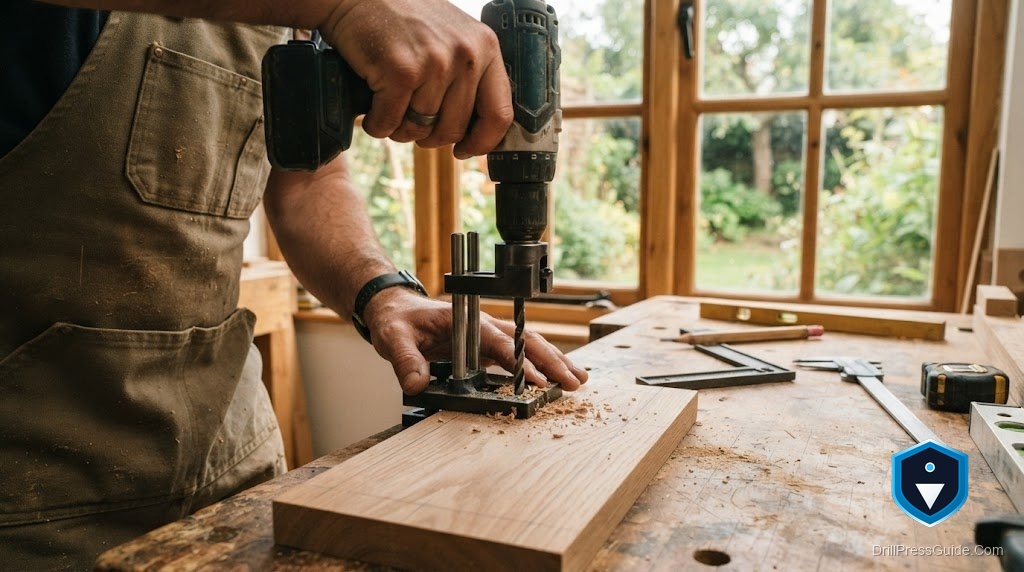
Not everyone has room for a drill press, and plenty of good work happens without one. The problem is that a handheld drill wants to wander: the bit walks off the mark, tips a few degrees, and the hole that was supposed to be square comes out leaning, so the shelf pin sits proud or the dowel joint refuses to close. Drilling precision holes in wood without a drill press is entirely possible, but it depends on borrowing the two things a press gives you for free, a square starting angle and a controlled depth, from a guide or a jig instead.
Drilling precision holes in wood without a drill press means using a portable guide, a jig, or a careful setup to keep a handheld drill square, on-center, and to the right depth. The tools stand in for the press’s rigidity and vertical alignment, which is what makes a hole accurate.
The short answer to how: use a portable drill guide or a self-centering dowel jig to hold the bit square, mark and start the hole with a punch or a brad-point bit so it does not walk, and set a depth stop so every hole matches. Precision without a press comes from the guide, not from a steady hand alone.
Why a handheld drill wanders
A drill press is accurate because it holds the bit rigidly perpendicular and pushes it straight down. A handheld drill has neither advantage. Your wrist sets the angle, and the eye is a poor judge of true vertical, so most freehand holes lean a few degrees without you noticing. The bit also tends to skate at the start on a smooth surface, walking away from the mark before it bites.
Those two failures, wrong angle and a walking start, are what a guide fixes. Get the bit to start exactly on the mark and to travel straight down, and a handheld drill produces holes nearly as clean as a press. The whole strategy for precision without a press is to remove the guesswork from angle and starting point.
Portable drill guides
A portable drill guide is the closest thing to a press you can hold in your hand. It clamps your drill into a frame with vertical posts and a spring return, so the bit can only travel straight down, and most have an adjustable base for angled holes and a depth stop.
The Milescraft 1318 DrillMate portable drill guide accepts a hand drill with a 3/8-inch chuck, drills straight or at set angles, and has a V-groove base that centers on round stock, which is genuinely hard to do freehand. Its honest flaw is that it is a mix of steel and plastic and is only as accurate as your setup, so it will not match a rigid press over many precise holes, and heavy use eventually shows in the plastic. Skip it if you need production-grade repeatability. For occasional accurate holes where a press will not fit or does not exist, it is the single most useful tool you can own, because it turns a wandering drill into a guided one.
Self-centering dowel jigs
When the precision you need is a dowel joint, a self-centering dowel jig is often better than a general guide, because it solves centering and squareness at once. Its jaws close on the workpiece and automatically place the drill bushing dead center on the edge, and hardened bushings keep the bit perfectly square as it enters.
The ELEON self-centering dowel jig clamps onto stock of varying widths and centers the hole without measuring, with bushings for common dowel sizes. Its honest limit is that it is built for edge and face dowel holes, not for holes anywhere on a panel, so it is a specialist rather than a do-everything guide. Skip it if your holes are not dowel joints. Where it fits, it is faster and more repeatable than a general guide, because the centering is automatic. The Milescraft 1334 Joint Master doweling jig is a self-clamping alternative that handles edge, corner, and surface joints, useful when your joinery goes beyond simple edge dowels, though its extra adjustability means a little more setup per joint.
Guide, jig, or careful freehand
There is a real hierarchy here. A portable drill guide is the most versatile: any hole, any angle, on-center on round or flat stock, at the cost of setup per hole. A dowel jig is the most repeatable for its narrow job, centering dowel holes automatically, but it does only that. Careful freehand, using a punch, a brad-point bit, and a square stood beside the bit as a sightline, is the cheapest and works for rough or forgiving holes, but it will never match a guide for consistency. Choose by the job: guide for general precision, dowel jig for joinery, freehand only where a small error will not matter.
The bottom line
Drilling precision holes in wood without a drill press comes down to borrowing the press’s two gifts, a square angle and a controlled start, from a guide or a jig. A portable drill guide handles general accurate holes, a self-centering dowel jig nails repeatable joinery, and careful freehand covers the forgiving jobs. Add a punch to stop the bit walking and a depth stop to match every hole, and the absence of a press stops showing in the work.
- A handheld drill wanders in angle and at the start; guides and jigs fix both.
- Use a portable drill guide for general accurate holes at any angle.
- Use a self-centering dowel jig for repeatable, automatically centered joinery.
- Start every hole with a punch or brad-point bit and set a depth stop for consistency.
Precision does not require the press. It requires taking the guesswork out of angle and start, which a good guide does for you.
Frequently asked questions
Can you drill accurate holes in wood without a drill press? Yes. A portable drill guide holds a handheld drill square and lets it travel straight down, and a self-centering dowel jig centers and squares dowel holes automatically. Both give accuracy close to a press for their jobs.
What is a portable drill guide? A frame that clamps your drill and constrains the bit to travel straight down on vertical posts, usually with an adjustable base for angled holes and a depth stop. It brings press-like squareness to a handheld drill.
How do I keep a drill bit from wandering at the start? Mark the center with an awl or punch to make a small divot, or use a brad-point bit whose center spur bites first. Either gives the bit a place to start so it cannot skate across the surface.
How do I drill a hole to a consistent depth without a press? Use the depth stop on a drill guide, a stop collar on the bit, or a piece of tape wrapped at the target depth. A physical stop makes every hole match without judging depth by eye.
Is a dowel jig better than a drill guide? For dowel joints, usually yes, because it centers and squares the hole automatically without measuring. For general holes anywhere on a workpiece, a portable drill guide is more versatile since it is not limited to edges.
Can I drill straight into round stock without a press? Yes, with a drill guide that has a V-groove base, which cradles the round piece and centers the bit so it does not roll off the crown. Freehand on round stock is very hard to keep on-center.
References
- WOOD Magazine, favorite doweling jigs and technique: https://www.woodmagazine.com/tool-reviews/our-favorite-doweling-jigs
- Fine Woodworking, drill bit speed chart (PDF): https://images.finewoodworking.com/app/uploads/2020/01/22111726/drill-bit-speed-chart.pdf
- OSHA, machine guarding and point-of-operation safety: https://www.osha.gov/machine-guarding


