
Drill Press Speed for Wood: The Bit and Support Choices That Change the Result
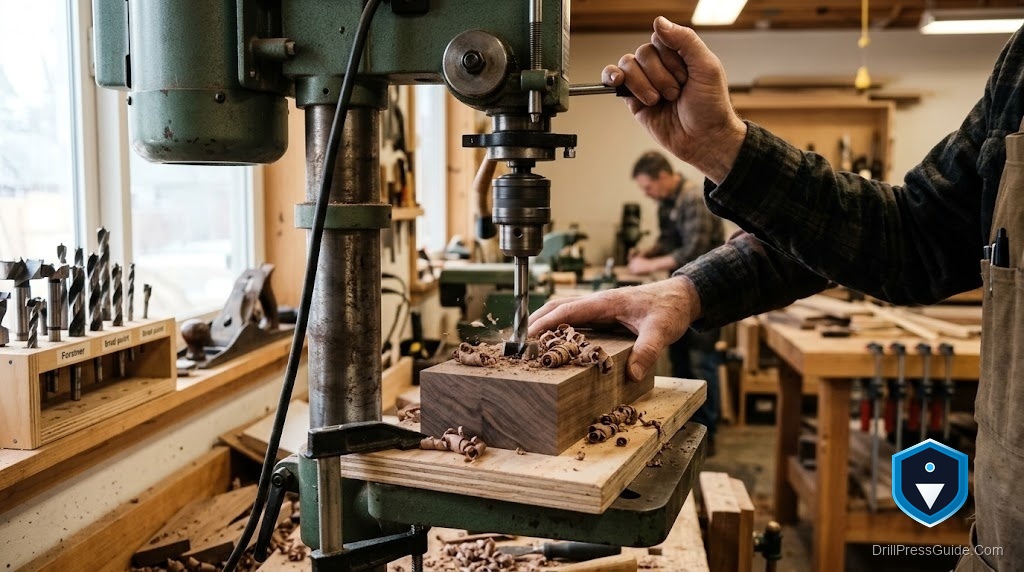
A drill press turns woodworking projects from fiddly to precise, but only if the speed and the setup match the job in front of you. Boring shelf-pin rows, hinge cups, and dowel joints each want a different speed and a different kind of support, and the project usually tells you what it needs before the bit does. Drill press speed for wood is best learned by the work you are doing, not by memorizing a lone number.
Drill press speed for wood is the spindle speed that cuts wood cleanly without burning or tearing, driven by the bit’s type and diameter. Small bits run fast, large bits run slow, and the support you add, backer boards, fences, and clamps, decides whether the result is furniture-grade.
The short answer: small twist and brad-point bits near 3000 RPM, mid brad points around 1500 to 2000, and large Forstner bits and hole saws down near 250 to 700. Then back up the exit and clamp or fence the work so every hole lands clean and in the right place.
Speed, matched to the bit
Wood speed follows bit size closely. Fine Woodworking’s speed chart runs small twist bits around 3000 RPM and slows steadily as diameter grows, with large Forstner bits slowest of all. The reason is rim speed: a wide bit’s edge travels fast at any RPM and scorches unless you slow the spindle, while a tiny bit needs high RPM just to cut.
Hold three anchors in your head and you rarely need the chart: small bits fast, one-inch Forstner bits medium, two-inch and larger Forstner bits slow. In dense hardwoods, favor the lower end to avoid burning.
Let the project guide the setup
Shelf-pin and dowel rows. These live and die by repeatability. Set a fence and a stop block so every hole sits the same distance from the edge and the same depth. A brad-point bit at moderate to high speed places each hole exactly.
Hinge cups and flat-bottom holes. A Forstner bit at low speed cuts the clean, flat bottom a hinge needs. Peck to clear chips and keep the speed down so the wide rim does not scorch.
Through-holes in a panel or shelf. Back the exit with a sacrificial board so the underside does not blow out, and clamp the panel so it cannot spin when the bit exits.
Angled or overlapping holes. Forstner bits handle these better than any other, because the rim registers the cut. Start flat to score the circle, then ease into the angle.
The machine that fits wood projects
Because wood spans a wide speed range, variable speed is a genuine convenience for project work. The WEN 4214T 12-inch variable-speed press lets you swing from a small brad point to a large Forstner bit with a lever and confirms the speed on its display, which suits a shop that jumps between tasks. A simpler SKIL 10-inch five-speed press covers most project work by picking the nearest belt step; its steady induction motor holds speed through hardwood.
Sharp bits make the speed forgiving. A Forstner set with carbide tips cuts cool, flat bottoms across the sizes most furniture and cabinet projects use, and a sharp edge shrugs off a small speed error that a dull one turns into a scorch mark.
Support and safety on every hole
Clamp the work or hold it against a fence; never pinch a small part in your fingers, because a grabbing bit can spin it into a hazard. Back up through-holes with scrap, peck deep and large holes to clear chips, and let the bit reach speed before it touches the wood. Wear eye protection and keep hands clear of the point of operation. These habits are what separate a clean project from a torn one and a safe shop from a trip to urgent care.
The verdict
Drill press speed for wood is simple once you let the project lead: fast for small bits, slow for large, and always with the right support for the hole you are cutting. Match speed to the bit, back up the exit, and fence or clamp the work, and shelf pins, hinge cups, and dowels all come out clean.
Carry these forward:
- Bit size sets the speed: small fast, large slow, wide Forstner bits slowest.
- Let the project pick the setup, a fence for rows, a backer for through-holes.
- Sharp bits forgive small speed errors; dull ones burn.
- Clamp or fence every part and back up the exit for clean, safe holes.
Frequently asked questions
What speed for drilling wood on a drill press? Match it to the bit: small bits near 3000 RPM, mid brad points 1500 to 2000, and large Forstner bits 250 to 500.
How do I stop the wood from burning? Slow down for large bits, use a sharp bit, and keep it feeding instead of dwelling. Hardwoods burn easily, so favor lower speeds.
How do I drill a row of evenly spaced holes? Set a fence to fix the distance from the edge and a stop block to fix the position, then index the workpiece against them for each hole.
What bit gives a flat-bottomed hole? A Forstner bit at low speed. It cuts a clean, flat bottom that hinge cups and plugs need.
How do I prevent tear-out on the back side? Clamp a sacrificial backer board under the piece so the bit exits into wood rather than air.
Do I need variable speed for woodworking? It is convenient because wood bits span a wide speed range, but a five-speed belt machine covers project work if its steps reach both high and low enough.
References
- Fine Woodworking, Drill Press Speed Chart: https://images.finewoodworking.com/app/uploads/2020/01/22111726/drill-bit-speed-chart.pdf
- WOOD Magazine, Wise Buys: Drill-Press Tables: https://www.woodmagazine.com/woodworking-tools/reviews/drill/drill-press-tables


