
A Practical Guide to Drill Press Speed for Steel
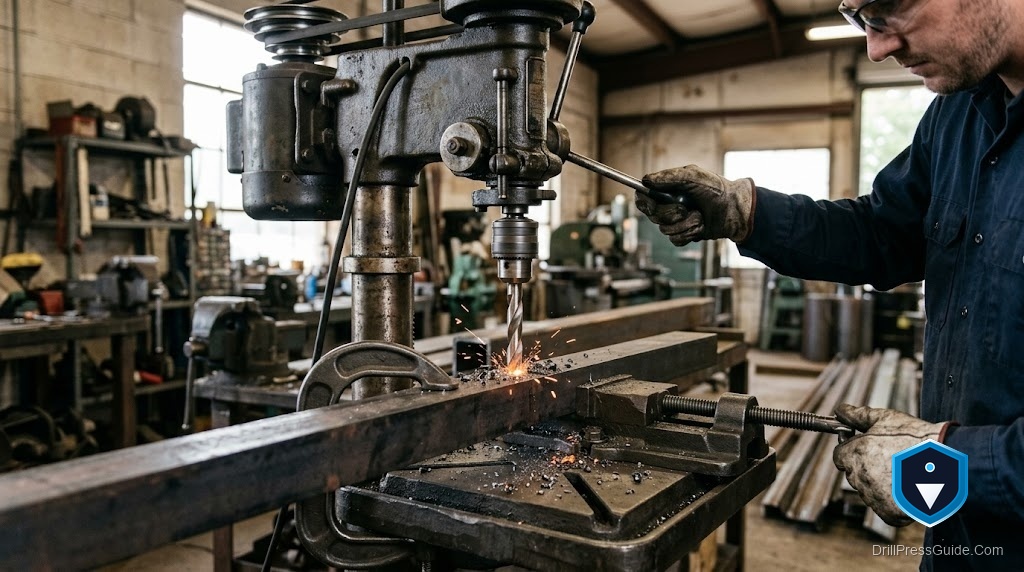
The thickness of the steel changes everything, and almost no one tells beginners that. The speed that drills a clean hole in thin 1/8-inch flat bar will cook a bit halfway through a 1/2-inch block, because the thicker the steel, the longer the bit lives in the heat and the harder the chips are to clear. Drill press speed for steel starts with the grade and the bit size, but thickness is the quiet third factor that decides whether the hole finishes clean.
Drill press speed for steel is the spindle speed that cuts steel without overheating, set by the steel’s grade, the bit diameter, and how deep the hole runs. Mild steel takes moderate speed, stainless takes slow speed, and thick sections need slower feeds and chip clearing regardless of grade.
The short answer: mild steel around 80 to 100 SFM, stainless 20 to 40, converted to RPM by bit size. A 1/4-inch bit lands near 1400 RPM in mild steel and 460 in stainless. For thick steel, keep the speed the same but slow the feed, peck to clear chips, and use plenty of fluid.
Grade and bit size set the base speed
Start where every steel job starts: RPM = (SFM x 3.82) / diameter. Mild steel at 90 SFM gives roughly 2750 RPM for a 1/8-inch bit, 1375 for 1/4-inch, and 690 for 1/2-inch. Stainless at 30 SFM drops those to about 915, 460, and 230. Set the closest speed at or below the target on your machine.
That base speed does not change with thickness. What changes is how you feed and clear, which is where thin and thick steel part ways.
Thickness: the factor charts leave out
Thin steel (up to about 1/8 inch). The bit is barely in the cut, so heat and chips are not a big problem. The bigger risk is grabbing at breakthrough, especially with a twist bit in sheet, which can triangulate the hole. Clamp hard, ease off near the exit, and consider a step bit for sheet.
Medium steel (1/8 to 3/8 inch). The base speed and a steady feed with fluid do the job. Keep the bit cutting a continuous chip and do not let it dwell.
Thick steel (3/8 inch and up). Now heat and chip packing dominate. Keep the base RPM, but slow the feed, peck to lift chips out, and flood the hole with fluid. On holes deeper than about three to four bit diameters, cut speed and feed by roughly half. Drilling a pilot hole first lets the full-size bit cut without its web rubbing.
The machine has to reach low and stay steady
Thick steel and stainless both want low RPM, so a press that bottoms out too high will fight you. A floor machine like the WEN 4227T 17-inch, 12-speed press reaches 150 RPM and has the mass to resist chatter in heavy plate, which is exactly what large bits in thick steel need. For lighter and mixed work, the variable-speed WEN 4214T 12-inch dials the number precisely, though its lighter build asks for a patient feed on big holes.
Rigidity is not optional in steel. Bolt a floor press down, keep the table square, and clamp the work in a vise so nothing shifts and the hole stays round.
Bit and fluid for steel
Use cobalt once steel gets hard or thick. A cobalt M35 twist drill set survives the heat of a long cut in thick stock and of stainless, where plain HSS glazes. A 135-degree split point self-centers and resists walking, and a center punch starts the hole true. Keep cutting fluid flowing; in thick steel it is the difference between a bit that finishes the hole and one that dies in it.
Clamp the part, wear eye protection, and clear the long, hot chips with a brush. Ease off pressure at breakthrough so the bit does not grab.
The verdict
Drill press speed for steel is set by grade and bit size, but thickness decides the technique: thin steel needs clamping against grab, thick steel needs slow feeds, pecking, and fluid at the same base RPM. Give the machine a low enough speed and the mass to stay steady, run a cobalt bit, and steel of any thickness becomes manageable.
Keep these close:
- Set base RPM from grade and bit size, at or below the target.
- Thickness changes feed and chip clearing, not the base speed.
- Pilot thick holes and peck to clear chips past three to four diameters.
- Cobalt bits, a split point, and steady fluid keep the bit alive in thick or hard steel.
Frequently asked questions
What speed for drilling steel on a drill press? Mild steel around 80 to 100 SFM, so roughly 1375 RPM for a 1/4-inch bit and 690 for a 1/2-inch bit. Stainless runs much slower.
Does steel thickness change the drill speed? The base RPM stays the same, but thick steel needs a slower feed, pecking, and more fluid because heat and chips build up over a longer cut.
How do I drill thick steel without burning the bit? Use a pilot hole, keep the correct RPM, slow the feed, peck to clear chips, and flood with cutting fluid. Cobalt bits help.
Why does thin sheet steel tear or triangulate? A twist bit grabs at breakthrough. Clamp hard, ease off near the exit, and use a step bit for clean holes in sheet.
What speed for stainless steel? Slow, 20 to 40 SFM. A 1/4-inch bit lands near 460 RPM. Keep constant feed so the surface does not work-harden.
Do I need a floor press for thick steel? A rigid floor machine with low speeds helps a lot for big holes in thick stock, but a heavy benchtop can handle occasional work with a pilot hole and patience.
References
- Carbide Depot, HSS Twist Drill Recommended Speeds and Feeds: https://www.carbidedepot.com/formulas-drills-speeds.htm
- Norseman Drill and Tool, Feeds and Speeds for Drills: http://www.norsemandrill.com/feeds-speeds-drill.php
- University of Florida Design and Manufacturing Lab, Speeds and Feeds: https://web.mae.ufl.edu/designlab/Advanced%20Manufacturing/Speeds%20and%20Feeds/Speeds%20and%20Feeds.htm


