
A Practical Guide to Drill Press RPM for Wood
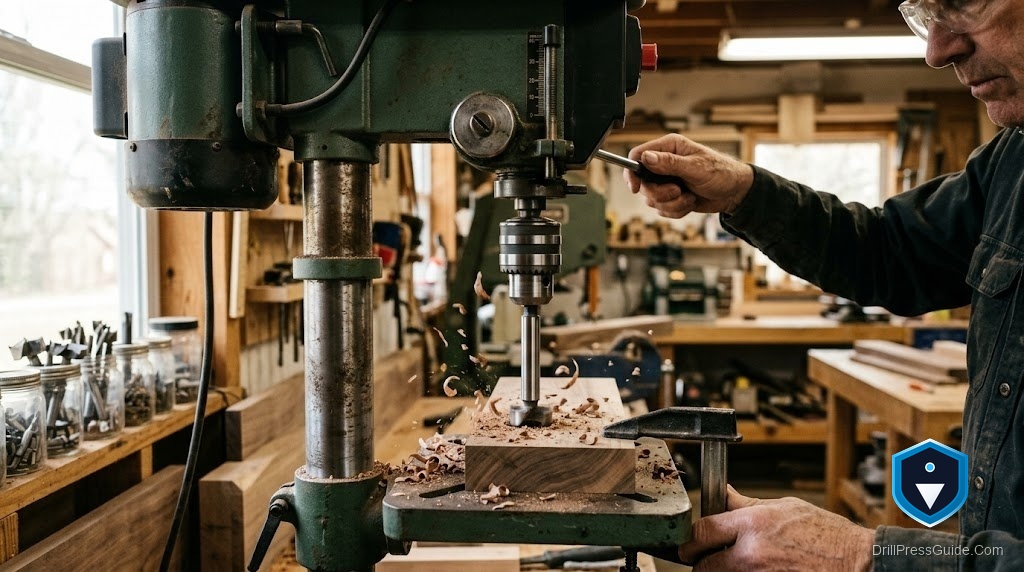
Wood hides its speed mistakes for exactly one second, then shows them all at once: a puff of smoke around a Forstner bit, a scorched ring on maple, a fuzzy blown-out exit. Almost every one of those traces back to spindle speed. Drill press RPM for wood is not one number, it is a sliding scale set by the bit you chose, and once you match the two the machine finally behaves.
Drill press RPM for wood is the spindle speed that lets a given bit cut cleanly without burning or tearing, and it is driven mostly by bit type and diameter. Small bits want high speed, large bits want low speed, and the style of bit shifts the target too.
The short answer: small twist and brad-point bits near 3000 RPM, mid-size brad points and 1-inch Forstner bits around 1500 to 2000 RPM, and large Forstner and hole saws down near 250 to 700 RPM. Slow down as the bit grows, and slow down more for flat-bottom and large bits.
Why bit type sets the speed
Unlike metal, where the material governs, wood speed is mostly about the bit. A tiny twist bit has so little rim speed at its edge that it needs high RPM to cut instead of burnish. A wide Forstner bit has a large rim traveling fast at any given RPM, so it scorches unless you slow the spindle way down. Same wood, opposite settings, purely because of diameter and edge geometry.
Fine Woodworking’s drill press speed chart lays this out clearly: small twist bits sit around 3000 RPM and speeds fall steadily as diameter climbs, with the largest Forstner bits running slowest. Internalize the slope, not the exact cells, and you will rarely be far off.
RPM by bit, at a glance
| Bit | Typical size | Rough RPM |
|---|---|---|
| Twist / brad point | up to 1/4 in | 2500 to 3000 |
| Brad point | 1/4 to 1/2 in | 1500 to 2500 |
| Forstner | up to 1 in | 1500 to 2000 |
| Forstner | 1 to 2 in | 700 to 1200 |
| Forstner | over 2 in | 250 to 500 |
| Spade | 1/2 to 1 in | 1500 to 2000 |
| Hole saw | 1 to 3 in | 300 to 700 |
Hardwoods like maple and cherry burn more easily than softwoods, so favor the lower end of a range in dense stock. If you see smoke or a browned rim, the bit is too fast or dwelling.
The machine that makes this easy
Because wood spans such a wide speed range, variable speed is a real comfort. The WEN 4214T 12-inch variable-speed press lets you drop from a small brad point to a 2-inch Forstner bit with a lever instead of a belt swap, and the readout confirms where you are. On a simpler machine like the SKIL 10-inch five-speed press, just pick the nearest step at or below the target; its 610 RPM low end handles large Forstner bits, though the very biggest bits are happier slower still on a floor machine.
Whatever you run, the bit matters as much as the speed. A quality Forstner set with carbide tips cuts cooler and cleaner than a dull bargain bit, and a sharp edge forgives a small speed error that a dull one turns into a scorch.
Technique that keeps wood clean
Back up the exit with a sacrificial board so the underside does not blow out. Clamp the work or use a fence and stop, both for safety and for repeatable holes. Peck large and deep holes to clear chips, since a packed Forstner bit burns fast. Let the bit reach full speed before it touches the wood, and ease off as it exits. Wear eye protection and keep hands clear of the point of operation, because a grabbing bit can spin a small part.
The verdict
Drill press RPM for wood follows the bit: fast for small, slow for large, slower still for wide flat-bottom bits. Match speed to diameter, keep the bit sharp, back up the exit, and clamp the work, and clean holes stop being luck. When in doubt in hardwood, slow down a notch.
Carry these forward:
- Bit type and diameter set the speed, not the wood species alone.
- Large Forstner bits and hole saws need low RPM to avoid scorching.
- A sacrificial backer board prevents exit blowout.
- A sharp bit forgives small speed errors; a dull one burns.
Frequently asked questions
What RPM should I use for wood on a drill press? It depends on the bit. Small bits near 3000 RPM, mid bits around 1500 to 2000, and large Forstner bits down near 250 to 500.
Why is my drill press burning the wood? Too much speed for the bit size, a dull bit, or dwelling in the cut. Slow down, sharpen, and keep the bit feeding.
What speed for a 2-inch Forstner bit? Slow, around 250 to 500 RPM. Big rims move fast at any RPM and scorch if the spindle is not slowed way down.
Does wood species change the speed? Somewhat. Dense hardwoods burn more easily, so favor the lower end of a bit’s range, while softwoods tolerate a bit more speed.
How do I stop tear-out on the back of the hole? Clamp a sacrificial backer board under the workpiece so the bit exits into wood, not air.
Can I run large bits on a small benchtop press? Yes if it slows down enough and you peck to clear chips. Very large Forstner bits are easier on a machine that reaches low speeds.
References
- Fine Woodworking, Drill Press Speed Chart: https://images.finewoodworking.com/app/uploads/2020/01/22111726/drill-bit-speed-chart.pdf
- WOOD Magazine, Wise Buys: Drill-Press Tables: https://www.woodmagazine.com/woodworking-tools/reviews/drill/drill-press-tables


