Drill Press RPM Chart Metal: The Setup Details That Change the Result
The most useful thing taped to my drill press is not a fancy jig. It is a small card of numbers. Once the correct RPM for a given metal and bit size is a two-second glance instead of a guess, the holes come out round and the bits stop dying. A drill press RPM chart for metal turns a nervous decision into a lookup, and this is that chart, with the setup details that make the numbers actually hold.
A drill press RPM chart for metal converts each metal’s recommended surface speed and your bit diameter into a spindle speed. It exists because surface speed, not RPM, is what a bit truly cares about, and the same RPM is far too fast for a large bit and far too slow for a small one.
The numbers below come straight from the standard relationship RPM = (SFM x 3.82) / diameter in inches, using published surface speeds for high-speed steel bits. Read them as a starting point, then trust your eyes and ears: clean curls of chip and no smoke mean you are close.
Start with surface speed
Drill and tool makers publish surface speeds that agree closely. Carbide Depot and Norseman both list aluminum around 200 to 300 SFM, brass near 150 to 250, copper and bronze about 100 to 200, mild steel near 80 to 100, gray cast iron about 100 to 150, and stainless in the 300 series down at a demanding 20 to 40 SFM.
Those ranges are the input to every number in the chart. Pick a value in the range for your metal, drop it into the formula with your bit size, and you have your RPM. The chart below just does that arithmetic for the common sizes.
The chart: RPM by metal and bit size (HSS)
| Bit size | Aluminum (250 SFM) | Brass (175 SFM) | Mild steel (90 SFM) | Cast iron (100 SFM) | Stainless (30 SFM) |
|---|---|---|---|---|---|
| 1/8 in | 3000+ | 3000+ | 2750 | 3050 | 915 |
| 1/4 in | 3000+ | 2675 | 1375 | 1530 | 460 |
| 3/8 in | 2550 | 1785 | 915 | 1020 | 305 |
| 1/2 in | 1910 | 1340 | 690 | 765 | 230 |
| 5/8 in | 1530 | 1070 | 550 | 610 | 185 |
| 3/4 in | 1275 | 890 | 460 | 510 | 155 |
Where a cell reads 3000+, the math asks for more RPM than most benchtop presses provide, which top out near 3000 to 3600. In those cases run wide open and lean on lubricant and chip clearing instead of chasing the number.
The setup details that make the chart true
A chart only works if the machine backs it up. Set the belt or the variable-speed dial to the closest available speed at or below the target; slightly slow is safe, too fast is not. A variable-speed press such as the WEN 4214T 12-inch with a digital readout lets you land near these numbers exactly, while a five-speed belt machine like the SKIL 10-inch means picking the nearest step, which is fine.
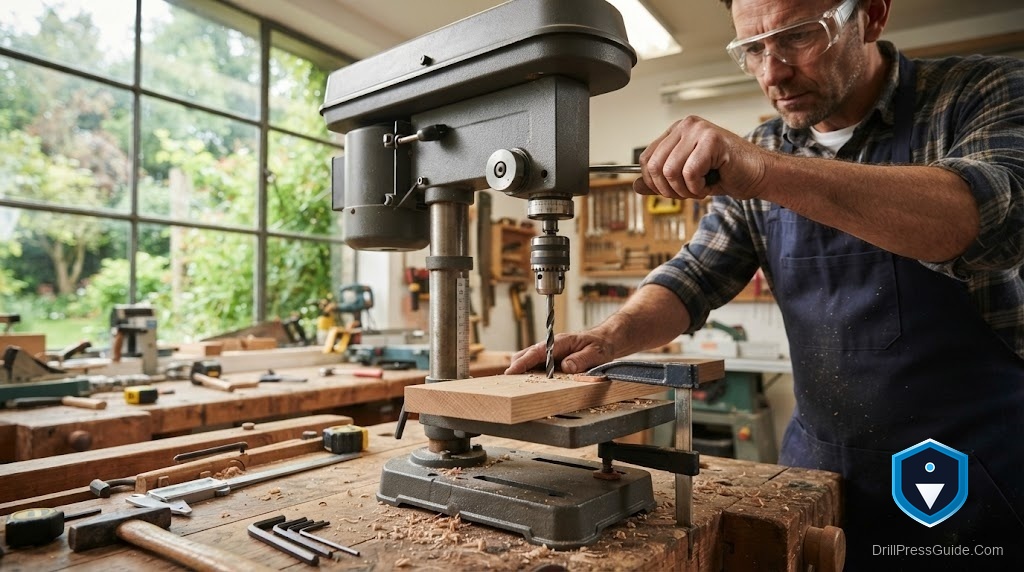
Then the fundamentals. Clamp the part in a vise so it cannot spin. Center-punch the mark and use a split-point cobalt bit for hard metal, since the chart assumes a sharp, well-pointed drill. Add cutting fluid on steel and stainless. Reduce speed and feed by roughly half when a hole runs deeper than about three to four bit diameters, because chips cannot clear and heat builds. A cobalt M35 bit set keeps the edge that makes the numbers repeatable.
Reading the machine, not just the card
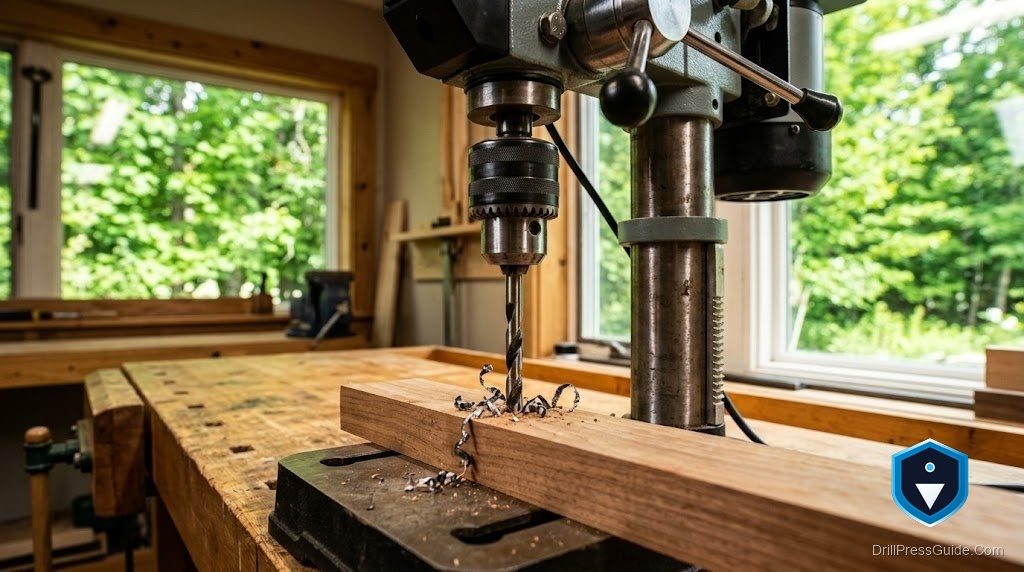
The chart gets you to the right neighborhood; the work tells you the rest. Long, curling chips and a bit that stays cool mean the speed is right. Blue chips, smoke, or a squeal mean slow down. Powder instead of chips in steel usually means the bit is dull or dwelling. Trust those signs over any printed number, because bit sharpness and exact alloy shift the ideal.
The verdict
A drill press RPM chart for metal is the fastest accuracy upgrade in the shop, because it replaces guessing with a glance. Match the closest speed at or below the target, keep the bit sharp and the work clamped, and adjust by what the chips tell you. Print the table, tape it up, and drill.
Keep these handy:
- Set speed at or just below the chart value, never above.
- Small bits and soft metals push past most machines’ top speed; run wide open there.
- Cut speed and feed roughly in half for deep holes past three to four diameters.
- Let chip color and sound fine-tune the setting.
Frequently asked questions
How do I calculate drill press RPM for metal? Use RPM = (SFM x 3.82) / bit diameter in inches. Look up the metal’s surface speed, plug in your bit size, and set the closest speed at or below the result.
What RPM for a 1/2-inch bit in steel? Around 690 RPM for mild steel at 90 SFM. Drop to roughly 230 RPM for stainless.
Why does the chart list speeds my press cannot reach? Small bits in soft metal need very high RPM. Most benchtop presses top out near 3000 to 3600, so run wide open and rely on lubricant and clearing chips.
Is a metric chart different? The idea is identical; only the units change. The metric formula is RPM = (surface speed in m/min x 1000) / (pi x diameter in mm).
Do I set speed for the bit or the metal? Both. The metal sets the surface speed, and the bit diameter converts that into RPM. Bigger bits and harder metals both mean lower RPM.
What RPM for aluminum on a drill press? Aluminum wants high surface speed, so small and mid bits run at the machine’s top speed with lubricant. A 1/2-inch bit lands near 1900 RPM.
References
- Carbide Depot, HSS Twist Drill Recommended Speeds and Feeds: https://www.carbidedepot.com/formulas-drills-speeds.htm
- Norseman Drill and Tool, Feeds and Speeds for Drills: http://www.norsemandrill.com/feeds-speeds-drill.php
- University of Florida Design and Manufacturing Lab, Speeds and Feeds: https://web.mae.ufl.edu/designlab/Advanced%20Manufacturing/Speeds%20and%20Feeds/Speeds%20and%20Feeds.htm