What Speed Drill Press for Metal Without Sacrificing Finish or Accuracy
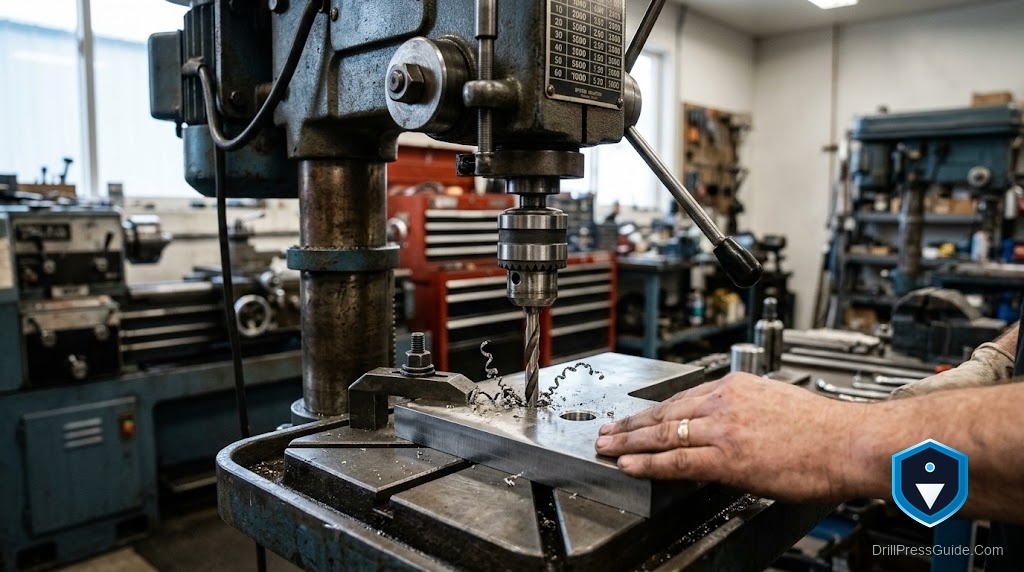
Most torn-up holes in metal come from the same mistake: the drill press is spinning too fast. It feels productive to run a bit at full tilt, but in steel that heat has nowhere to go except into the cutting edge, and a sharp bit turns blue and dull in seconds. The right question is not how fast the machine will go, it is what speed a drill press should run for the metal in front of you.
Drill speed for metal is set by surface speed, measured in surface feet per minute (SFM), and bit diameter. Each metal has a recommended SFM range for high-speed steel drills, and you convert that into spindle RPM with a simple formula. Softer metals like aluminum and brass take high SFM, and hard ones like stainless take very low SFM.
The short answer: for most mild steel with an HSS bit, aim for about 80 to 100 SFM, which lands a 1/4-inch bit near 1400 RPM and a 1/2-inch bit near 700 RPM. For stainless, drop to 20 to 40 SFM and slow the machine to its lowest usable setting. Set speed to the material and the bit, keep steady feed pressure, and use cutting fluid.
The one formula that replaces guessing
The conversion is worth memorizing: RPM = (SFM x 3.82) / drill diameter in inches. The University of Florida’s manufacturing lab teaches the same relationship as N = 12V divided by pi times D, and it works out to the same thing. Plug in a recommended surface speed and your bit size, and the machine setting falls out.
A worked example keeps it honest. A 1/4-inch HSS bit in mild steel at 100 SFM gives (100 x 3.82) / 0.25, or roughly 1500 RPM. The same bit in 304 stainless at 40 SFM gives about 611 RPM. Same bit, same machine, and the correct speed differs by more than double, purely because of the metal.
Surface speeds worth trusting
Published charts from drill makers agree closely, which is reassuring. Carbide Depot and Norseman both put aluminum and its alloys around 200 to 300 SFM, brass near 150 to 250, and copper and bronze around 100 to 200. Mild steel sits near 80 to 100 SFM. Stainless in the 200 and 300 series drops to roughly 20 to 40 SFM, and gray cast iron runs about 100 to 150 SFM.
Read those numbers as ceilings for a home drill press, not targets to chase. Aluminum at 300 SFM with a small bit asks for far more RPM than a benchtop machine can reach, so you simply run wide open and lean on lubricant and chip clearing instead.
Why slower usually finishes better
Heat is the enemy of both the bit and the hole. Too much speed work-hardens stainless under the edge, glazes the bit, and leaves a ragged, oversized hole. Backing off the RPM lets each flute take a real chip instead of rubbing, and a bit that is cutting rather than rubbing stays sharp and cool.
Feed matters just as much as speed. A steady, firm push that produces two continuous curls of swarf is the target. Hesitate mid-hole in stainless and the surface hardens where the bit dwelled, and the next pass has to fight through it.
What to run the metal on
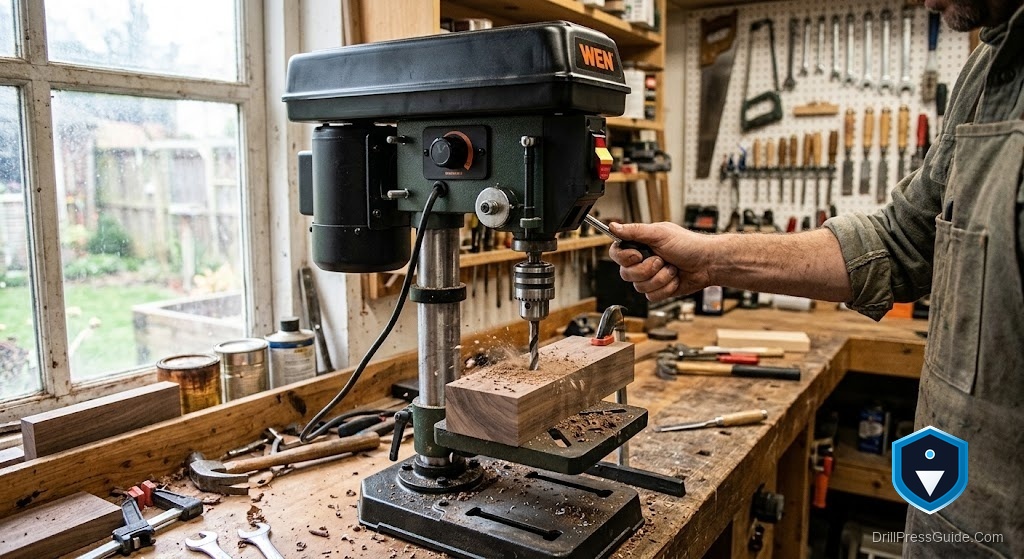
The machine has to slow down and hold still to do this well. A variable-speed press like the WEN 4214T 12-inch makes dialing 600 RPM for stainless as easy as spinning up for brass, and the digital readout tells you where you actually are. Its weak point for metal is rigidity: it is a light machine, so heavy 1/2-inch holes in thick steel want a slow feed and patience. For a simpler five-speed option, the SKIL 10-inch press reaches down to 610 RPM, which covers most steel; its floor is a little high for the slowest stainless work.
The bit matters more than most beginners expect. A cobalt set such as this M35 cobalt twist drill set holds an edge in stainless and hardened steel far longer than plain HSS, which is exactly where correct speed and a tougher bit pay off together. Keep a small can of cutting fluid at the machine; it is the cheapest accuracy upgrade you can make.
Clamp it, always
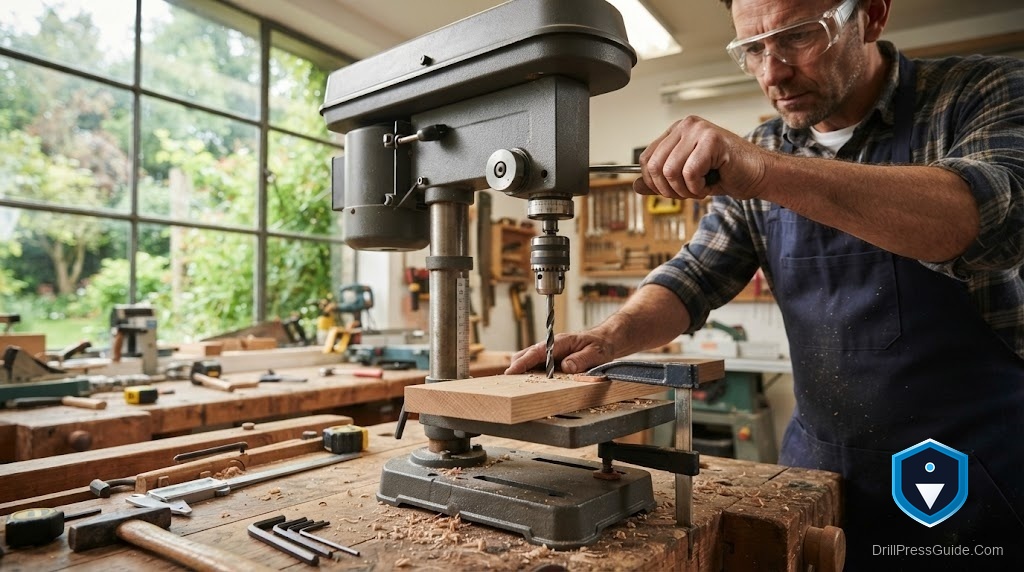
Metal grabs. A drill breaking through a plate can spin the workpiece into a spinning blade in an instant, and hot chips fly. Clamp the part to the table or hold it in a drill press vise, wear eye protection, and keep hands clear of the point of operation. Brushing chips away with a bare hand is how people get cut; use a brush and let the piece cool.
The verdict
For metal, speed follows the material, not your patience. Set mild steel around 80 to 100 SFM, stainless near 20 to 40, aluminum wide open with lubricant, and let bit diameter do the rest through the formula. A variable-speed press and a cobalt bit turn that theory into clean, round holes.
Keep these close:
- Slower is almost always the fix for a rough or oversized hole in steel.
- Convert SFM to RPM once, write your common bit sizes on a card, and tape it to the machine.
- Cutting fluid and steady feed do as much for finish as the RPM setting.
- Clamp the work every time; metal does not forgive a hand-held part.
Frequently asked questions
What speed should a drill press run for mild steel? Around 80 to 100 SFM. That puts a 1/8-inch bit near 3000 RPM, a 1/4-inch bit near 1400 RPM, and a 1/2-inch bit near 700 RPM.
What speed for stainless steel? Much slower, roughly 20 to 40 SFM. A 1/4-inch bit lands near 600 RPM and a 1/2-inch bit near 300 RPM. Keep constant feed so the surface does not work-harden.
Why does my bit keep burning up in metal? Almost always too much speed, too little feed, or no lubricant. Slow the machine, push harder for a real chip, and add cutting fluid.
Do I need a variable-speed press for metal? It helps a lot, because metal speeds swing widely by material and bit size. A five-speed belt machine works too, as long as its lowest speed reaches down near 600 RPM.
What speed for a hole saw in metal? Slow. Large diameters mean low RPM, often 100 to 300, with firm pressure and fluid, or the teeth overheat and dull.
Does the bit material change the speed? Cobalt tolerates more heat than plain HSS, so you can push it a little, but the material SFM still sets the ballpark. The bigger benefit of cobalt is edge life in hard metal.
References
- Carbide Depot, HSS Twist Drill Recommended Speeds and Feeds: https://www.carbidedepot.com/formulas-drills-speeds.htm
- Norseman Drill and Tool, Feeds and Speeds for Drills: http://www.norsemandrill.com/feeds-speeds-drill.php
- University of Florida Design and Manufacturing Lab, Speeds and Feeds: https://web.mae.ufl.edu/designlab/Advanced%20Manufacturing/Speeds%20and%20Feeds/Speeds%20and%20Feeds.htm