
Central Machinery Drill Press Parts: What to Measure Before You Order
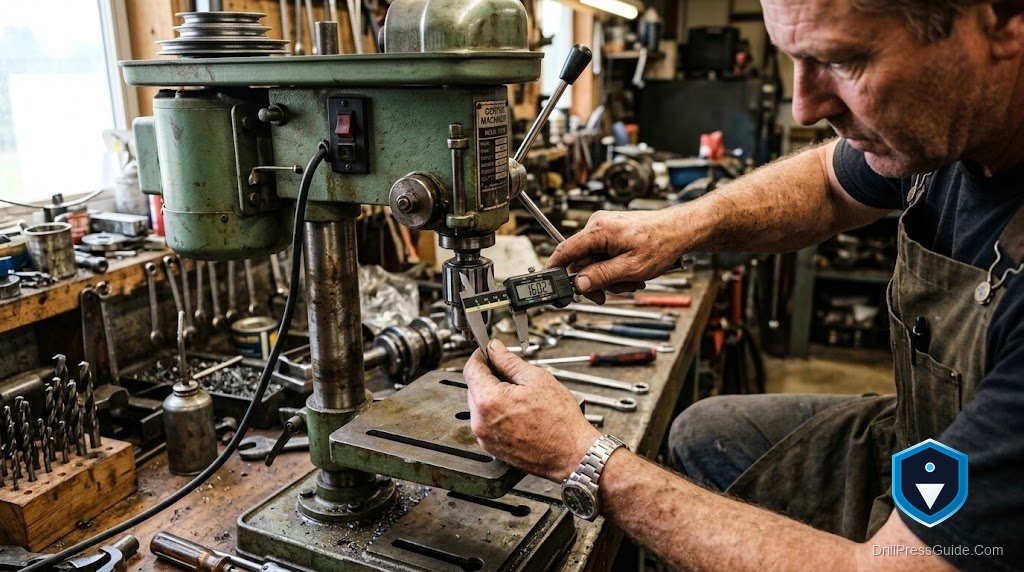
The belt snaps, or the quill spring lets go with a bang, or the chuck finally wobbles past the point of drilling a straight hole, and you go looking for Central Machinery drill press parts. Then the trouble starts. Central Machinery is Harbor Freight’s house brand, the same drill press has worn a half-dozen item numbers over the years, and the exploded diagram online does not always match the machine on your bench. The fix is not to guess. It is to measure. A caliper and five minutes will beat an hour of scrolling every time.
Why matching parts is tricky
Central Machinery presses are made by different overseas factories across production runs, so two presses that look identical can use slightly different belts, springs, or chucks. The same 8-inch machine, for instance, has been sold as item 60238, 38119, 44506, 62390, and 62520. Harbor Freight hosts manuals and parts diagrams for each, but the safe path is to confirm the physical dimensions of the part you need rather than trusting that your machine matches a given diagram exactly.
Start by finding your item number on the label, usually on the head or the base. That points you to the right manual. Then measure to confirm.
What to measure before ordering
The V-belt. Measure the belt’s outside length and its top width, or read the code molded into the old belt (for example, an M-section or a numbered length). Belts are the most common part to replace and the easiest to get wrong by eye. On many small Central Machinery presses the belt is an M-section; confirm yours.
The chuck and arbor. Two measurements: the chuck’s capacity (typically 1/2 inch on the 8-inch machines, 5/8 inch on larger ones) and the arbor taper (often JT33 on smaller presses, MT2 on bigger ones). Drop the chuck by tapping a wedge drift through the spindle slot and read the taper stamped on the arbor, or measure the arbor’s large and small diameters.
The quill return spring. These vary in width, thickness, and length. Note how many turns of preload the old one had before you release it, because that saves a lot of trial and error on reassembly.
The chuck key. Match the pilot diameter and the gear pitch. A key that is close but wrong will chew the chuck.
The switch. Note the voltage, the number of terminals, and whether it is a no-volt (paddle) or simple toggle switch.
The parts that actually fail
On these presses, wear concentrates in a few places: the V-belt (stretches and cracks), the chuck (loses its grip and runs out), the quill return spring (fatigues and snaps), the switch (contacts fail), and the pulleys or spindle bearings on hard-used machines. The good news is that every one of those is a generic component. You are rarely hunting a proprietary casting; you are matching a standard belt, chuck, spring, or switch by size.
Because the parts are generic, the smart approach is to buy quality replacements rather than exact factory spares. A good 1/2-inch or 5/8-inch keyed drill chuck with the matching arbor, a correctly sized drill press V-belt, a drill press quill return spring, and a spare drill press chuck key cover the vast majority of repairs. Since Central Machinery presses are Harbor Freight machines, any truly model-specific casting is ordered from Harbor Freight by item number, but those are the exception, not the rule.
A quick word on the “on” switch
One of the most-searched Central Machinery parts is the on/off switch, because it is a common failure and a common upgrade. If yours is intermittent, replacing a worn toggle with a proper no-volt paddle switch is both a repair and a safety improvement: a no-volt switch will not restart the machine on its own after a power interruption. Match the voltage and terminal count when you order.
The verdict
Buying Central Machinery drill press parts goes smoothly the moment you stop trusting the picture and start trusting the caliper. Find your item number for the right manual, then measure the belt, chuck, arbor taper, spring, and switch before you order, because the same-looking machine changed small details across its many item numbers. Nearly every wear part is generic, so buy a quality replacement and match it by dimension. Do that, and a house-brand press stays useful for a long time, one correctly measured part at a time.
Takeaways:
- Central Machinery presses span many item numbers, so parts can differ between identical-looking machines.
- Find your item number for the manual, then measure the part to confirm fit.
- Belt, chuck, arbor taper, quill spring, chuck key, and switch are the common failures, and all are generic.
- Buy quality generic replacements by dimension; order only true castings from Harbor Freight by item number.
FAQ
Are Central Machinery drill press parts interchangeable between models? Often, but not always. The same design was built by different factories across item numbers, so measure the belt, chuck, and spring rather than assuming two machines match.
What belt does a Central Machinery drill press use? It varies by model; many small units use an M-section V-belt. Measure the outside length and top width or read the code on the old belt before ordering.
How do I identify my Central Machinery drill press? Find the item number on the label on the head or base (for example 60238, 38119, or 44506), then pull the matching manual from Harbor Freight.
What chuck and taper does it use? Smaller 8-inch presses typically use a 1/2-inch chuck on a JT33 arbor; larger ones use 5/8-inch on MT2. Confirm by removing and reading the arbor.
Can I replace the on/off switch myself? Yes. Match the voltage and terminal count. Upgrading to a no-volt paddle switch is a common, worthwhile safety improvement.
Where do I get the parts diagram? Harbor Freight hosts manuals and exploded parts diagrams by item number online, and several are mirrored by maker networks.
Why does my chuck run out after replacing it? Usually a mismatched or damaged arbor taper, or debris in the taper. Clean the spindle bore and arbor, and confirm the taper matches (JT33 versus MT2).
References
- Harbor Freight 44506 8-inch Drill Press parts list and diagram (mirrored): https://wiki.lansingmakersnetwork.org/_media/equipment/44506.pdf
- Harbor Freight Tools 38119 5-Speed Drill Press manual: https://nps.edu/documents/111291366/113869380/Central_Drillpress.pdf
- Harbor Freight Tools, Central Machinery 8-inch Drill Press item history (60238 / 38119 / 44506 / 62390 / 62520): https://go.harborfreight.com/coupons/2020/04/60238-90980786/


