How to Drill Press Metal Without Losing Accuracy
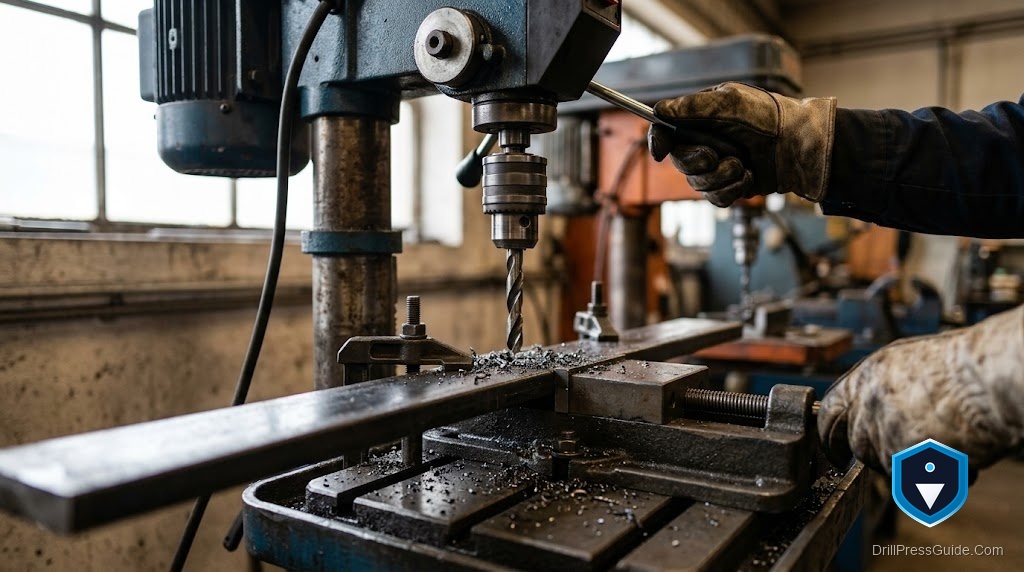
Drilling metal on a press is where a lot of people discover that the machine is easy and the technique is everything. The press holds the bit square, but it will happily drive a dull bit at the wrong speed straight into a part that then spins loose. Accuracy in metal comes from a short sequence you repeat every time: mark, set speed, secure, cut with fluid, and clear chips. Get that sequence right and clean holes stop being luck.
Here is the quick version. Center punch your mark, look up the right speed for the diameter and material, clamp the part, feed steadily with cutting fluid, and peck to clear chips on deeper holes. The rest of this walks through each step and why it protects your accuracy.
Start with a center punch
Metal is smooth and a bit tip will skate across it, starting the hole off your mark and ruining accuracy before you begin. A center punch makes a small dimple that captures the bit tip so it starts exactly where you want. This one step fixes most wandering-hole problems and costs a second. Mark, punch, then drill.
Set the speed for the material and size
Metal has a narrow safe speed window, and it drops as the bit grows. As sharp high-speed steel starting points: mild steel runs near 1500 RPM at 1/4 inch, 1000 at 3/8, and 750 at 1/2. Stainless runs at roughly half those speeds because it hardens under heat. Aluminum tolerates much faster speeds. Set the nearest belt step, then let the chips confirm you are in the window.
Secure the work, always
As a bit breaks through the far side of metal, it grabs, and an unclamped part becomes a spinning blade. Hold the work in a drill press vise or clamp it to the table. A sharp set of bits helps you cut cleanly at these speeds; a quality option like this cobalt drill bit set handles steel and stainless because the cobalt content resists the heat that rounds over ordinary bits. Clamping is not optional on metal; it is the difference between a round hole and an accident.
Cut with fluid and steady feed
Cutting fluid carries heat off the edge and flushes chips, which keeps the bit sharp and the hole accurate. Feed with steady pressure so the bit makes continuous chips rather than powder. Powder means the bit is rubbing, which builds heat and work-hardens steel. Silver or straw chips mean you are cutting well. Blue chips mean too much heat, so slow down and add fluid.
Peck deep holes and pilot large ones
For holes deeper than about the bit diameter, retract periodically to clear chips out of the flutes. Packed chips generate heat and push the bit off line. For large holes, drill a smaller pilot first so the big bit’s center is not just pushing metal; this keeps the large bit tracking true and reduces the force on the machine.
The verdict
Accurate metal drilling on a press is a repeatable routine, not a knack:
- Center punch every hole so the bit starts on your mark.
- Match speed to diameter and material, and confirm with chip color.
- Clamp the work, cut with fluid and steady feed, and peck deep holes.
Who tends to struggle? People who skip the punch and the clamp, then blame the bits. Fix those two habits first and accuracy improves immediately.
Frequently asked questions
Why does my bit wander even on a press? Almost always a missing center punch. Without a dimple, the tip skates on smooth metal before it bites.
Do I really need cutting fluid? For anything past a light touch, yes. Fluid keeps the edge below the temperature that dulls it and helps hold accuracy over the hole’s depth.
What speed for stainless? About half the mild-steel speed for the same diameter, because stainless work-hardens. Slow and steady with fluid keeps the edge cutting.
How tight should the feed be? Enough to make continuous chips. Powder means too light, a stalling machine means too heavy. Aim for steady curls.
Why pilot a large hole? The center of a large bit pushes rather than cuts. A pilot hole removes that material so the big bit tracks true and the machine works less.
Can I use regular bits on steel? Standard high-speed steel works on mild steel with fluid and correct speed. For stainless and repeated hard use, cobalt bits hold up far better.
References
- CCOHS, Metalworking Machines - Drill Presses: https://www.ccohs.ca/oshanswers/safety_haz/metalworking/drillpresses.html
- Dynabrade HSS Drill Speed Recommendation Chart: https://www.dynabrade.com/pdf/lit/D1201_Singles/D12.01_pg134.pdf
- Pro Tool Reviews, How to Use a Drill Press: https://www.protoolreviews.com/how-to-use-drill-press/