Drill Press Speed Chart for Wood: Match the Bit, Speed, and Support to the Job
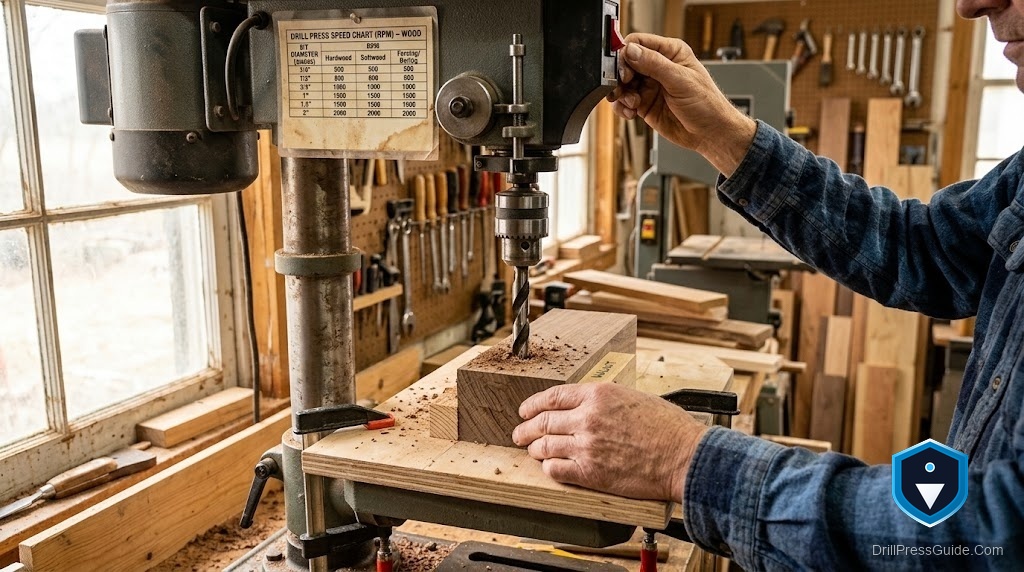
Wood forgives a lot, which is why most people never think about drill press speed until a big Forstner bit scorches a nice board or packs its flutes with smoking chips. A wood speed chart prevents that: it tells you how fast to run each bit so it cuts clean instead of burning. Wood runs faster than metal, but large bits still need to slow down. Here is a practical drill press speed chart for wood by tooling, plus the reasoning so you can adapt it to any bit.
For wood on a drill press, small twist and brad-point bits run fast, around 1800 to 3000 RPM, while large Forstner bits and hole saws need much slower speeds, down to 300 to 700 RPM, to avoid burning and grabbing. The rule is the same as for metal, slow down as the bit grows, just at higher overall speeds because wood cuts more easily.
The wood speed chart
Practical drill press starting points by tooling:
| Tooling | Diameter | Speed (RPM) |
|---|---|---|
| Twist / brad-point | up to 1/4 in | 3000 |
| Twist / brad-point | 1/4 to 1/2 in | 1800 to 2500 |
| Brad-point | 1/2 to 3/4 in | 1500 to 1800 |
| Forstner | up to 1 in | 1800 to 2000 |
| Forstner | 1 to 2 in | 700 to 1200 |
| Forstner | over 2 in | 500 |
| Spade bit | 1/2 to 1 in | 1500 to 2000 |
| Hole saw | 1 to 2 in | 500 to 900 |
| Hole saw | over 2 in | 300 to 500 |
Hardwoods run at the lower end of each range, softwoods at the higher end. Set the belt to the nearest speed at or below the chart figure.
Why big bits slow down
The reason mirrors metal. What matters at the cutting edge is surface speed, and the rim of a large bit travels much farther per turn than a small one, so a big bit reaches a burning surface speed at far fewer RPM. Push a 2 inch Forstner bit at small-bit speed and its rim overheats, scorching the wood and dulling the edge. Hardwood adds heat too, so it runs slower than softwood. This is the same surface-speed logic behind metal charts like the Dynabrade chart, and the Delta manual reflects it in its speed tables.
Reading the results
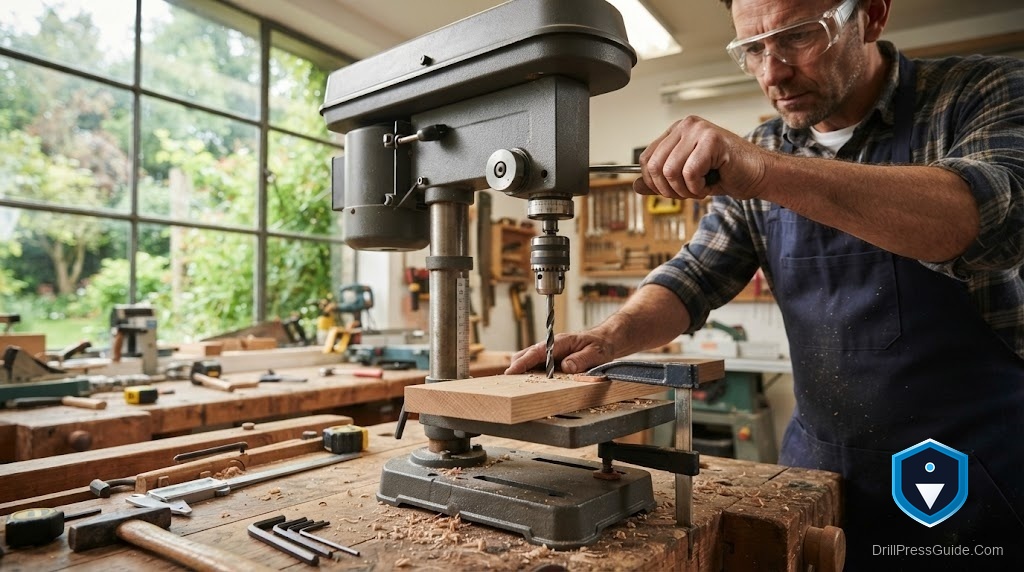
The wood itself tells you if the speed is right. Clean chips and shavings with no scorch marks mean you are on target. Brown or burned edges, smoke, or a glazed hole mean the speed is too high for the bit, slow down and clear chips more often. A bit that grabs or self-feeds usually needs a slower speed and a firmer grip on the work. Always back the piece with scrap to stop tear-out, hold it so it cannot spin, and wear eye protection, the safety basics from OSHA and CCOHS.
The verdict
A wood drill press speed chart captures one rule: run small bits fast and slow big ones down to keep the rim from burning. Three takeaways: wood runs faster than metal but large Forstner bits and hole saws still need low speeds, hardwood runs slower than softwood, and the scorch marks (or lack of them) confirm any chart value. Who should tape this inside the cover? Anyone who drills wood regularly, it saves boards and bits, especially on large holes.
Frequently asked questions
What speed should a drill press run for wood? Small twist and brad-point bits run around 3000 RPM, mid-size bits 1500 to 2500, large Forstner bits 700 to 1200, and hole saws 300 to 900 RPM depending on diameter. Slow down as the bit grows and for hardwoods.
Why do large Forstner bits need slower speeds? Because the rim of a large bit travels much farther per revolution than a small one, reaching a burning surface speed at far fewer RPM. Running a big Forstner bit too fast scorches the wood and dulls the edge, so it needs a low speed.
Should hardwood and softwood run at different speeds? Yes. Hardwood generates more heat, so run it at the lower end of each range, and softwood at the higher end. If a hardwood hole starts to scorch, drop the speed and clear chips more often.
What speed for a hole saw in wood? Hole saws run slow: about 500 to 900 RPM for 1 to 2 inch sizes and 300 to 500 RPM for larger ones. They cut a lot of material and grab easily, so a slow speed and a firmly clamped workpiece are important.
How do I know if the speed is too high? The wood tells you: brown or burned edges, smoke, or a glazed hole mean the speed is too high for the bit. Clean shavings with no scorching mean you are on target. Slow down and clear chips if you see burning.
Does the chart change for different bit types? The principle is constant, slow down as diameter grows, but Forstner bits and hole saws remove more material and run slower than twist or brad-point bits of the same diameter. Use the tooling rows in the chart as your guide.
Why does my bit grab or pull into the wood? Self-feeding usually means the speed is too high or the bit is aggressive for the material. Slow the speed, feed more gently, and hold the work firmly. Spade bits and hole saws grab most, so keep the piece clamped.
References
- Dynabrade, HSS Drill Speed Recommendation Chart. https://www.dynabrade.com/pdf/lit/D1201_Singles/D12.01_pg134.pdf
- Delta 17-900 Drill Press Instruction Manual. https://powertool.manualsonline.com/manuals/mfg/delta/17900.html
- OSHA, Woodworking eTool: Drill Press. https://www.osha.gov/etools/woodworking/production/machines-tools/drill-press
- CCOHS, Metalworking Machines: Drill Presses. https://www.ccohs.ca/oshanswers/safety_haz/metalworking/drillpresses.html