
How to Use a Drill Press for Metal: Setup, Checks, and Common Mistakes
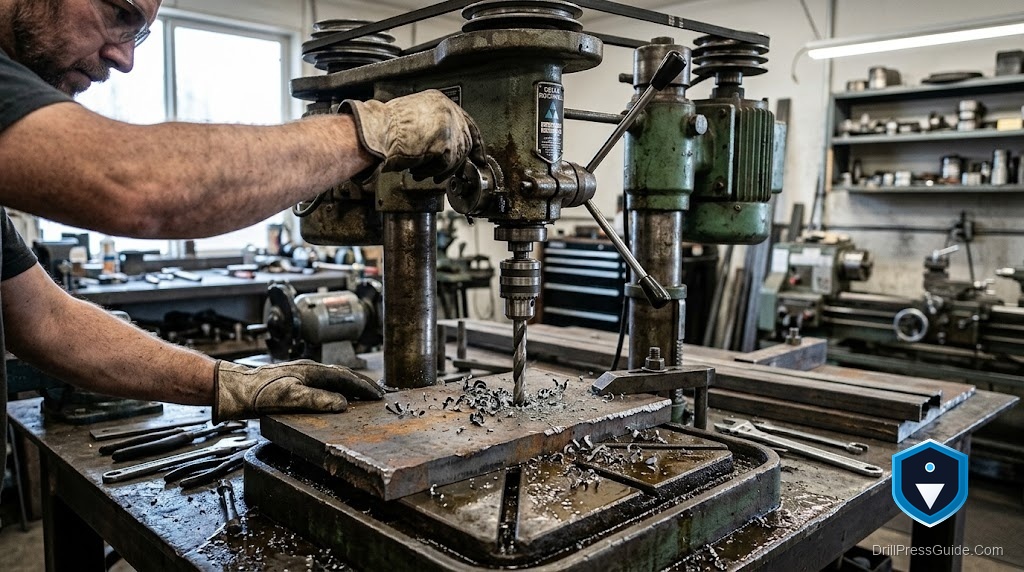
Drilling metal on a drill press is not hard, but it is easy to do badly, and metal punishes the mistakes with dull bits, torn holes, and spinning workpieces. The good news is that clean metal holes come from a short, repeatable routine: set a slow speed, clamp the work, mark the hole, feed to make chips, and cool the cut. Most failures trace back to skipping one of those steps. Here is how to use a drill press for metal, step by step, with the common mistakes called out so you can avoid them.
To use a drill press for metal: mark and center-punch the hole, set a slow speed matched to bit diameter and metal, clamp the workpiece in a vise or to the table, mount a sharp HSS or cobalt bit, add cutting fluid on steel, then feed firmly to make continuous chips and ease off as the bit breaks through. Slow speed and firm clamping are the essentials.
Step by step
Follow the same routine every time:
- Mark and center-punch. Lay out the hole and punch a dimple so the bit starts on the mark instead of wandering.
- Set the speed. Match it to the bit and metal, slow for large bits and hard metals. A small bit in aluminum can run near 3000 RPM; a 1/2 inch bit in steel wants about 750 RPM.
- Clamp the work. Hold it in a vise or bolt it to the table. Never hand-hold metal.
- Mount a sharp bit. HSS for mild steel and aluminum, cobalt for hard and stainless steel.
- Add cutting fluid on steel and stainless to cool the edge and clear chips.
- Feed to make chips. Press firmly enough for continuous curls, and ease off as the bit exits.
This mirrors the setup routines in the Delta manual and Pro Tool Reviews, with speeds following the Dynabrade chart.
Speed at a glance
| Bit diameter | Aluminum | Mild steel | Stainless |
|---|---|---|---|
| 1/8 in | 3000 | 3000 | 1200 |
| 1/4 in | 3000 | 1500 | 600 |
| 3/8 in | 2500 | 1000 | 400 |
| 1/2 in | 1900 | 750 | 300 |
| 3/4 in | 1250 | 500 | 200 |
Common mistakes to avoid
Most metal-drilling trouble comes from a handful of errors. Running too fast is the big one, it overheats and dulls the bit almost instantly, especially in stainless. Skipping the clamp lets the workpiece spin, which is dangerous and ruins the hole. Feeding too lightly lets the bit rub and work-harden steel instead of cutting it. Forgetting cutting fluid shortens bit life. And clearing chips with a hand instead of a brush invites cuts from hot, sharp swarf, the hazard OSHA and CCOHS call out. Avoid those five and the job goes smoothly.
The verdict
Using a drill press for metal is a short routine done right every time: mark and punch, set a slow speed, clamp the work, mount a sharp bit, cool the cut, and feed to make chips. Three takeaways: slow speed and firm clamping are the essentials, the chips tell you whether the speed and feed are right, and most failures come from five avoidable mistakes led by running too fast. Who should be most careful? Anyone drilling stainless or large holes, where speed and cooling matter most.
Frequently asked questions
How do you use a drill press for metal step by step? Mark and center-punch the hole, set a slow speed for the bit and metal, clamp the workpiece, mount a sharp HSS or cobalt bit, add cutting fluid on steel, then feed firmly to make continuous chips and ease off as the bit breaks through.
What speed should I use to drill metal? Match it to bit diameter and metal: near 3000 RPM for a small bit in aluminum or mild steel, about 750 RPM for a 1/2 inch bit in steel, and roughly half the steel figure for stainless. Larger bits and harder metals run slower.
Why do I need to center-punch metal first? A center punch makes a dimple that keeps the bit from wandering off your mark as it starts, giving a more accurate hole. It matters most on smooth or hard metal where a bit tends to skate before biting.
Do I have to clamp metal on a drill press? Yes, always. The bit’s torque, especially as it breaks through, can grab and spin an unclamped part, which is dangerous and ruins the hole. Hold metal in a vise or bolt it to the table every time.
Why does my bit overheat in metal? Usually the speed is too high for the bit and metal, or you are feeding too lightly so the bit rubs instead of cutting. Slow down, feed firmly to make chips, and use cutting fluid on steel and stainless.
When should I use cutting fluid? On steel and stainless, apply it to cool the edge, clear chips, and extend bit life, reapplying as the hole deepens. Aluminum can be drilled dry or with a light lubricant, and cast iron is drilled dry.
What are the most common metal-drilling mistakes? Running too fast, skipping the clamp, feeding too lightly, forgetting cutting fluid, and clearing chips by hand. Avoiding those five, especially the speed, prevents most dull bits, torn holes, and spinning workpieces.
References
- Dynabrade, HSS Drill Speed Recommendation Chart. https://www.dynabrade.com/pdf/lit/D1201_Singles/D12.01_pg134.pdf
- Delta 17-900 Drill Press Instruction Manual. https://powertool.manualsonline.com/manuals/mfg/delta/17900.html
- Pro Tool Reviews, How to Use and Set Up a Drill Press. https://www.protoolreviews.com/how-to-use-drill-press/
- OSHA, Woodworking eTool: Drill Press. https://www.osha.gov/etools/woodworking/production/machines-tools/drill-press
- CCOHS, Metalworking Machines: Drill Presses. https://www.ccohs.ca/oshanswers/safety_haz/metalworking/drillpresses.html


