
Drill Press Speed Chart for Metal: Match the Bit, Speed, and Support to the Job
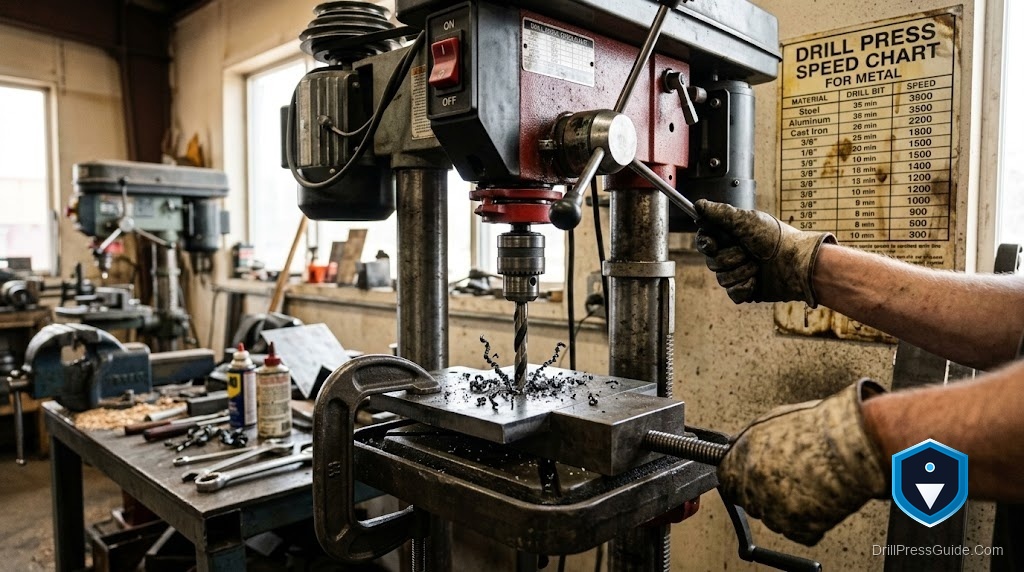
The single most useful thing you can tape inside your drill press cover is a metal speed chart, because metal is unforgiving about speed in a way wood is not. Run a bit too fast in steel and the edge overheats and dulls in seconds; run it right and slow, and it peels clean chips. The chart takes the guesswork out: find your bit diameter and your metal, read the RPM, set the belt. Here is a practical drill press speed chart for metal, plus the reasoning so you can adapt it to any bit or material.
For metal on a drill press, speed drops as the bit diameter grows and as the metal gets harder. As practical starting points: aluminum runs fastest, mild steel slower, and stainless slowest, roughly half of mild steel. Small bits can run near 3000 RPM in soft metal, while a 3/4 inch bit in steel wants around 500 RPM and in stainless around 200. Slower is safer than faster.
The metal speed chart
These are practical drill press starting points in RPM for high-speed steel bits:
| Bit diameter | Aluminum | Brass | Mild steel | Cast iron | Stainless |
|---|---|---|---|---|---|
| 1/16 in | 3000 | 3000 | 3000 | 3000 | 2000 |
| 1/8 in | 3000 | 3000 | 3000 | 2500 | 1200 |
| 1/4 in | 3000 | 3000 | 1500 | 1200 | 600 |
| 3/8 in | 2500 | 2500 | 1000 | 800 | 400 |
| 1/2 in | 1900 | 1800 | 750 | 600 | 300 |
| 5/8 in | 1500 | 1400 | 600 | 500 | 250 |
| 3/4 in | 1250 | 1200 | 500 | 400 | 200 |
| 1 in | 900 | 900 | 350 | 300 | 150 |
Many benchtop presses cap near 3000 RPM, so the small-bit values are practical ceilings. Set the belt to the nearest available speed at or below the chart figure.
Why speed drops with size and hardness
The chart is not arbitrary. What matters to the cutting edge is surface speed, how fast the metal passes the edge, and that depends on both RPM and bit diameter. A big bit’s edge travels much farther per turn than a small one, so it needs fewer RPM to keep the same safe surface speed. Harder metals tolerate a lower surface speed before the edge overheats, so stainless drops well below mild steel. This is exactly the relationship the Dynabrade HSS chart is built on, and the Delta manual reflects it in its speed tables.
Reading the chips to confirm
A chart gets you close; the chips confirm it. Long, continuous curls mean the speed and feed are right. Blue or discolored chips mean too much heat, drop the speed. Fine powder or a squealing bit means it is rubbing, not cutting, often too fast with too little feed. Adjust from the chart value based on what the chips tell you, and always add cutting fluid on steel and stainless, clamp the work, and wear eye protection, the basics from OSHA and CCOHS.
The verdict
A metal drill press speed chart works because it captures one rule: keep the surface speed safe by slowing down as the bit grows and as the metal hardens. Three takeaways: aluminum fast, steel slower, stainless slowest at about half of steel; big bits need far fewer RPM than small ones; and the chips are the final check on any chart value. Who should tape this inside the cover? Anyone who drills metal regularly, it saves bits and time on every hole.
Frequently asked questions
What speed should I drill steel at on a drill press? For mild steel, roughly 3000 RPM at 1/8 inch, 1500 at 1/4 inch, 1000 at 3/8 inch, 750 at 1/2 inch, and 500 at 3/4 inch. Slow down as the bit grows, and drop to about half these figures for stainless.
Why do larger drill bits need slower speeds? Because the edge of a large bit travels farther per revolution than a small one. To keep the cutting edge at a safe surface speed and temperature, a bigger bit must turn at fewer RPM, which is why the chart drops as diameter rises.
What speed for aluminum on a drill press? Aluminum tolerates high speed: near 3000 RPM for small bits, around 1900 at 1/2 inch, and about 1250 at 3/4 inch. Use a light lubricant to keep the soft metal from clogging the flutes, and clear chips often.
How much slower should stainless steel be? About half the mild-steel speed or less: roughly 1200 RPM at 1/8 inch, 600 at 1/4 inch, 300 at 1/2 inch, and 200 at 3/4 inch. Stainless work-hardens with heat, so err slower and keep the bit cutting.
My drill press only goes down to a certain speed, what then? Set it to the slowest speed at or below the chart figure. If even the lowest speed is too fast for a large bit in steel or stainless, take smaller bites, use plenty of cutting fluid, and expect slower progress.
Does the chart change for cobalt bits? The speeds are similar, cobalt mainly lets the edge survive the heat in hard and stainless steel rather than allowing faster speeds. Keep to the chart figures and rely on cobalt for durability, not for running faster.
How do I know if my speed is correct? Watch the chips. Continuous curls mean the speed and feed are right. Blue chips mean too much heat, so slow down. Powder or a squealing bit means it is rubbing, usually too fast with too little feed.
References
- Dynabrade, HSS Drill Speed Recommendation Chart. https://www.dynabrade.com/pdf/lit/D1201_Singles/D12.01_pg134.pdf
- Delta 17-900 Drill Press Instruction Manual. https://powertool.manualsonline.com/manuals/mfg/delta/17900.html
- OSHA, Woodworking eTool: Drill Press. https://www.osha.gov/etools/woodworking/production/machines-tools/drill-press
- CCOHS, Metalworking Machines: Drill Presses. https://www.ccohs.ca/oshanswers/safety_haz/metalworking/drillpresses.html


