
How to Measure a Drill Press: A Clear, Shop-Ready Method
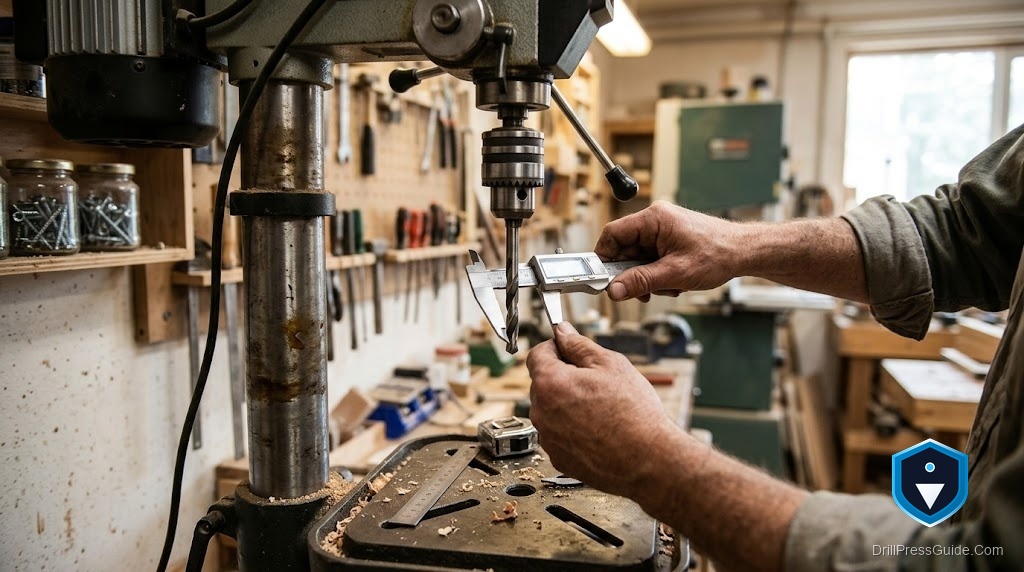
“Measure the drill press” sounds like one job, but people mean very different things by it: the swing that names the machine’s size, the chuck capacity, the arbor taper for a replacement chuck, the belt length, the vise jaws, the runout, or the speed. Each has its own method and its own tool, and mixing them up leads to wrong parts and bad fits. This walkthrough covers every measurement you are likely to need, in the order you will reach for them, so you can pull out a tape or caliper and get a number you can trust.
To measure a drill press: swing is twice the distance from the chuck center to the column; chuck capacity is the largest bit shank the jaws close on; the arbor is identified by its taper (often a Morse or Jacobs taper); belt length is measured around the installed belt path; runout is read with a dial indicator on the spindle; and speed is set from the pulley chart or measured with a tachometer.
Measuring the machine’s size (swing and throat)
Start with the number that names the press. Measure the horizontal distance from the center of the chuck to the front face of the column, that is the throat depth, then double it for the swing. A 6-inch throat means a 12-inch drill press. While you are there, measure spindle travel (how far the quill lowers in one pass) and table-to-chuck clearance (how tall a workpiece fits), since those are the specs swing leaves out.
Measuring the chuck and arbor
Two related measurements matter for tooling and replacements:
Chuck capacity is the range of shank diameters the jaws grip. Open the jaws fully and measure across them for the maximum; most benchtop chucks close on shanks to 1/2 inch or 5/8 inch.
Arbor taper identifies how the chuck mounts to the spindle. After removing the chuck, measure the taper’s large and small diameters and its length, then match to a standard such as a Jacobs taper (JT33, JT6) or a Morse taper (MT2). Getting this right is what makes a replacement chuck seat properly, a point the removal walkthrough at eReplacementParts stresses.
Measuring belts, vises, and other parts
Wear parts each have their own method:
| What you measure | How to measure it | Why it matters |
|---|---|---|
| Belt | Lay the old belt flat, measure the inside loop, or wrap a string around the pulley path | Correct replacement length |
| Vise jaws | Jaw width and maximum opening | Workholding capacity |
| Table | Length and width of the work surface | Fit for tables and fences |
| Column | Diameter with calipers | Guard and table-collar fit |
When a model is discontinued, matching parts by measurement beats trusting a label, which is why parts references like the Grizzly G7948 FAQ point owners to dimensions.
Measuring runout and speed
Two performance numbers round out the list. Runout is the wobble at the spindle or chuck: clamp a dial indicator against the spindle, rotate by hand, and read the total swing of the needle; smaller is better for accurate holes. Speed is normally set from the pulley chart printed inside the belt cover, matching the belt position to a listed RPM, but you can confirm the true figure with a handheld tachometer if a chart is missing. Both readings tie back to safe, accurate operation as described by Pro Tool Reviews and the safety basics from OSHA and CCOHS.
The verdict
Measuring a drill press is really several separate jobs: swing from twice the throat depth, chuck capacity across the open jaws, arbor by its taper standard, belt by its loop, vise by jaw width and opening, runout with a dial indicator, and speed from the pulley chart or a tachometer. Three takeaways: know which measurement you actually need before reaching for a tool, use a caliper for tapers and shanks and a tape for the larger dimensions, and match discontinued parts by dimension rather than by name. Who needs this? Anyone buying tooling, ordering parts, or checking accuracy, the right number depends on the right method.
Frequently asked questions
How do you measure a drill press size? Measure the horizontal distance from the center of the chuck to the front of the column, the throat depth, then double it. A 5-inch throat gives a 10-inch swing, which is how the machine’s size is named.
How do I measure a drill press chuck? Chuck capacity is the largest shank the jaws grip: open them fully and measure across the opening. To replace the chuck, also identify the arbor taper by measuring the taper’s diameters and length and matching a Jacobs or Morse taper standard.
How do I measure a drill press arbor? Remove the chuck and measure the arbor taper’s large diameter, small diameter, and length with calipers, then match those to a standard taper such as JT33 or MT2. The taper, not a part number alone, determines what chuck will seat.
How do I measure a drill press belt? Remove the old belt, lay it flat, and measure the inside of the loop, or wrap a string around the pulley path at the belt position you use and measure the string. Match the length and profile when ordering.
How do you measure drill press runout? Clamp a dial indicator so its tip rests against the spindle or a precision rod in the chuck, rotate the spindle by hand, and read the total movement of the needle. That total is the runout; smaller means truer, more accurate holes.
How do you measure drill press speed? Speed is normally read from the pulley chart inside the belt cover, which lists the RPM for each belt position. To confirm the actual figure, aim a handheld tachometer at the spinning chuck or a mark on the pulley.
How do I measure the swing on a drill press? Swing equals twice the distance from the center of the chuck to the front edge of the column. Measure that gap horizontally and double it, so an 8.5-inch gap is a 17-inch drill press.
References
- eReplacementParts, How to Remove and Reinstall a Drill Press Chuck. https://www.ereplacementparts.com/repair/how-to-remove-and-reinstall-a-drill-press-chuck/
- Grizzly, FAQ for the G7948 Drill Press. https://support.grizzly.com/hc/en-us/articles/4411307933079-FAQ-G7948-Drill-Press-Discontinued
- Pro Tool Reviews, How to Use and Set Up a Drill Press. https://www.protoolreviews.com/how-to-use-drill-press/
- OSHA, Woodworking eTool: Drill Press. https://www.osha.gov/etools/woodworking/production/machines-tools/drill-press
- CCOHS, Metalworking Machines: Drill Presses. https://www.ccohs.ca/oshanswers/safety_haz/metalworking/drillpresses.html


