How to Square a Drill Press: Getting the Table True to the Bit
You set up a careful hole, drill it, and the far side comes out at a slight angle, or a dowel seated in it leans. The usual culprit is not your technique but the table: it is not square to the bit. A drill press table that sits even a degree off will drill angled holes all day, and the fix is a ten-minute alignment you can do with a tool you may already own. Squaring the table is one of those quiet setup steps that separates accurate machines from frustrating ones.
To square a drill press, adjust the table so it sits perpendicular to the bit in both directions. The quickest check uses a length of rod bent into an L, chucked in the press: rotate it to touch the table at different points and adjust the table until the gap is equal all around. A machinist square against the bit confirms it. Squaring the table makes holes come out straight.
Why a square table matters
The drill bit travels straight down along the quill. If the table is not perpendicular to that travel, every hole enters at an angle relative to the workpiece surface, so holes are not truly vertical, dowels and bolts sit crooked, and mating parts do not line up. Squaring realigns the work surface to the bit’s path so holes come out perpendicular to the face of your stock. It is the difference between parts that assemble cleanly and ones that fight you, and it costs nothing but a few minutes.
The bent-rod method (most reliable)
This classic method checks the table against the spindle’s true axis, not the bit’s flutes, so it is not fooled by a slightly bent bit.
- Unplug the press. Alignment happens on a stopped, unplugged machine, per CCOHS.
- Make a gauge. Bend a length of steel rod into an L, or a wide U, so one end chucks in the press and the other reaches down near the table.
- Chuck it and check one axis. Rotate the rod so its tip nearly touches the table on the left, note the gap, then rotate 180 degrees to the right. If the table is square, the gap is the same on both sides.
- Adjust and recheck. Loosen the table’s tilt (bevel) lock and adjust until the left and right gaps match, then retighten.
- Check the other axis. Rotate the rod front to back and repeat, if your table tilts that way, or confirm it reads equal.
Quick confirmation with a square
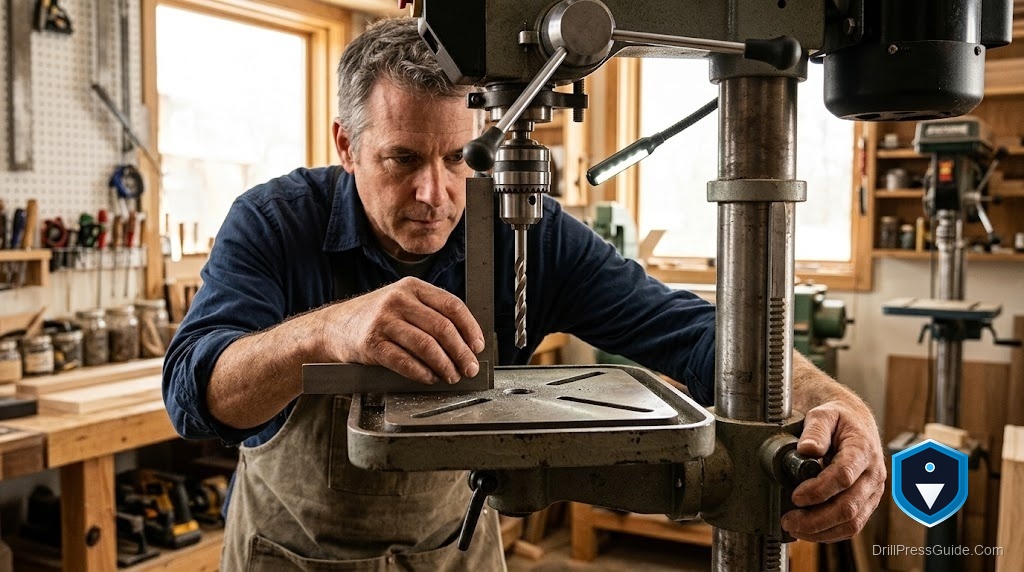
For a fast check or to confirm the rod method, put a straight bit or a ground rod in the chuck and stand a machinist square on the table beside it. The bit and the square’s blade should be parallel with no gap top or bottom. Check from the front and from the side. A machinist square is the handy tool here, and keeping one in the shop makes this a five-second verification. The square is quick; the bent-rod method is more accurate because it references the spindle axis rather than the bit.
Methods compared
| Method | Tool | Accuracy | Best for |
|---|---|---|---|
| Bent rod | Rod in the chuck | High, uses spindle axis | True squaring |
| Machinist square | Square against a bit | Good | Quick check or confirmation |
| Test hole in scrap | Drill and inspect | Rough | Sanity check after adjusting |
Keeping it square
Once squared, note or mark the table’s zero position so you can return to it after tilting the table for an angled hole, many tables have a bevel scale or a locating pin at zero. Recheck squareness if the table has been tilted, bumped, or if holes start coming out angled again. And as always, do alignment with the machine unplugged and the work clamped when you return to drilling, in line with OSHA practice. A quick square check at the start of a precise job is cheap insurance.
The verdict
Squaring a drill press means setting the table perpendicular to the bit’s downward travel so holes come out straight. The bent-rod method is the reliable way, because it references the spindle axis and equalizes the gap on both sides, while a machinist square gives a fast confirmation. Three takeaways: an off-square table drills angled holes no technique can fix, the bent-rod check beats eyeballing or trusting a possibly bent bit, and you should re-square after tilting or bumping the table. Who should do this? Anyone whose holes come out crooked, and anyone starting a job where square, true holes matter.
Frequently asked questions
How do you square a drill press? Adjust the table so it sits perpendicular to the bit in both directions. Chuck an L-bent rod, rotate it to compare the gap to the table on each side, and adjust the table until the gaps are equal. Confirm with a machinist square.
Why are my drill press holes coming out angled? Usually the table is not square to the bit’s travel, so holes enter the work at an angle. Squaring the table so it is perpendicular to the spindle axis makes holes come out straight.
What is the bent-rod method? You bend a rod into an L, chuck one end, and rotate it so the other end nearly touches the table on opposite sides. Equal gaps mean the table is square. It references the spindle axis, so a bent bit cannot fool it.
Can I just use a square against the bit? Yes, as a quick check: stand a machinist square next to a straight bit and look for parallel with no gap. It is fast but slightly less reliable than the bent-rod method, which uses the spindle axis rather than the bit.
Do I need to square both directions? Check left-to-right and, if your table tilts front-to-back too, that direction as well. The table should be perpendicular to the bit in both, so holes are vertical regardless of orientation.
How often should I square the table? Whenever holes start coming out angled, and any time the table has been tilted for a bevel or bumped. Marking the table’s zero position helps you return to square quickly after tilting.
What tool do I need to square a drill press? A length of steel rod to bend into an L for the accurate check, and a machinist square for quick confirmation. Both are inexpensive and worth keeping in the shop.
References
- CCOHS, Metalworking Machines: Drill Presses. https://www.ccohs.ca/oshanswers/safety_haz/metalworking/drillpresses.html
- OSHA, Woodworking eTool: Drill Press. https://www.osha.gov/etools/woodworking/production/machines-tools/drill-press
- Pro Tool Reviews, How to Use and Set Up a Drill Press. https://www.protoolreviews.com/how-to-use-drill-press/