
How to Mount a Drill Press: Bench, Stand, and Floor Setups Done Right
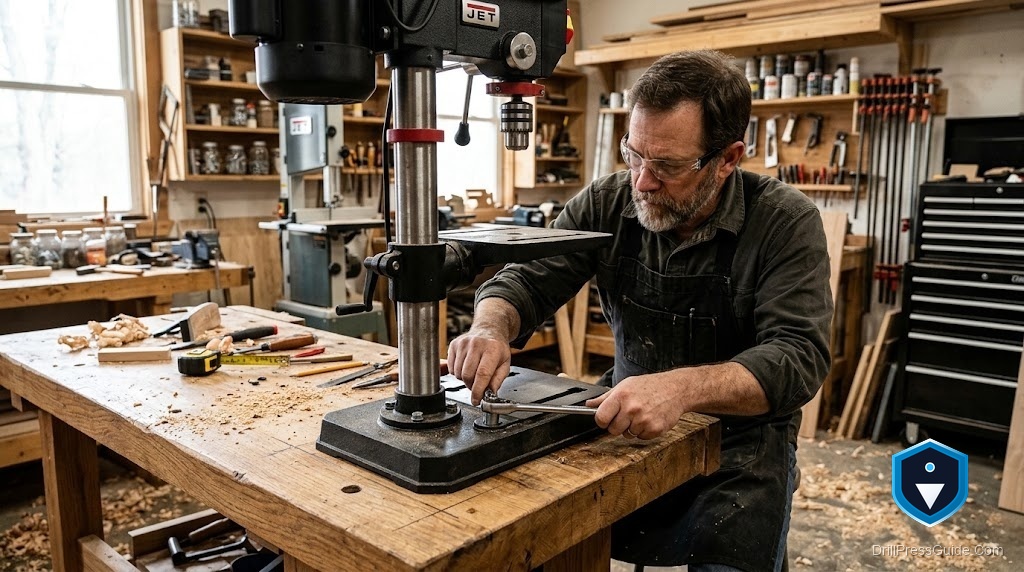
An unmounted drill press is a hazard waiting to happen. The machine is top-heavy, drilling forces try to twist it, and a bit that grabs can spin an unsecured press or the workpiece with it. “Mounting” covers a few different situations, though, bolting a benchtop unit to a bench, setting it on a dedicated stand, or anchoring a floor model, and each has its own method. This guide walks through all three so your press ends up solid, level, and safe no matter which one you own.
To mount a drill press, bolt it through the base’s mounting holes into a sturdy surface: a benchtop model onto a solid workbench or a dedicated stand, and a floor model onto the shop floor or a heavy base. Use bolts sized to the base holes, check that the machine sits level and does not rock, and confirm the surface can carry the weight and resist twisting. Mounting is required, not optional.
Why mounting is non-negotiable
A drill press concentrates weight up high and generates torque when it cuts. If a bit binds, the reaction can rotate an unsecured machine or fling the work. Bolting the base down turns the press and its support into one rigid unit that stays put, which is why safety authorities like OSHA and CCOHS treat secure mounting as a baseline requirement, not a nicety. Skipping it does not just risk the machine tipping; it makes every hole less accurate because the press can shift under load.
Mounting a benchtop press to a bench
The most common setup. Choose a bench that is heavy and rigid enough not to tip or flex under a top-heavy machine. Position the press so the head has clearance and the handle swings freely, mark through the base’s mounting holes, and drill pilot holes. Bolt it down with bolts sized to the holes, either lag screws into a thick wooden top or through-bolts with washers and nuts under the bench for the firmest hold. Snug everything and confirm the press does not rock. A benchtop machine such as the WEN 4210T has cast mounting holes in its base intended for exactly this.
Mounting on a dedicated stand
If bench space is tight, a drill press stand gives a stable, correct-height base. Assemble the stand fully, then bolt the press base to the stand’s top plate through the mounting holes, just as you would to a bench. Because a stand plus a top-heavy press can itself become tippy, many stands are designed to be weighted or, in a permanent shop, anchored to the floor. Confirm the assembled stand is stable before use.
Anchoring a floor press
A floor model stands on its own base but should still be secured, especially a tall one, so it cannot tip or walk. Level it on the floor, shimming if needed so it does not rock, then anchor the base to a concrete floor with suitable masonry anchors through the mounting holes, or bolt it to a heavy base plate. A level, anchored floor press is both safer and more accurate.
Mounting method by machine
| Machine | Mount to | Fasteners | Key check |
|---|---|---|---|
| Benchtop press | Solid bench | Lag screws or through-bolts | Bench won’t tip; no rock |
| Benchtop press | Dedicated stand | Bolts to stand top plate | Stand weighted or anchored |
| Floor press | Concrete floor | Masonry anchors | Level, no rock, no tip |
Final checks before drilling
Once mounted, verify three things. The press does not rock, wobble, or shift when you push on the head. The base bolts are tight. And the machine sits level so the table and travel are true. Then set up the work as usual, clamped, never hand-held, per the same safety guidance. A properly mounted press is the foundation every other setup step depends on.
The verdict
Mounting a drill press means bolting its base to a support solid enough to resist a top-heavy, torque-producing machine: a bench or stand for benchtop units, the floor or a heavy base for floor models. Three takeaways: mounting is required for both safety and accuracy, match the method to your machine, bench, stand, or anchored floor, and always finish by confirming the press is level and does not rock. Who must do this? Everyone, an unmounted drill press is unsafe and drills poorly, regardless of size.
Frequently asked questions
How do you mount a drill press? Bolt the base through its mounting holes into a sturdy surface: a benchtop model onto a solid bench or dedicated stand, a floor model onto the concrete floor or a heavy base. Then confirm it sits level and does not rock.
Does a drill press have to be bolted down? Yes. A drill press is top-heavy and produces torque that can spin an unsecured machine if a bit grabs. Bolting the base down is a baseline safety requirement and also makes drilling more accurate.
What bolts should I use to mount a benchtop drill press? Bolts sized to the base’s mounting holes, lag screws into a thick wooden bench top, or through-bolts with washers and nuts underneath for the firmest hold. Snug them and check for rock.
Can I mount a drill press on a stand instead of a bench? Yes. Assemble the stand fully and bolt the press base to its top plate through the mounting holes. Because the combination can be tippy, weight the stand or anchor it to the floor.
How do I secure a floor drill press? Level it on the floor, shimming out any rock, then anchor the base to concrete with masonry anchors through the mounting holes, or bolt it to a heavy base plate so a tall machine cannot tip.
What if my bench isn’t heavy enough? Use a heavier or more rigid bench, add mass, or fix the bench to the wall or floor. A light bench under a top-heavy press can tip, which defeats the purpose of mounting.
How do I know the press is mounted correctly? It should not rock, wobble, or shift when you push on the head, the base bolts should be tight, and the machine should sit level so the table and spindle travel are true.
References
- OSHA, Woodworking eTool: Drill Press. https://www.osha.gov/etools/woodworking/production/machines-tools/drill-press
- CCOHS, Metalworking Machines: Drill Presses. https://www.ccohs.ca/oshanswers/safety_haz/metalworking/drillpresses.html
- Pro Tool Reviews, How to Use and Set Up a Drill Press. https://www.protoolreviews.com/how-to-use-drill-press/


