How to Choose a Drill Press: A Buyer's Framework That Actually Works
Drill press listings throw a wall of numbers at you, swing, speeds, spindle travel, chuck capacity, motor rating, and it is easy to fixate on whichever one sounds biggest. That is how people end up with a press that has impressive specs and still cannot do their work. Choosing well is less about chasing the highest number and more about running your actual projects through a short, ordered checklist. Here is that checklist, in the order that keeps you from overbuying or underbuying.
To choose a drill press, first decide benchtop or floor based on your space and workpiece height, then confirm the swing fits your widest work, the spindle travel covers your deepest hole, and the speed range suits your materials. After that, weigh chuck capacity, power, table quality, and build rigidity. Match these to the work you do rather than buying the biggest machine.
Step 1: Benchtop or floor
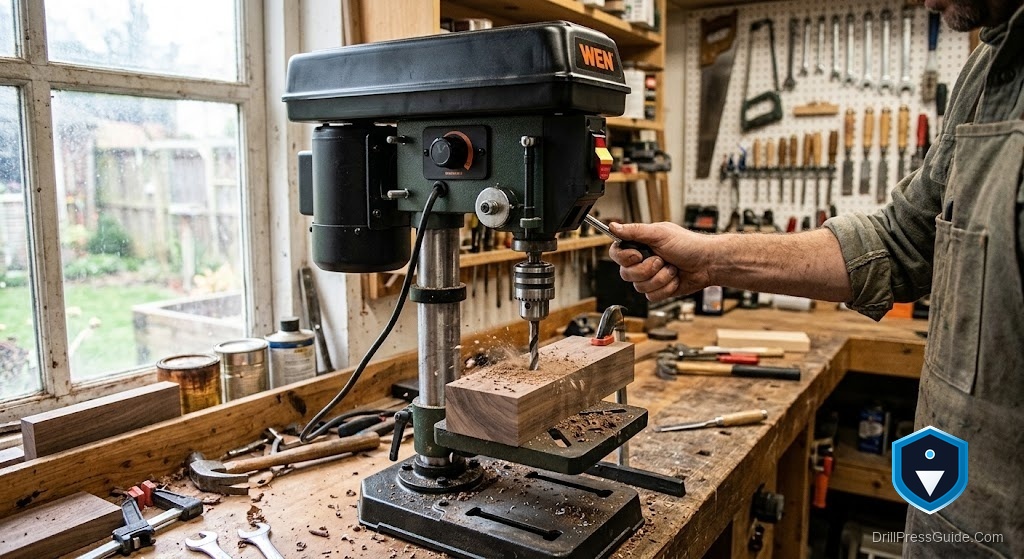
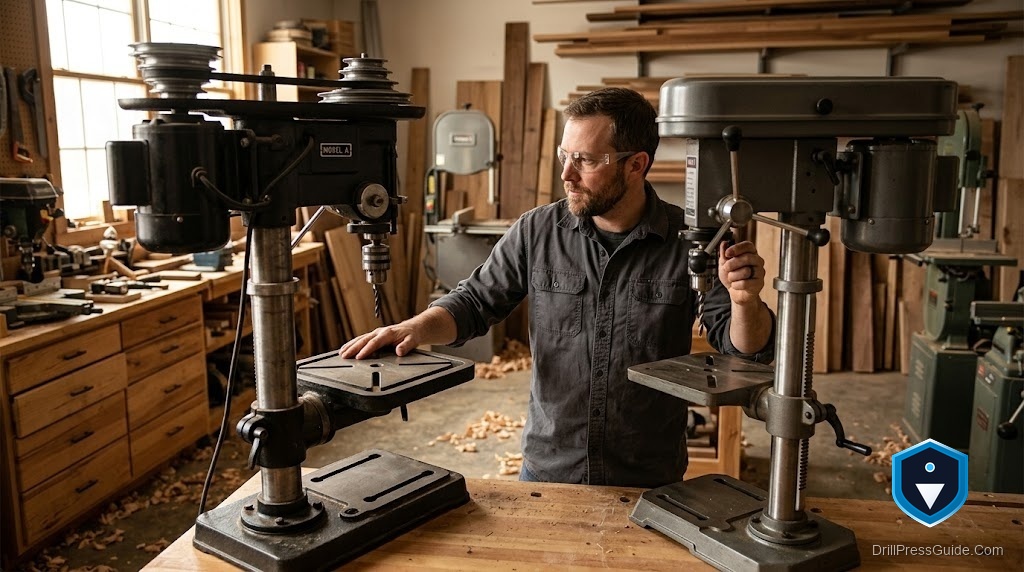
Start with format, because it frames everything else. A benchtop press sits on a bench, saves space, and covers small to medium work. A floor press stands on the ground with a tall column for tall workpieces, more travel and power, and greater stability. If you drill tall stock or want maximum capacity and have the room, go floor; otherwise a benchtop is lighter, cheaper, and enough. A benchtop like the WEN 4210T suits most home shops, while a floor machine like the WEN 4227T is the move when capacity matters.
Step 2: Swing, travel, and speed
These three decide whether the press can physically do your work.
Swing is twice the bit-to-column distance and sets the widest piece you can center a hole in. Measure your widest work and make sure the swing covers it.
Spindle travel is how deep the bit descends in one pass. Check it against your deepest hole so you are not drilling in awkward stages.
Speed range matters because different bits and materials need different RPM, slow for big bits and metal, fast for small bits in wood. A wider range, or variable speed, means you can match speed to the job, the habit setup guides like Pro Tool Reviews insist on.
Step 3: The secondary specs
| Spec | What to look for | Why it matters |
|---|---|---|
| Chuck capacity | Fits your largest bit shank | Limits maximum bit size |
| Motor power | Enough for your materials | Prevents bogging in metal or big bits |
| Table | Flat, tilts, easy to raise and lock | Supports and angles the work |
| Rigidity and mass | Solid column, minimal flex | Reduces runout and wander |
| Speed change | Belt steps or variable | Ease of matching speed |
These refine the choice once the format and the big three fit.
Step 4: Sanity-check against your projects
Before buying, run two or three real jobs through the specs. The tallest thing you drill against table clearance. The widest against swing. The deepest against travel. The toughest material against speed range and power. If a machine passes all of them with a little headroom, it is right-sized. If you find yourself justifying a spec you will never use, step back down. And remember the safety and mounting basics from OSHA and CCOHS apply to whatever you buy: it must be bolted down and the work clamped.
The verdict
Choosing a drill press works best as an ordered checklist: pick benchtop or floor for your space and workpiece height, confirm swing, spindle travel, and speed range fit your work, then weigh chuck capacity, power, table, and rigidity. Three takeaways: decide format first because it frames everything, let the big three, swing, travel, speed, gate whether a machine can do your jobs at all, and sanity-check the final pick against two or three real projects. Who is this for? Anyone staring at spec sheets unsure which number matters, run your work through the checklist and the right press stands out.
Frequently asked questions
How do I choose a drill press? Decide benchtop or floor by space and workpiece height, confirm the swing fits your widest work, spindle travel covers your deepest hole, and the speed range suits your materials, then weigh chuck capacity, power, table quality, and rigidity.
Should I get a benchtop or floor drill press? Benchtop for small to medium work and limited space; floor for tall workpieces, more travel and power, and greater stability when you have the room. Start with this choice, since it frames the rest.
Which specs matter most? Swing (widest piece you can center), spindle travel (deepest single-pass hole), and speed range (matching RPM to material). If these three fit your work, the machine can physically do the job.
How many speeds do I need? Enough range to run slow for large bits and metal and fast for small bits in wood. More belt steps or variable speed make matching easier, which improves finish and bit life.
Does motor power matter for a drill press? Yes, for drilling thick metal, large bits, hole saws, and Forstner bits. Light presses can bog down; more power and rigidity keep the cut steady. Match power to your toughest material.
What chuck capacity should I look for? One that accepts your largest bit shank with a little margin. Chuck capacity sets the biggest bit you can mount, so check it against the bits you actually use.
How do I avoid overbuying? Run two or three real projects through the specs, tallest, widest, deepest, toughest, and buy the machine that clears them with modest headroom rather than the one with the biggest numbers you will never use.
References
- Pro Tool Reviews, How to Use and Set Up a Drill Press. https://www.protoolreviews.com/how-to-use-drill-press/
- OSHA, Woodworking eTool: Drill Press. https://www.osha.gov/etools/woodworking/production/machines-tools/drill-press
- CCOHS, Metalworking Machines: Drill Presses. https://www.ccohs.ca/oshanswers/safety_haz/metalworking/drillpresses.html