
How to Use a Drill Press: A Clear, Shop-Ready Method
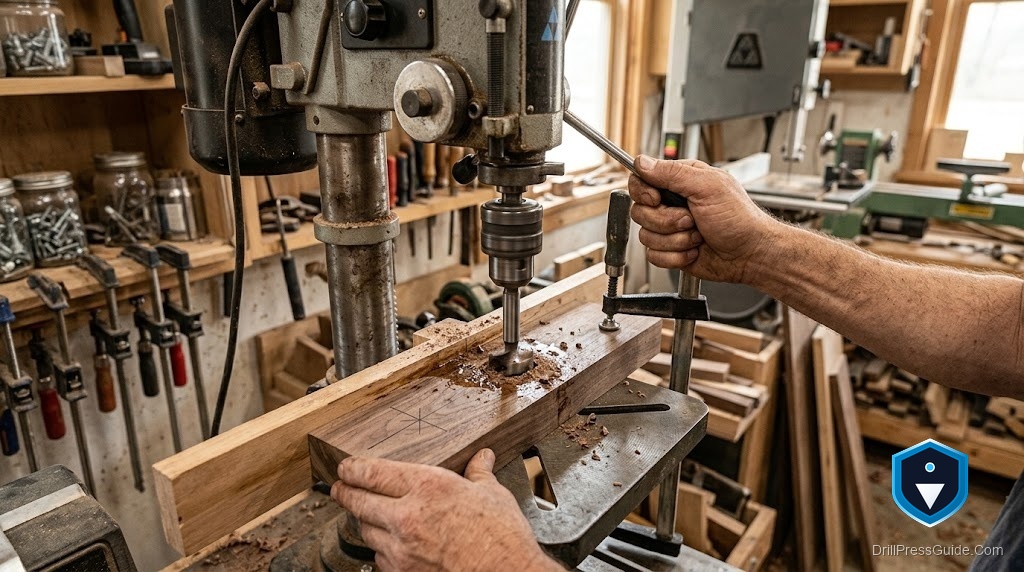
Plenty of people learn a drill press by watching a video, hitting pause, and copying what the hands do. That works, but a video moves fast and skips the why, so you end up mimicking steps without knowing which ones actually matter. This walks through the same sequence a good demonstration would, in order, with the reasoning attached, so you can run the machine confidently from the first hole instead of pausing and rewinding.
To use a drill press, set the correct speed for your bit and material, secure the workpiece in a vise or with clamps, mark and punch the center, position it under the bit, set the depth stop if needed, then start the machine and feed the bit down smoothly, easing off at breakthrough and letting the spindle stop before you clear chips. The order is the whole method.
Before you switch on
Three things happen before the motor runs, and skipping any of them shows up in the hole.
Set the speed. Match it to the bit and material: slower for large bits and metal, faster for small bits in wood. On a belt machine you move the belt to the right pulley step; on a variable-speed model you turn a dial. Wrong speed is the most common beginner error, so fix it first.
Secure the work. Clamp it or hold it in a vise so it cannot spin, and set a backer board underneath. Never hold the piece by hand, the rule at the heart of the OSHA and CCOHS safety guidance.
Mark and punch the center. Mark where the hole goes and dent it with a center punch or awl so the bit does not skate off the mark when it touches down.
Drilling the hole
With setup done, the drilling itself is calm and deliberate.
1. Position the work. Line the punched center under the bit. Lower the bit by hand, motor off, to confirm it lands on the mark, and adjust the work.
2. Set the depth stop if needed. For a set depth or several identical holes, lower the bit to the target and set the stop.
3. Start the machine. Switch on with hands clear and the chuck key removed.
4. Feed smoothly. Pull the feed lever to bring the bit down at a steady rate. Let the bit cut, do not force it. In metal, add cutting fluid, and in deep holes, back out now and then to clear chips, which the general method in Pro Tool Reviews’ guide also stresses.
5. Ease off at breakthrough. As the bit nears the far side, slow the feed so it does not grab as it exits.
6. Retract and stop. Raise the bit, switch off, and let the spindle stop on its own before clearing chips or changing bits.
The sequence at a glance
| Order | Step | Key point |
|---|---|---|
| 1 | Set speed | Slower for big bits and metal |
| 2 | Secure work, add backer | Never hand-hold |
| 3 | Mark and punch center | Stops the bit skating |
| 4 | Position under bit | Check with motor off |
| 5 | Set depth stop | For depth or repeat holes |
| 6 | Start, feed smoothly | Let the bit cut |
| 7 | Ease at breakthrough | Prevents grabbing |
| 8 | Retract, stop, clear | Brush chips, never by hand |
Common beginner mistakes
Running too fast, which burns wood and dulls metal bits. Not punching the center, so the bit wanders off the mark. Hand-holding the work. Forcing the feed instead of letting the bit cut. And clearing chips or changing bits before the spindle stops. Each is a shortcut a rushed video watcher tends to copy without realizing it is the wrong move.
The verdict
Using a drill press is a fixed sequence: speed, secure, mark and punch, position, depth stop, then drill smoothly and let the spindle stop before clearing chips. Learn it in that order and the machine is easy and predictable, no pausing and rewinding required. Three takeaways: set the correct speed before anything else because it is the top beginner error, always secure the work and punch the center, and feed smoothly while easing off at breakthrough. Who is this for? Anyone starting out who wants the reasoning behind each step, not just hands to copy.
Frequently asked questions
How do you use a drill press step by step? Set the speed, secure the workpiece, mark and punch the center, position it under the bit, set the depth stop if needed, start the machine, feed the bit smoothly, ease off at breakthrough, then retract and let the spindle stop before clearing chips.
What is the first thing to do when using a drill press? Set the correct speed for your bit and material. Running too fast is the most common beginner mistake and causes burning, grabbing, and dull bits.
How fast should the bit feed into the work? Steadily, letting the bit cut rather than forcing it. Ease off as the bit breaks through the far side to prevent it grabbing on exit.
Do I need to punch the center first? Yes. A center punch or awl dents the spot so the bit does not skate off your mark when it first touches the surface.
Why should I let the spindle stop before clearing chips? Because hot, sharp swarf can cut you and wrap around a spinning bit. Always let it stop and use a brush, not your hand.
How do I drill to a consistent depth? Lower the bit to the target depth and set the depth stop, so the quill cannot travel past it. This also makes repeat holes identical.
Should I use cutting fluid? For metal, yes. It keeps the bit cool and cutting cleanly. Wood does not need it. Back the bit out to clear chips in deeper holes.
References
- OSHA, Woodworking eTool: Drill Press. https://www.osha.gov/etools/woodworking/production/machines-tools/drill-press
- CCOHS, Metalworking Machines: Drill Presses. https://www.ccohs.ca/oshanswers/safety_haz/metalworking/drillpresses.html
- Pro Tool Reviews, How to Use and Set Up a Drill Press. https://www.protoolreviews.com/how-to-use-drill-press/


