
How to Slow Down Drill Press Speed, Step by Step
Some drill presses simply will not go slow enough. You move the belt to the lowest setting, and the chart still reads seven or eight hundred RPM, which is fine for wood but far too fast for a large hole saw or a big bit in steel. That gap between the speed you have and the speed the job needs is a real limitation of many budget presses, and the fix is not just moving the belt you already have. This is about the options for getting a genuinely low spindle speed, from the built-in adjustment to a permanent modification.
To slow drill press speed, first use the machine’s own adjustment: move the belt toward the largest spindle pulley or turn the variable-speed dial to its low end. When the lowest built-in speed is still too high, add mechanical reduction with a jackshaft or a slow-speed pulley setup, or step up to a variable-speed machine. Avoid electronic router-style controllers on a standard motor.
Step one: use the built-in low speed first
Before modifying anything, make sure you are actually at the machine’s slowest setting.
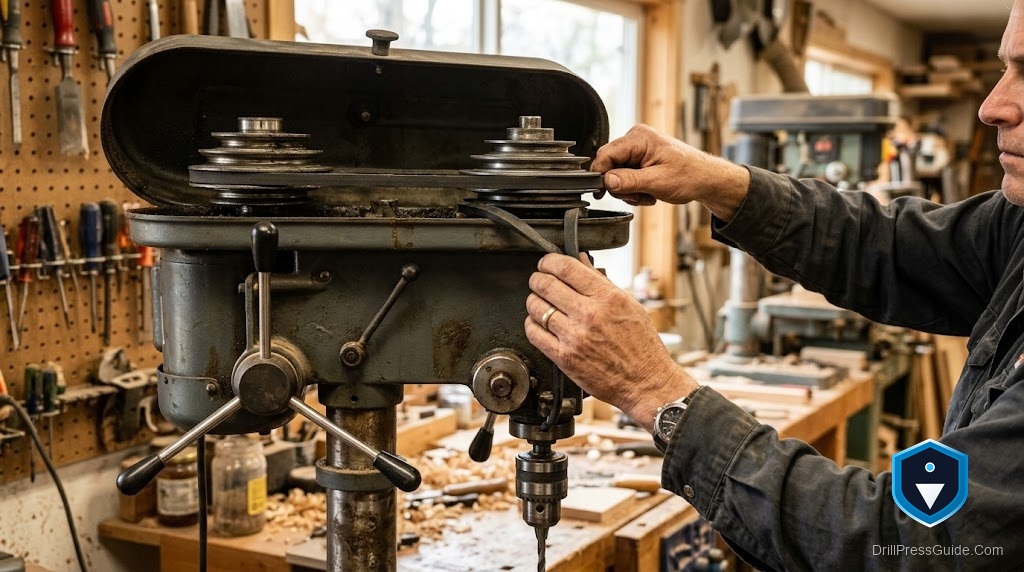
On a belt press, unplug it, open the cover, release the belt tension, and set the belt on the largest pulley on the spindle side with the smallest on the motor side. Read the resulting RPM from the chart inside the cover. On a variable-speed press, run the dial or lever to its lowest mark. Often people think their press cannot go slow when it simply was not set to its lowest ratio. General setup references like Pro Tool Reviews treat this belt-position change as the first move for a reason.
Step two: when the lowest speed is still too fast
If you are at the slowest built-in setting and a hole saw still burns or a big bit grabs, you need mechanical reduction, meaning you add another stage of pulleys so the motor turns the spindle even slower.
A jackshaft. This is the classic fix. You mount an intermediate shaft with its own pulleys between the motor and the spindle, adding a second reduction stage. The motor drives the jackshaft slowly, and the jackshaft drives the spindle slower still, reaching speeds far below the factory low. It takes some fabrication and space but genuinely solves the problem.
A slow-speed pulley set. Some presses accept larger or additional pulleys that lower the range. This is simpler than a jackshaft where it fits.
Both work because they change the drive ratio, the same principle as moving the belt, just taken further with more reduction.
Step three: or change the machine
Sometimes the honest answer is that the machine cannot reach the speed you need without more trouble than it is worth. A variable-speed drill press gives a low end out of the box and lets you dial the exact RPM, which is the least-hassle path if slow speeds are a constant need. Weigh the fabrication of a jackshaft against simply owning a machine built for the range you want.
The method to skip
Do not slow a standard single-phase induction motor with a cheap electronic speed controller, the router-dimmer type. It reduces torque and slows the motor’s own cooling fan, so the motor overheats and can fail, and it does not control speed cleanly. Real slow speed comes from the drive ratio, not from choking the motor electrically.
Options compared
| Method | How slow it goes | Effort |
|---|---|---|
| Lowest belt setting | Factory minimum, often 500 to 800 RPM | Two minutes |
| Variable-speed dial | Machine’s low end | Instant, if equipped |
| Slow-speed pulley set | Below factory low | Moderate, if it fits |
| Jackshaft | Well below factory low | Higher, some fabrication |
| Electronic controller on induction motor | Not recommended | Overheats the motor |
Common mistakes
Assuming the press is maxed out when the belt is not actually on the lowest ratio. Skipping the unplug step before opening the cover. Building a jackshaft with a loose or misaligned belt that slips or squeals. And reaching for a dimmer-style controller instead of adding mechanical reduction. The order matters: exhaust the built-in low speed, then add reduction, then consider a new machine.
The verdict
Slowing drill press speed starts with the machine’s own lowest ratio, moving the belt to the largest spindle pulley or dialing a variable-speed model down. When that is still too fast for hole saws or big bits in steel, add mechanical reduction with a jackshaft or a slow-speed pulley set, or move to a variable-speed press. Three takeaways: confirm you are truly at the lowest built-in setting first, add a second reduction stage when you need to go lower, and never fake it with an electronic controller on a standard motor. Who needs to go this far? Anyone running large hole saws or drilling heavy metal, where factory low speeds are simply not slow enough.
Frequently asked questions
How do I slow down drill press speed? Set the machine to its lowest built-in ratio first, moving the belt to the largest spindle pulley or turning a variable-speed dial down. If that is still too fast, add mechanical reduction with a jackshaft or slow-speed pulleys.
What is a jackshaft on a drill press? An intermediate shaft with its own pulleys mounted between the motor and spindle, adding a second reduction stage so the spindle turns far slower than the factory low speed.
Why won’t my drill press go slow enough? Many budget presses bottom out around 500 to 800 RPM, which is too fast for large hole saws and big bits in steel. Reaching lower requires added reduction or a variable-speed machine.
Can a slow-speed pulley kit help? Yes, where it fits your press. Larger or additional pulleys lower the speed range with less work than building a jackshaft.
Is an electronic speed controller a good way to slow it down? No, not on a standard single-phase induction motor. It cuts torque and slows the cooling fan, overheating the motor. Use the drive ratio instead.
What speed do hole saws and big bits need? The slowest the machine can manage, often below the factory minimum for large diameters, which is exactly why added reduction is sometimes necessary.
Should I just buy a variable-speed drill press? If you frequently need low speeds, yes. It gives a low end out of the box and dials exact RPM without fabricating a jackshaft.
References
- Pro Tool Reviews, How to Use and Set Up a Drill Press. https://www.protoolreviews.com/how-to-use-drill-press/
- OSHA, Woodworking eTool: Drill Press. https://www.osha.gov/etools/woodworking/production/machines-tools/drill-press
- CCOHS, Metalworking Machines: Drill Presses. https://www.ccohs.ca/oshanswers/safety_haz/metalworking/drillpresses.html


