How to Slow Down a Drill Press: Setup, Checks, and Common Mistakes
The most common reason a hole comes out burnt, or a big bit screams and grabs, or a metal bit goes dull in one job, is simple: the press was spinning too fast. New owners often leave the speed wherever it was and push on, not realizing that speed is the dial that matters most for large bits, metal, and hole saws. Slowing the machine down is usually easy, but the right way depends on what kind of press you own, and there is one wrong way that quietly ruins motors.
To slow down a drill press, change the drive ratio: on a belt-and-pulley machine, move the belt to a larger pulley on the spindle and a smaller one on the motor; on a variable-speed machine, turn the speed dial or lever. Do not try to slow a standard press with a router-style electronic speed controller, which overheats the motor. Bigger bits and metal need the slow speeds.
Why slower is often better
Speed is really about the rim speed of the bit’s cutting edge, and big bits cover a lot of distance per turn. Spin them fast and the edge overheats, burning wood, dulling in metal, and grabbing on breakthrough. Slowing down keeps the cutting edge cool and controlled. This is the same principle behind matching speed to material in general setup guides like Pro Tool Reviews’, and it is why the largest cutters, hole saws and big Forstner bits, want the slowest speeds the machine offers.
Belt-and-pulley presses: move the belt
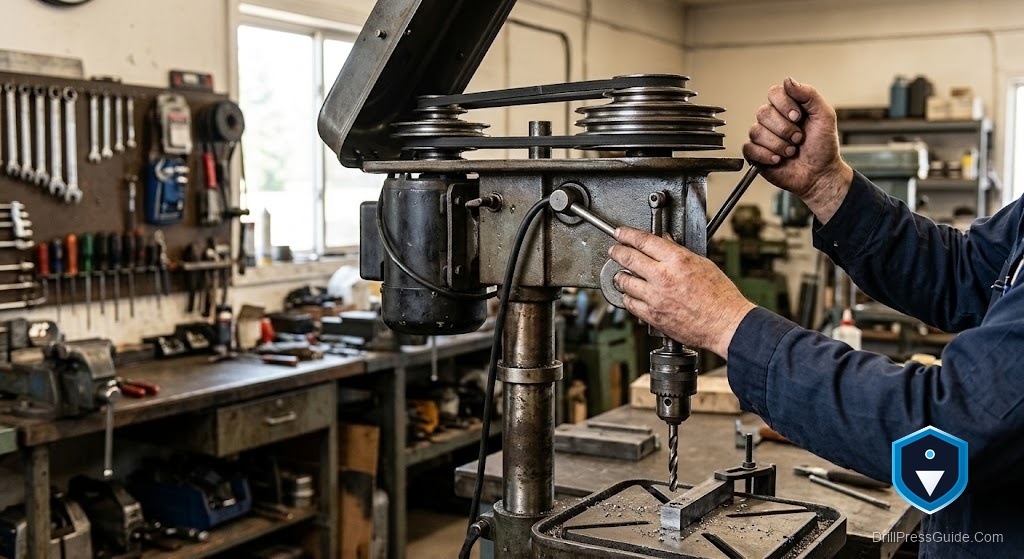
Most drill presses set speed with stepped pulleys and a belt. To slow it down:
1. Unplug the machine. Always, before opening the belt cover.
2. Open the cover and release belt tension. Most presses have a lever or a motor that slides to loosen the belt.
3. Move the belt to a bigger spindle pulley. For the slowest speeds, put the belt on the largest pulley step on the spindle side and the smallest on the motor side. The speed chart inside the cover shows which combination gives which RPM.
4. Retension and close up. Snug the belt so it does not slip but is not drum-tight, then close the cover before plugging back in.
Variable-speed presses: just turn the dial
If your machine has variable speed, slowing down is a dial or lever, no belt moving needed. On many designs you adjust the speed while the motor runs, which is part of the appeal. Set it to the low end for big bits and metal and read the RPM off the gauge if there is one.
The method to avoid
There is a tempting shortcut: wire in a cheap router-style electronic speed controller to slow the motor. On a standard single-phase induction motor this is a mistake. It cuts torque and slows the cooling fan, so the motor runs hot and can fail, and it does not truly control speed the way the drive ratio does. Genuine variable speed comes from the machine’s own mechanism or a proper drive on the right motor, not a dimmer box.
Speed guide by job
| Job | Speed | How to get there |
|---|---|---|
| Small bits in wood | Fast | Belt on small spindle pulley, or dial up |
| General wood drilling | Medium | Middle pulley steps, or mid dial |
| Metal drilling | Slow | Large spindle pulley, or dial down, use fluid |
| Large Forstner bits | Slow | Slowest belt setting or dial |
| Hole saws | Slowest | Lowest speed the machine offers |
Common mistakes
Leaving the speed high for a big bit, which burns and grabs. Forgetting to unplug before opening the belt cover. Over-tightening the belt, which strains bearings, or leaving it too loose, which slips. And reaching for an electronic controller on a standard motor instead of simply moving the belt. The belt takes two minutes and does the job right.
The verdict
Slowing down a drill press means changing the drive ratio, moving the belt to a larger spindle pulley on a pulley machine or turning the dial on a variable-speed one, and it is the single most useful adjustment for big bits, metal, and hole saws. The one method to skip is a router-style speed controller on a standard motor, which overheats it. Three takeaways: match speed to the bit and material with slower for bigger and for metal, unplug before opening the belt cover and retension properly, and never fake variable speed with a dimmer box on an induction motor. Who needs this most? Anyone drilling metal or running large cutters, where too much speed burns, grabs, and destroys bits.
Frequently asked questions
How do you slow down a drill press? Change the drive ratio. On a belt machine, move the belt to a larger pulley on the spindle and a smaller one on the motor. On a variable-speed machine, turn the speed dial or lever.
Why would I want to slow down my drill press? Big bits, metal, and hole saws need slow speeds to keep the cutting edge cool and controlled. Too much speed burns wood, dulls metal bits, and makes large cutters grab.
Can I use a speed controller to slow a drill press? Not a router-style electronic controller on a standard single-phase motor. It cuts torque and slows the cooling fan, overheating the motor. Move the belt or use a proper variable-speed machine.
What speed should I use for metal? Slow, using a large spindle pulley or a low dial setting, along with cutting fluid. The larger the bit, the slower it should run.
How do I set the slowest speed on a belt drill press? Unplug it, open the cover, and put the belt on the largest spindle pulley and the smallest motor pulley. The chart inside the cover confirms the RPM.
Is it safe to change speed while the press runs? Only on variable-speed machines designed for it. On belt-and-pulley presses, always unplug and stop the machine before opening the cover to move the belt.
Why does my belt slip after I move it? The belt tension is too loose. Retension it so it drives without slipping but is not drum-tight, then close the cover.
References
- Pro Tool Reviews, How to Use and Set Up a Drill Press. https://www.protoolreviews.com/how-to-use-drill-press/
- OSHA, Woodworking eTool: Drill Press. https://www.osha.gov/etools/woodworking/production/machines-tools/drill-press
- CCOHS, Metalworking Machines: Drill Presses. https://www.ccohs.ca/oshanswers/safety_haz/metalworking/drillpresses.html