
How to Set Up a Drill Press Without Losing Accuracy
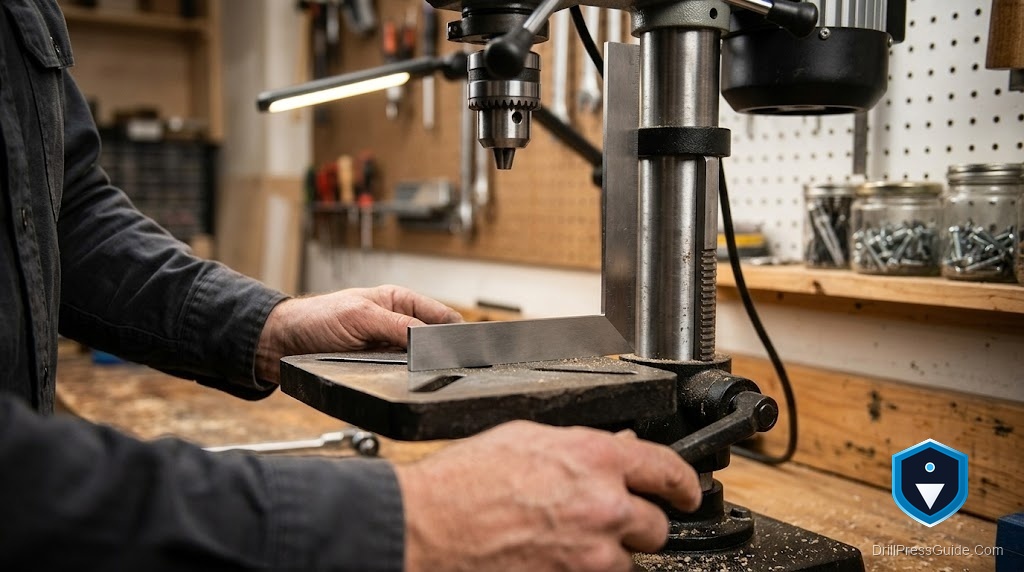
A drill press that is set up carelessly will still make holes, and that is the trap. It hides its own errors, drilling slightly off-square, wandering off the mark, or chewing the material, and you blame the bit or your technique when the real problem was the ten minutes of setup you skipped. Setting one up properly is not complicated, but each step removes a specific way the machine can lie to you, and doing them in order is what turns a rough drill into an accurate one.
To set up a drill press, secure it to a solid bench or floor, mount and seat the chuck, square the table to the bit, set the correct speed for your bit and material, then position the work with a vise or clamps, set the depth stop, and confirm everything with a test hole in scrap. Each step protects accuracy that the next one depends on.
Start with a stable base
Accuracy begins with a machine that does not move. Bolt a benchtop press to a heavy bench and a floor press to concrete, and check it does not rock. Everything downstream, squareness, placement, depth, assumes the machine holds still when the bit grabs, which is also the stability the safe-setup guidance from OSHA and CCOHS is built around.
Seat the chuck and check it runs true
Mount the chuck on its taper with the seat clean and dry, and seat it firmly, since a dirty taper causes wobble or a dropped chuck. Then spin it by hand and watch the bit tip for obvious wobble. A little is normal, gross wobble means a bent bit, a dirty taper, or a chuck problem to fix now, before it shows up in every hole.
Square the table to the bit
This is the step most people skip and most regret. Put a straight rod in the chuck and use a square against it, or bend a rod into an L, chuck one end, and swing it to compare the gap to the table on both sides. Adjust the table until the bit is truly perpendicular. An out-of-square table drills slanted holes no technique can straighten.
Set the right speed
Match speed to bit size and material: slower for large bits and metal, faster for small bits in wood. On a belt-and-pulley machine, open the cover and move the belt to the right step; on a variable-speed machine, dial it in. Too fast is the usual error, burning wood and dulling bits in metal.
Secure the work and set depth
Clamp the workpiece or hold it in a drill press vise so it cannot spin, and add a backer board under the piece to protect the table and give a clean exit. If you want holes to a set depth, or many identical holes, lower the bit to the mark and set the depth stop now. A vise also makes repeat holes line up without re-measuring.
Confirm with a test hole
Before the real work, drill a hole in scrap of the same material. Check that it is square, on the mark, the right depth, and clean. This last step catches a wrong speed or a table still slightly off before it ruins your actual piece.
Setup order at a glance
| Step | Do this | It protects |
|---|---|---|
| 1 | Bolt down, confirm no rock | Stability and safety |
| 2 | Seat chuck, check for wobble | Runout and grip |
| 3 | Square the table to the bit | Straight, square holes |
| 4 | Set speed for bit and material | Finish and bit life |
| 5 | Clamp work, add backer, set depth stop | Placement and clean exit |
| 6 | Test hole in scrap | Catches errors early |
Common setup mistakes
Running too fast, which is the most frequent and the most damaging to bits and finish. Never squaring the table, then wondering why holes lean. Hand-holding the work instead of clamping it. And skipping the scrap test, so the first flaw appears in the real piece. Every one of these is a shortcut that costs more time than the step would have taken.
The verdict
Setting up a drill press is a short, ordered routine, stable base, seated chuck, squared table, correct speed, secured work with a depth stop, then a test hole, and each step guards the accuracy the next relies on. Skip them and the machine still drills, just not where or how you intended. Three takeaways: square the table to the bit because nothing downstream can fix a leaning hole, set speed to the bit and material to save your bits and finish, and always prove the setup on scrap before the real piece. Who benefits most? Anyone chasing clean, square, repeatable holes, which is the whole reason to own a press.
Frequently asked questions
How do you set up a drill press? Bolt it down, seat the chuck, square the table to the bit, set the correct speed, clamp the work and set the depth stop, then drill a test hole in scrap to confirm everything before real work.
How do I square a drill press table? Chuck a straight rod and check it against a square, or bend a rod into an L, chuck one end, and swing it to compare the gap to the table on each side. Adjust the table until the bit is perpendicular.
What speed should I set? Slower for large bits and metal, faster for small bits in wood. Move the belt on a pulley machine or turn the dial on a variable-speed one. Running too fast is the most common mistake.
How do I set up a drill press vise? Bolt or clamp the vise to the table so it cannot shift, clamp the workpiece in its jaws, and position it under the bit. It also helps line up repeat holes without re-measuring.
How do I use the depth stop? Lower the bit to your marked depth, then set the stop so the quill cannot travel past it. This gives consistent depth and identical repeat holes.
Why are my holes not square even after setup? Usually the table was not squared to the bit, or the chuck or bit is wobbling. Recheck squareness and look for runout from a bent bit or dirty taper.
Do I need to test on scrap first? Yes. A test hole in matching scrap confirms squareness, placement, depth, and speed, catching any error before it reaches your actual workpiece.
References
- OSHA, Woodworking eTool: Drill Press. https://www.osha.gov/etools/woodworking/production/machines-tools/drill-press
- CCOHS, Metalworking Machines: Drill Presses. https://www.ccohs.ca/oshanswers/safety_haz/metalworking/drillpresses.html
- Pro Tool Reviews, How to Use and Set Up a Drill Press. https://www.protoolreviews.com/how-to-use-drill-press/


