
How to Mill with a Drill Press: A Clear, Shop-Ready Method
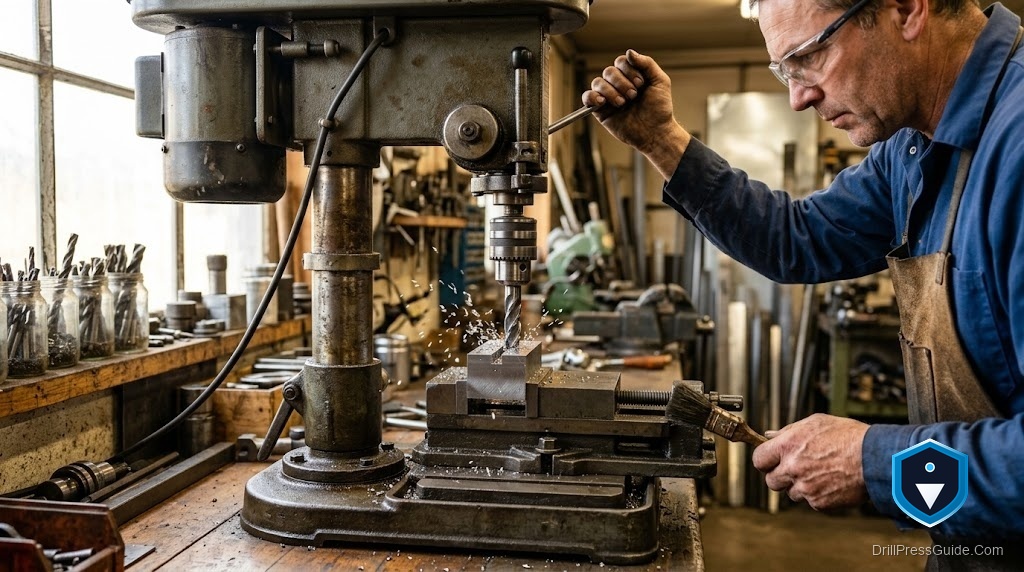
Search this phrase and you will find plenty of videos of people cutting slots on a drill press. What you will not always hear is the part where the spindle flexes, the end mill grabs, and the workpiece jumps. Milling on a drill press sits in an awkward spot: it is physically possible for the lightest jobs and genuinely risky for anything more, and the honest way to teach it is to show the narrow method that works while being blunt about why the machine fights you the rest of the time.
Milling with a drill press means taking very light cuts in soft material using a cross-slide vise to move the work and a center-cutting end mill, with the quill locked short for rigidity. It works only for shallow slots and light cleanup in aluminum or plastic, not for steel, deep cuts, or accurate profiles, because a drill press spindle and chuck are built for downward force, not the side loads milling creates.
Understand the limit before the method
A milling machine is rigid in every direction and grips the cutter in a collet. A drill press feeds straight down through a sliding quill and grips the bit in a friction chuck. Push a cutter sideways and two things give: the quill flexes because it needs clearance to slide, and the chuck can let the end mill twist or walk out. That is the whole reason milling on a press is limited, and it is why the safety guidance from CCOHS and OSHA about keeping work secured and the tool matched to its job hits hardest here.
The method that works for light jobs
If you accept those limits and only need a shallow slot or a bit of cleanup in soft metal, here is the least-bad way.
1. Use the right cutter. A center-cutting end mill, which can plunge as well as move sideways. Keep it small, a large mill loads the spindle far more.
2. Lock the quill short. Retract the quill so the spindle sticks out as little as possible, then lock it, which minimizes flex. Set depth by raising the table, not by extending the quill.
3. Bolt down a cross-slide vise. A cross-slide vise moves the work in two axes under the fixed spindle. Bolt it solidly to the table so nothing shifts, and clamp the workpiece hard in its jaws.
4. Take tiny cuts. A few thousandths per pass, no more. Feed slowly and evenly by cranking the vise, and listen: a loading motor or chatter means back off.
5. Stop at the first sign of trouble. Grab, chatter, or a cutter trying to climb means stop. You are working at the edge of what the machine allows.
What it can and cannot do
| Task | On a drill press | Reality |
|---|---|---|
| Shallow slot in aluminum | Marginal, possible | Light passes, locked quill |
| Light edge cleanup, soft metal | Marginal, possible | Small cutter, tiny cuts |
| Plunging a pocket start | Possible with center-cutting mill | Then move very gently |
| Slots or profiles in steel | No | Spindle and chuck cannot cope |
| Accurate, repeatable milling | No | Flex and chuck slip ruin accuracy |
Protect yourself and the machine
Eye and face protection are not optional, because a cutter that lets go or a part that shifts moves fast. Keep hands away from the point of operation and clear chips with a brush, never fingers. Understand that even done carefully, side loading wears the spindle and bearings, so frequent milling shortens the machine’s life. You are borrowing capability, not adding it.
When to stop pretending and get a mill
The tell is repetition. If you are setting up to mill on the drill press more than rarely, or reaching for steel, or needing the slot to actually be accurate, the machine is the wrong one. A mill-drill combo is the sensible next step, rigid enough to mill and still able to drill, and a benchtop milling machine is the right tool if milling becomes real work. No cross-slide vise turns a drill press into either.
The verdict
Milling with a drill press is a narrow, careful workaround: a small center-cutting end mill, a bolted-down cross-slide vise, a quill locked short, and cuts of only a few thousandths in aluminum or plastic. It is never a method for steel, deep cuts, or accuracy, because the spindle flexes and the chuck cannot hold against side loads. Three takeaways: lock the quill short and set depth with the table to fight flex, take tiny cuts and stop at any chatter or grab, and move up to a mill-drill or mill the moment milling stops being a rare favor. Who should not attempt it at all? Anyone working steel or needing an accurate result, which the machine cannot deliver.
Frequently asked questions
Can you mill with a drill press? Only for very light cuts in soft material using a cross-slide vise and a center-cutting end mill with the quill locked short. It cannot mill steel, take deep cuts, or produce accurate profiles.
How do you set up a drill press to mill? Bolt a cross-slide vise to the table, clamp the work in its jaws, retract and lock the quill so the spindle is short and stiff, fit a small center-cutting end mill, and set depth by raising the table.
Why is milling on a drill press risky? The spindle rides in a sliding quill that flexes under side load, and a drill chuck can let the end mill twist or walk out. Both make the cut grab and can throw the work.
Can I mill aluminum on a drill press? A shallow slot or light cleanup in aluminum is the realistic ceiling, with tiny passes and a locked quill. Expect a rough finish and stop at any chatter.
What end mill should I use? A small center-cutting end mill, so it can plunge to start and then move sideways gently. Large mills load the spindle far too much.
Will milling damage my drill press? Repeated side loading wears the spindle and bearings over time. A rare light pass is unlikely to ruin it, but regular milling shortens its life.
When should I get a milling machine instead? When you mill more than rarely, work steel, or need accuracy. A mill-drill combo or a benchtop mill is built for the side loads a drill press cannot handle.
References
- CCOHS, Metalworking Machines: Drill Presses. https://www.ccohs.ca/oshanswers/safety_haz/metalworking/drillpresses.html
- OSHA, Woodworking eTool: Drill Press. https://www.osha.gov/etools/woodworking/production/machines-tools/drill-press
- Pro Tool Reviews, How to Use and Set Up a Drill Press. https://www.protoolreviews.com/how-to-use-drill-press/


