How to Drill Without a Drill Press: What to Check Before You Start
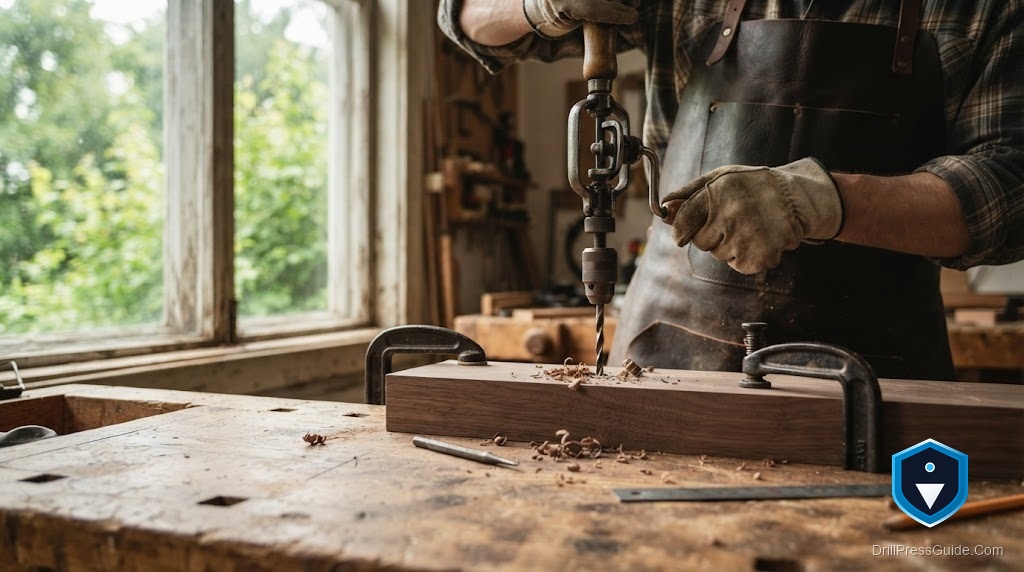
Most holes in most projects are drilled without a drill press, so the honest starting point is that you do not need one for the majority of jobs. What you need is a way to keep a handheld drill straight, because the whole reason people reach for a press is squareness, and squareness is exactly what a wandering hand loses. Get that under control and a cordless drill covers a surprising amount of ground, from a straight shelf-pin hole to a clean hole in aluminum.
To drill without a drill press, use a technique or a jig that keeps the bit square: a drill guide attachment, a self-centering doweling jig, a simple squared block clamped beside the bit, or a two-view sighting method with a helper. Clamp the work, mark and punch the center, choose the right bit and speed for the material, and let the bit cut rather than forcing it.
First, decide how straight the hole must be
Not every hole needs precision, and matching effort to the job saves time.
A rough hole for a wall anchor or a rough-in can be eyeballed. A hole that must be square, for a dowel joint, a shelf pin, or a clean pass through metal, needs a guide. Knowing which one you are drilling tells you whether to grab the drill and go or set up a jig first.
Ways to keep the bit straight
A drill guide attachment. The most reliable option short of a press. A tool like the Milescraft DrillMate portable drill guide clamps your handheld drill into a base that holds the bit perpendicular and even drills angles on purpose. It turns a cordless drill into a near-press for straight holes and travels anywhere.
A doweling jig. For edge holes in boards, a self-centering doweling jig positions and squares the bit for you, which is what makes dowel joints line up.
A squared block. The free method: set a machinist’s square or a scrap block with a truly square corner right beside your mark, and align the bit to it as you drill. Two blocks at ninety degrees to each other reference both directions.
The two-view method. With no jig at all, have a helper watch from the front while you watch from the side, or stand a square on the work, and correct the bit to vertical in both planes as you start. It is not perfect, but it beats guessing.
Material and setup still matter
A straight bit is only half the job. Clamp the workpiece so it cannot spin, since a handheld drill grabs just like a press does, a point the safety guidance from OSHA and CCOHS applies to any powered drilling. Mark the center and dent it with a punch or an awl so the bit does not skate. Pick the bit and speed for the material: slower with cutting fluid for metal, faster for wood. Start slow to establish the hole, then settle into a steady feed and let the bit cut. For metal especially, a center punch and slow start prevent the wandering that ruins placement.
Matching method to the job
| Job | Best approach | Why |
|---|---|---|
| Rough hole, low stakes | Freehand, punched center | Speed matters more than square |
| Dowel and edge joinery | Doweling jig | Self-centers and squares the bit |
| Straight holes anywhere | Drill guide attachment | Closest thing to a press, portable |
| Metal, clean hole | Guide plus punch, fluid, slow speed | Prevents wandering and heat |
| One-off, no tools | Two-view sighting with a square | Free, better than eyeballing |
What you cannot expect
Be realistic. Without a press you will not match its repeatability for many identical holes, its steadiness for large bits and hole saws, or its dead-square accuracy for precision metalwork. If you find yourself fighting those limits often, that is the signal a drill press would genuinely help. For the occasional straight hole, though, a guide and good technique get you most of the way there.
The verdict
You can drill without a drill press for most jobs by controlling squareness: a drill guide attachment is the closest stand-in, a doweling jig handles edge joinery, and a squared block or two-view sighting works in a pinch. The fundamentals do not change, clamp the work, punch the center, match bit and speed to material, and let the bit cut. Three takeaways: decide how square the hole must be before choosing a method, a portable drill guide turns a handheld drill into a near-press, and reach for a real press only when repeatability, big bits, or precision metal keep tripping you up. Who can happily skip the press? Anyone drilling occasional straight holes who sets up a guide and clamps the work.
Frequently asked questions
How do you drill a straight hole without a drill press? Use a drill guide attachment, a doweling jig, or a squared block clamped beside the bit to hold it perpendicular. Clamp the work, punch the center, and start slow.
What is the best tool to drill straight without a press? A portable drill guide attachment. It clamps your handheld drill into a base that keeps the bit square and even drills deliberate angles, traveling anywhere you need it.
How can I drill straight with no jig at all? Stand a square next to your mark and align the bit to it, or use the two-view method: watch from the side while a helper watches from the front, correcting the bit to vertical in both directions.
How do I drill metal without a drill press? Clamp the work, punch the center so the bit does not wander, use a guide for squareness, run a slow speed with cutting fluid, and feed steadily without forcing.
How do I stop the bit from wandering? Dent the center with a punch or awl before drilling, and start at a slow speed to establish the hole before feeding at full pace.
Can I drill dowel holes without a press? Yes. A self-centering doweling jig positions and squares the bit for edge holes, which is what keeps dowel joints aligned.
When do I really need a drill press instead? When you need many identical holes, steady control of large bits or hole saws, or dead-square precision in metal. Those are the limits handheld methods cannot fully match.
References
- OSHA, Woodworking eTool: Drill Press. https://www.osha.gov/etools/woodworking/production/machines-tools/drill-press
- CCOHS, Metalworking Machines: Drill Presses. https://www.ccohs.ca/oshanswers/safety_haz/metalworking/drillpresses.html
- Pro Tool Reviews, How to Use and Set Up a Drill Press. https://www.protoolreviews.com/how-to-use-drill-press/