How to Bolt Down a Drill Press, Step by Step
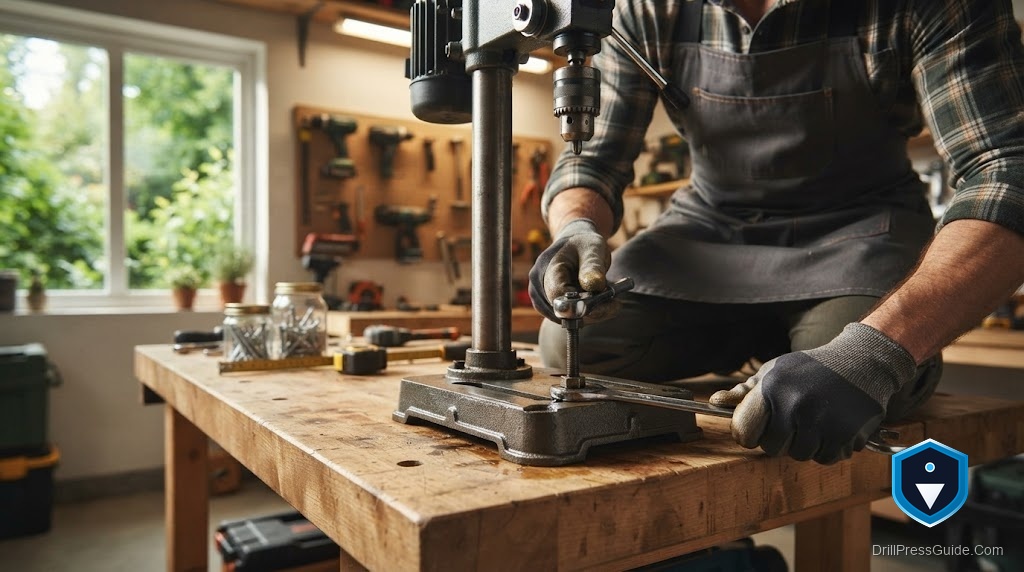
A drill press looks heavy and stable sitting on the bench, so the temptation to skip bolting it down is strong. Then one day you drill a big bit into steel, the bit grabs, and the whole machine tries to twist or the tall column rocks. That is the moment people wish they had spent ten minutes with a wrench. Bolting the press down is not about a tidy shop, it is about stopping the machine from moving when the work fights back, and it takes only a few fasteners and a level.
To bolt down a drill press, position it where you have room to work and reach the switch, mark the mounting holes in the base, drill or select pilot points, then fasten the base to the bench or floor with lag screws or bolts and check that it sits level and does not rock. A benchtop model bolts to a solid bench or stand, a floor model bolts to the concrete.
Why bolting down matters
A drill press puts its mass up high on a narrow column, so it is naturally tippy, and drilling adds twisting force when the bit grabs. An unsecured machine can rock, walk, or tip, which ruins accuracy and creates a hazard right where your hands are. Securing the machine is part of the same safe-setup thinking that OSHA and CCOHS describe: a stable machine and secured work together keep the cutting force under control.
Step by step
1. Choose and prepare the spot. Pick a location with clearance for long workpieces, easy reach to the on/off switch, and good light. For a benchtop press, make sure the bench itself is heavy and solid, a flimsy bench defeats the purpose. For a floor press, find firm, level concrete.
2. Position the press and mark the holes. Set the base where you want it and mark through the base’s mounting holes onto the bench or floor with a pencil or punch. Most bases have two or four holes cast in for exactly this.
3. Make the pilot holes. In a wood bench, drill pilot holes sized for your lag screws. In concrete, drill with a masonry bit for the anchors you are using, to the depth the anchors require.
4. Fasten the base. For a bench, drive lag screws with washers through the base into the wood, or use through-bolts with a nut underneath if you can reach the underside. For concrete, set the anchors and tighten bolts into them. Snug each fastener in turn rather than fully tightening one at a time, so the base pulls down evenly.
5. Check level and rock. Put a level on the table and adjust as needed, and press on the top of the column to confirm the base does not lift or rock. Shim any gap under the base before final tightening so you are not clamping a twist into the casting.
Fastening choices
| Mounting surface | Fastener | Note |
|---|---|---|
| Solid wood bench | Lag screws with washers | Simple, strong for benchtop models |
| Bench with accessible underside | Through-bolts and nuts | The most secure bench option |
| Concrete floor | Masonry anchors and bolts | Standard for floor-standing presses |
| Portable or rented space | Bolt to a heavy mobile base | Stable yet movable |
Common mistakes
Bolting to a light bench that then rocks with the machine, which just moves the problem. Overtightening one fastener first and twisting the base, which can introduce a wobble. Forgetting to shim a gap, so the base flexes as you tighten. And placing the press without thinking about workpiece clearance or switch access, then living with an awkward setup. A few minutes of planning in step one saves all of these.
The verdict
Bolting down a drill press is a short job that pays off every time a bit grabs: mark the base holes, make pilot holes, fasten with lag screws or through-bolts on a bench or masonry anchors on concrete, then level it and confirm it does not rock. The machine’s high mass on a narrow column is exactly why this matters. Three takeaways: secure benchtop models to a genuinely solid bench and floor models to concrete, tighten fasteners evenly and shim any gap so you do not build in a twist, and plan the location for clearance and switch access before you drill a single hole. Who should never skip it? Anyone drilling metal or large holes, where grab forces are strongest and a moving machine is most dangerous.
Frequently asked questions
How do you bolt down a drill press? Position it, mark through the base’s mounting holes, make pilot holes, then fasten the base with lag screws or through-bolts to a bench or masonry anchors to concrete, and confirm it sits level without rocking.
Do I really need to bolt down a benchtop drill press? Yes, if you drill metal, large holes, or anything where the bit can grab. A high, narrow machine can rock or tip, hurting accuracy and safety. At minimum bolt it to a heavy, solid bench.
What fasteners should I use? Lag screws with washers into a wood bench, through-bolts with nuts if you can reach underneath, or masonry anchors and bolts into concrete for a floor model.
How do I bolt a drill press to concrete? Mark the holes, drill with a masonry bit to the anchor’s required depth, set the anchors, then tighten the base bolts into them and check for level and rock.
Why is my drill press wobbling after bolting it down? Often a gap under the base or one fastener overtightened first, twisting the casting. Loosen, shim any gap, and retighten the fasteners evenly.
Can I mount a drill press to a mobile base? Yes. A heavy mobile base gives stability while letting you move the machine. Bolt the press securely to the base as you would to a bench.
Where should I position the drill press? Where you have clearance for long workpieces, easy reach to the switch, and good lighting, on a solid bench or firm level concrete.
References
- OSHA, Woodworking eTool: Drill Press. https://www.osha.gov/etools/woodworking/production/machines-tools/drill-press
- CCOHS, Metalworking Machines: Drill Presses. https://www.ccohs.ca/oshanswers/safety_haz/metalworking/drillpresses.html
- Pro Tool Reviews, How to Use and Set Up a Drill Press. https://www.protoolreviews.com/how-to-use-drill-press/