How to Drill Holes Without a Drill Press: Setup, Checks, and Common Mistakes
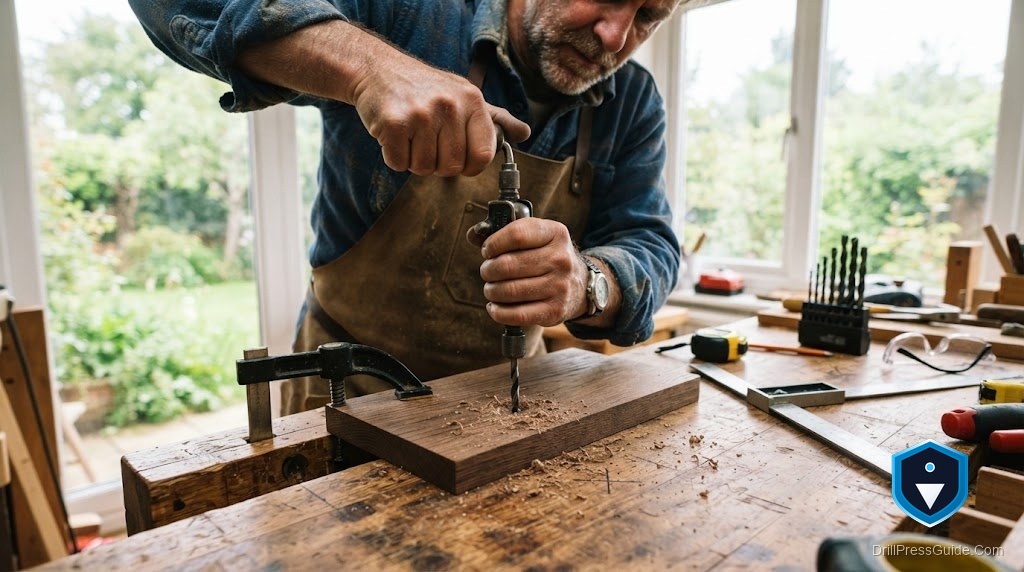
Not everyone has a drill press, and plenty of good work gets done without one. The trouble starts when a handheld drill has to stand in for a fixed machine and the hole comes out leaning, oversized, or blown out the back. A leaning hole in a shelf pin ruins the spacing. A leaning hole in a hinge mortise makes the door sag. The skill of drilling without a drill press is really the skill of faking the two things a press gives you for free: a square spindle and a clamped workpiece.
So how do you drill holes without a drill press? Use a guide to hold the bit vertical, clamp the workpiece so it cannot move, mark and punch your center, and control depth with tape or a stop collar. Do those four things and a cordless drill will produce holes clean enough for most furniture, framing, and repair work.
The problem you are solving
A drill press keeps the bit perpendicular and steady. In your hands, the bit follows your wrist, which drifts. It also lets the workpiece spin if the bit grabs. The same breakthrough grab that the CCOHS drill press guidance warns about on a machine is worse freehand, because nothing is holding the part but you. Every technique below is aimed at those two weaknesses.
Guide the bit so it stays vertical
Your options run from free to precise.
A drill guide block, the kind with two hardened bushings, drops over your bit and rides on the surface, keeping the bit square without any measuring. It is the closest thing to a press for a handheld drill, and it travels in a toolbox. A machined handheld drill guide does the same job with adjustable angles.
No guide? Two squares work. Stand a small try square upright next to the bit on one side and another at ninety degrees, then keep the bit parallel to both as you drill. A helper watching from the side catches lean you cannot see yourself.
For a repeatable trick, drill a pilot hole through a scrap block on an actual square surface, then clamp that block over your mark as a bushing. The pre-drilled block guides your bit straight.
Clamp the work, then clamp it again
Freehand drilling tempts you to pinch the part with one hand and drill with the other. Do not. Clamp the workpiece to a bench with the drilling spot hanging over the edge or over a hole, so the bit has somewhere to exit. Put a sacrificial backer underneath to stop tear-out and to protect the bench. If the part is round or odd, cradle it in a V-block or a scrap of wood with a notch cut in it, then clamp the whole assembly.
Mark, punch, and control depth
Cross two lines to find the center, then set the tip with a center punch in metal or an awl in wood. That dimple stops the bit skating, which matters far more freehand than on a press.
For depth, wrap a flag of tape around the bit at your target depth, or fit a stop collar. Stop when the tape kisses the surface. For a clean start in metal, the Pro Tool Reviews setup guide principles still apply freehand: start slow, add a drop of cutting fluid, and let the bit cut rather than forcing it.
Match the method to the material
| Material | Biggest risk freehand | The fix |
|---|---|---|
| Softwood | Wander and tear-out | Awl-punched center, backer board |
| Hardwood | Lean on deep holes | Drill guide block, brad-point bit |
| Sheet metal | Skating, grabbing | Center punch, slow speed, clamp hard |
| Tile or masonry | Cracking, wandering | Masonry bit, tape start, low speed |
The pattern holds across all of them: a punched center and a real clamp fix most of the trouble before speed or bit choice ever matters.
Common mistakes that ruin an otherwise good hole
Drilling in one push. Feed and back off to clear chips, especially in metal and deep wood holes, or the bit overheats and binds.
Trusting your eye for square. Everyone’s wrist drifts. Use a guide or a second set of eyes.
Letting the part move. If it can spin, it will, right at breakthrough. Clamp first, drill second.
No backer. The exit side always tears without support, and on the last sixteenth of an inch that is where the mess happens.
The verdict
You do not need a drill press to drill a good hole, you need to replace what a press provides: vertical guidance and a locked workpiece. A drill guide block and a clamp get a handheld drill most of the way to press accuracy for a fraction of the space. That said, if you drill dozens of repeatable holes a week, the freehand routine gets old fast, and a bench press starts to earn its place. Three takeaways: punch every center, clamp every workpiece, and guide the bit with a block or squares rather than your wrist. Who should skip the freehand approach? Anyone doing precise, repeated holes in metal, where the accuracy and safety of a fixed spindle genuinely matter.
Frequently asked questions
How do I drill a straight hole without a drill press? Use a drill guide block or stand two squares beside the bit and keep it parallel to both. Punch the center first so the bit does not wander, and clamp the workpiece so it cannot shift.
Can I drill accurate holes with just a handheld drill? Yes, for most woodworking and repair work, if you add a guide for square and a clamp for stability. Precision metal work is where a fixed press pulls ahead.
How do I keep the bit from wandering? Center punch metal or use an awl in wood to create a starting dimple, then start the drill slowly until the bit seats in the mark.
How do I control hole depth without a press stop? Wrap tape around the bit at the target depth or fit a stop collar, then stop drilling when it reaches the surface.
How do I drill a straight hole in metal by hand? Center punch hard, clamp the metal, run a slow speed with a drop of cutting fluid, and peck to clear chips. A guide block keeps the angle honest.
Why does the back of my hole blow out? No support on the exit side. Put a sacrificial backer board under the workpiece so the fibers are held as the bit breaks through.
What is the cheapest way to improve handheld accuracy? A center punch and a clamp cost very little and fix the two most common problems, wandering starts and moving parts.
References
- CCOHS, Metalworking Machines: Drill Presses. https://www.ccohs.ca/oshanswers/safety_haz/metalworking/drillpresses.html
- OSHA, Woodworking eTool: Drill Press. https://www.osha.gov/etools/woodworking/production/machines-tools/drill-press
- Pro Tool Reviews, How to Use and Set Up a Drill Press. https://www.protoolreviews.com/how-to-use-drill-press/