How to Use a Bench Drill Press: A Clear, Shop-Ready Method
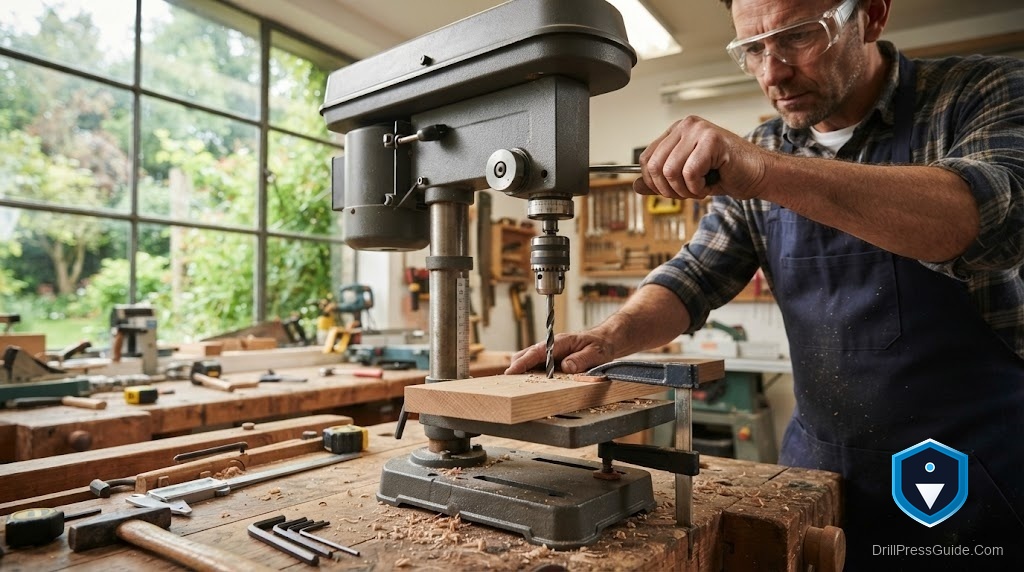
The first hole most people drill on a bench drill press wanders. You line up the bit, pull the feed handle, and the tip skates a little before it bites, leaving a hole sitting a hair off the mark. That wander is not bad luck. It is almost always three fixable things: an unmarked center, an unclamped workpiece, and a spindle speed that is wrong for the material. Fix those and the machine does exactly what it was built to do, which is put a straight, repeatable hole where you want it.
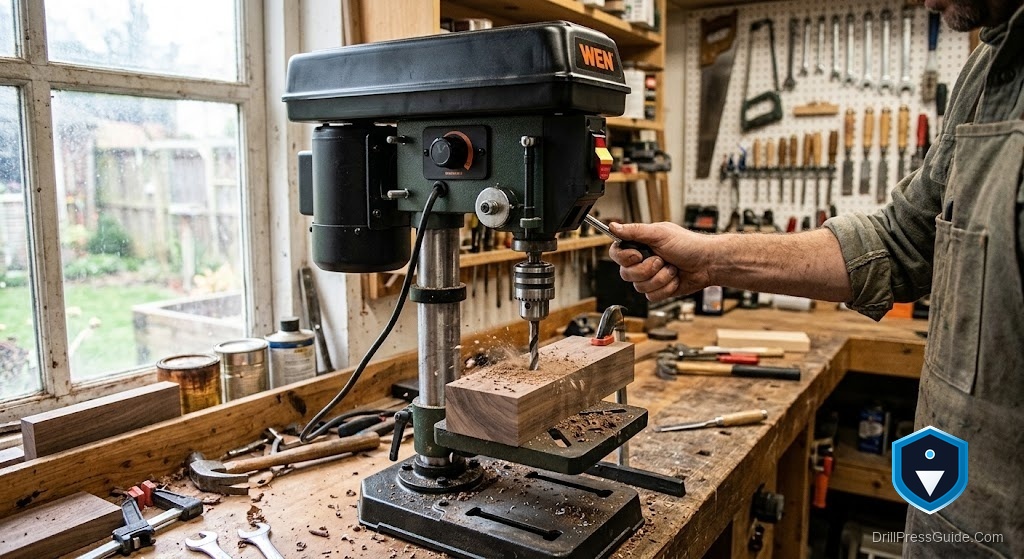
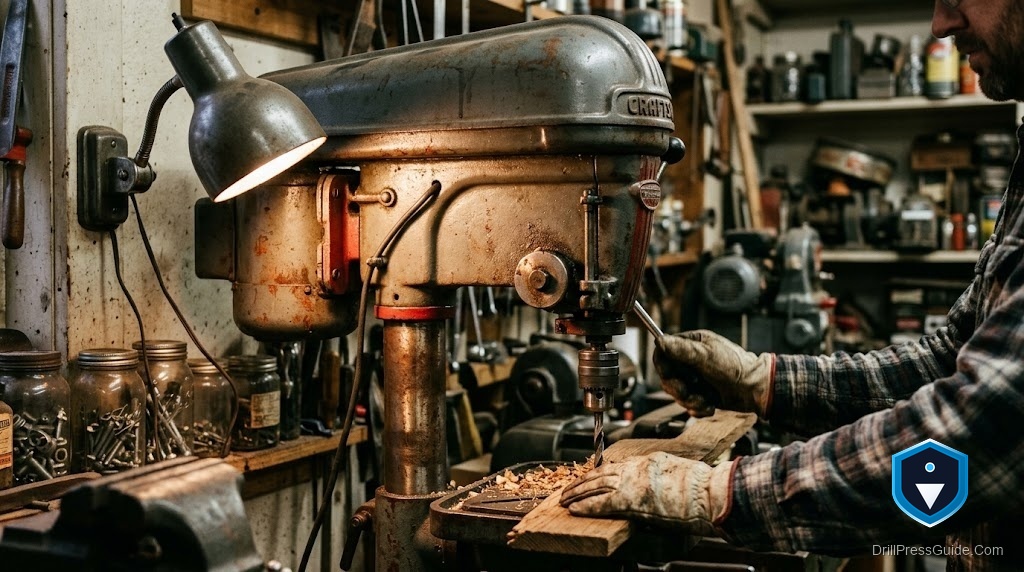
A bench drill press is a fixed motor and spindle mounted over a flat table, fed straight down by a lever. That geometry is the entire point, and it is why the tool beats a handheld drill for anything that has to be square or repeated. Learning to use one well is less about the drilling and more about the setup that happens before the bit ever turns.
The short answer, if you only read one paragraph
Clamp the work, set the speed for the material, mark and punch your center, then feed the bit down slowly and steadily while clearing chips. Wear eye and face protection, keep the chuck key out of the chuck before you switch on, and never hold small parts by hand near the rotating chuck. Everything below is the detail that makes those steps reliable.
Set the machine up before you touch a workpiece
Start with the table. It should sit square to the spindle so the bit enters at ninety degrees. Drop a length of straight rod into the chuck, bring it near the table, and check the gap with a small square on two sides. Adjust the table until the rod and the square agree.
Speed comes next, and it is where most beginners go wrong. Big bits and hard metal want slow speeds. Small bits and wood want faster ones. A one inch hole saw in steel might run near 300 RPM, while a small twist bit in pine is happy several times faster. Most bench presses change speed by moving a belt across stepped pulleys, so open the belt-drive enclosure, shift the belt, and close it before you run the motor. The OSHA drill press guidance is blunt about this: guards over the belt and pulleys stay on, and the machine gets switched off before you reach inside.
Set the depth stop last. For a through hole, run the bit down until it clears the underside, then lock the stop so you cannot drive the tip into the table. For a blind hole, measure from the workpiece surface and set the stop to that depth. This one habit saves tables, bits, and the occasional bruised thumb.
Hold the work, always
This is the rule that separates a clean shop from an emergency room visit. A drill bit grabs, especially as it breaks through the far side, and a grabbed part becomes a spinning blade. Clamp it. A drill press vise bolted or clamped to the table handles most small parts, and a hold-down fixture or clamp handles larger stock. The Canadian safety authority CCOHS is direct that workpieces should be secured, never hand held, precisely because of that breakthrough grab.
Put a sacrificial backer board under the work when you drill through. It supports the bottom fibers so wood does not blow out, and it protects the table.
Mark, punch, and drill
Mark your center where two lines cross, then tap a center punch into that spot. The little dimple gives the bit tip somewhere to sit so it starts on the mark instead of skating. Bring the spinning bit down to touch, confirm it lands in the punch mark, then feed.
Feed with intent. Too light and the bit rubs and heats. Too hard and it grabs. You want a steady curl of chips, called swarf in metal, coming up the flutes. If you see dust and smoke instead of chips, you are too slow or too dull. In metal, add cutting fluid and peck: feed a little, back out to clear chips and heat, feed again. Hot chips fly, which is another reason for eye and face protection and a reason not to brush chips away with a bare hand.
Bench press or floor press, which one fits your work
People shopping their first machine usually ask this, so here it is plainly.
| Factor | Bench drill press | Floor drill press |
|---|---|---|
| Footprint | Sits on a bench, saves floor space | Needs dedicated floor area |
| Capacity | Handles most hobby and repair work | Longer stock, taller work, bigger bits |
| Cost and setup | Lighter, easier to move and store | Heavier, more power, more reach |
| Best for | Home shops, small parts, most DIY | Frequent metal work, tall workpieces |
For a home shop, a solid bench model such as the WEN 4214T variable speed press covers the honest majority of jobs. It is not the machine for drilling into the end of a five foot post, and it is not built for heavy production, but for repeatable holes in wood, plastic, and mild steel it earns its bench space.
Shut down and maintain
When you finish, switch off at the start/stop button and know where the main disconnect is for anything bigger than a quick pause. Brush chips off with a chip brush, never your hand. If your chuck ever needs to come off for cleaning or a key change, use the proper chuck-removal tool and follow a step by step like the eReplacementParts chuck guide rather than prying at it.
The verdict
A bench drill press rewards preparation more than skill. Get the table square, match the speed to the material, clamp the work, and punch your center, and the machine turns hole drilling from a guess into a routine. Skip those, and you get wandering holes, torn wood, and grabbed parts. Three concrete takeaways to leave with: clamp every workpiece without exception, slow down for metal and large bits, and set the depth stop before you cut, not after you have gouged the table.
Frequently asked questions
How do I use a bench drill press for the first time? Clamp your workpiece in a vise, set the belt for a medium speed, punch a center mark, lower the running bit onto the mark, and feed slowly. Wear eye protection and keep the chuck key out before switching on.
What speed should a bench drill press run at? Slower for large bits and metal, faster for small bits and wood. A large hole saw in steel may want around 300 RPM, while a small bit in softwood can run several times faster. Check the machine chart if it has one.
Do I really need to clamp small parts? Yes. Small parts are the most likely to spin when the bit grabs at breakthrough, and a spinning part is dangerous. A drill press vise pays for itself the first time it stops a part from becoming a projectile.
Why does my drill bit wander off the mark? Usually no center punch. The bit tip needs a dimple to sit in. Punch the mark, and confirm the bit lands in it before you feed.
Can a bench drill press drill metal? Yes, within reason. Use a slow speed, cutting fluid, and a pecking motion to clear chips and heat. Mild steel and aluminum are routine, thick hardened steel is not its strength.
How do I stop wood from tearing out on the bottom? Put a sacrificial backer board under the workpiece so the exit fibers are supported as the bit breaks through.
What is the depth stop for? It limits how far the bit travels down. Set it for blind holes to a measured depth, and for through holes just past breakthrough so you never drive into the table.
References
- OSHA, Woodworking eTool: Drill Press. https://www.osha.gov/etools/woodworking/production/machines-tools/drill-press
- CCOHS, Metalworking Machines: Drill Presses. https://www.ccohs.ca/oshanswers/safety_haz/metalworking/drillpresses.html
- Pro Tool Reviews, How to Use and Set Up a Drill Press. https://www.protoolreviews.com/how-to-use-drill-press/
- eReplacementParts, How to Remove and Reinstall a Drill Press Chuck. https://www.ereplacementparts.com/repair/how-to-remove-and-reinstall-a-drill-press-chuck/