
A Plain-English Guide to the Radial Drill Press
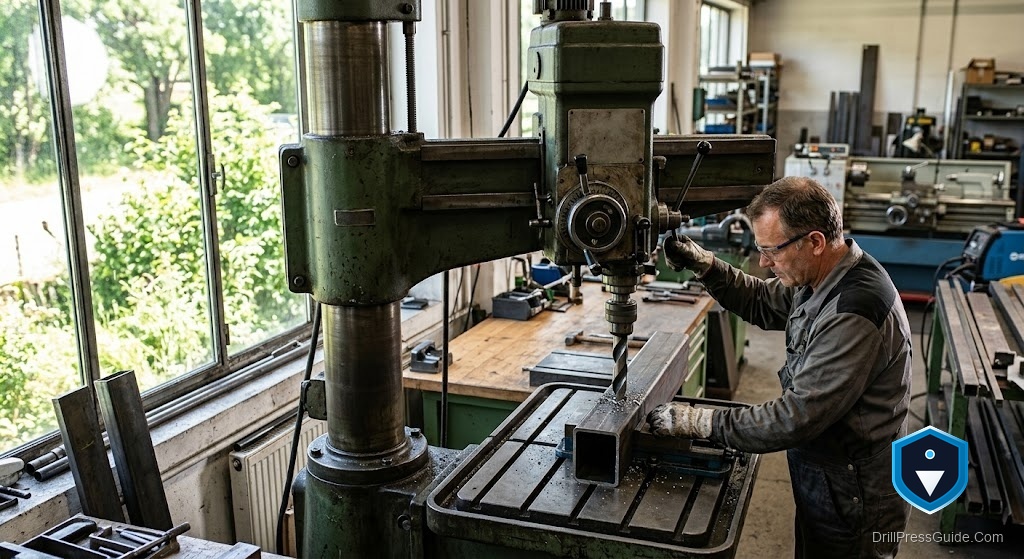
Most drill presses ask you to bring the work to the tool. A radial drill press does the opposite, and that single reversal explains its odd, crane-like shape and its place in heavy shops. If you have ever wondered what that big machine with the swinging arm actually is, here is the plain version.
A radial drill press is a large drilling machine built around a heavy column and a horizontal arm that carries the drilling head. The arm swings around the column, and the head slides along the arm, so the spindle can be positioned over a wide area without moving the workpiece. That reach is the distinguishing feature of a radial drill press: the tool travels to the hole, which is exactly backward from the benchtop machine most people picture.
Here is the direct answer to what it is. Think of a normal drill press with its spindle fixed above a small table. Now imagine lifting that drilling head onto a long arm that can rotate around the column and slide in and out. That is a radial drill press. The workpiece sits on a base or the floor, clamped once, and the operator swings and slides the head to reach each hole location. It is used for heavy drilling, reaming, counterboring, and tapping on large parts, and it lives in fabrication shops, foundries, and heavy maintenance, not on a hobby bench. There is no true consumer version, so if you are shopping for a home machine, a benchtop or floor drill press is what you actually want.
The parts that make it a radial
Start at the base, a heavy casting that plants the machine and often holds the work. Up from the base rises the column, a thick vertical post. The arm clamps around that column and can swing through a wide arc. Along the arm rides the drilling head, which contains the motor, the speed change, the spindle, the quill, and the feed handle, the same working guts as any drill press, just mounted where they can move.
That is the trick worth understanding. Everything that does the cutting is identical in spirit to a standard machine: a chuck grips the tool, the quill guides the spindle straight down, the feed handle drives the cut. The radial part is only about where that head sits and how it moves. Lock the arm and the head, and you have a rigid drill press positioned exactly where you need it.
Why anyone builds a machine this big
The reason is simple: some work will not move. A large casting, a thick steel weldment, or a machine base can weigh hundreds or thousands of pounds. Repositioning it under a fixed spindle for every hole is slow, dangerous, and hard on accuracy. The radial arm lets the part stay put while the tool comes to each hole, so one setup covers holes spread across the whole piece and they all share the same reference.
That capability costs size and weight. The column and arm must resist flex while the head hangs out over the work, so radial drills are heavy, floor-standing, and often need rigging to install. The same drill press safety rules still apply at the point of operation, clamp the work, guard the rotating chuck, control swarf and hot chips, and wear eye and face protection, as the Occupational Safety and Health Administration spells out for drilling machines.
Comparison: radial versus the drill press you know
A standard benchtop or floor drill press has a fixed spindle and a small table. It is compact, easy to house, and ideal for parts you can lift and position. It cannot reach across a large workpiece.
A radial drill press moves the head to the work over a wide arc, which makes short work of large, heavy parts, but it is an industrial machine that eats floor space and is not sold in a hobby size.
My verdict: the radial drill press is a specialist. If your shop wrestles big castings and weldments, it is worth every square foot. If you are outfitting a garage or a maker space, you do not need one and would be better served by a good benchtop machine.
Conclusion
A radial drill press is a standard drilling head mounted on a swinging, sliding arm so the tool can reach holes across a large, fixed workpiece. That is the whole idea. Know that, and the machine’s size, shape, and purpose all make sense, and you will also know it is a heavy-shop tool rather than a home one.
Key takeaways:
- A radial drill press carries its drilling head on an arm that swings and slides over the work.
- Its cutting parts match a normal drill press; only the head’s movement is different.
- It is a large industrial machine for heavy parts, with no real hobby version.
FAQ
What is a radial drill press in simple terms? A drill press whose head rides on a swinging, sliding arm so the tool reaches the work instead of the other way around.
What is its distinguishing feature? The horizontal arm that rotates around the column and lets the head slide in and out.
Is it more accurate than a normal drill press? For large parts, yes, because the work is clamped once and every hole shares the same reference.
Can I buy one for home use? Realistically no. They are heavy industrial machines. A benchtop or floor drill press suits home shops.
What jobs does it do? Heavy drilling, reaming, counterboring, and tapping on large castings and weldments.
Why is it so large? The column and arm must stay rigid while the head hangs over the work, which requires heavy castings.
Does it use the same bits and chucks? Yes, the cutting end works like any drill press, with a chuck gripping the tool on the spindle.
References
- Occupational Safety and Health Administration, machine guarding standard 1910.212 (osha.gov)
- Machinery’s Handbook, Industrial Press, drilling machine types and construction


