Rockwell Radial Drill Press 11-280: Specs, Capacity, Parts, and Owner Notes
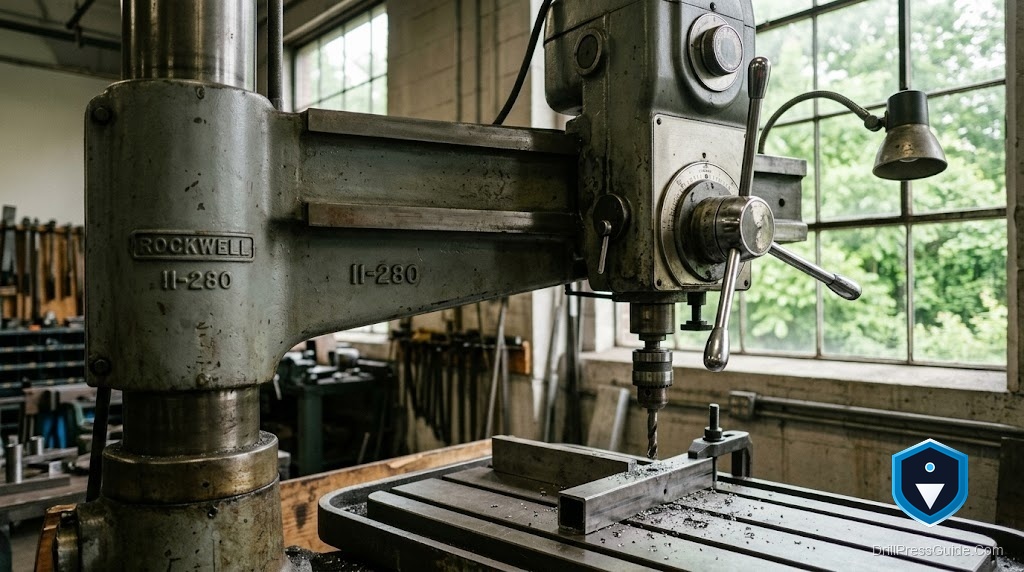
Most drill presses let you drill straight down into whatever is directly under the spindle. The Rockwell 11-280 does something fundamentally different: it lets you position the spindle anywhere within a 32-inch arc, rotate the head 360 degrees around the column, tilt the head sideways past 90 degrees, and drill horizontally if you want. That’s not a standard drill press with extra features. That’s a different category of machine entirely.
The 11-280 is a radial drill press — sometimes called a radial arm drill press or swing-arm press — built by Rockwell Manufacturing (later Rockwell-Delta) through the late 1960s and 1970s. If you’ve seen one at an estate sale for under $150 and walked past it, you may want to reconsider.
What Makes It a Radial Press (and Why That Matters)
On a standard column drill press, the table moves up and down on the column. You center your workpiece by sliding it around until it’s under the bit.
On a radial press like the 11-280, the head — motor, spindle, and chuck — rides on an arm that slides outward from the column. You can:
- Move the head along the radial arm to drill anywhere within the 32” swing diameter
- Rotate the entire arm 360° around the column
- Tilt the head 90°+ left and right to drill at any angle, including dead horizontal
The practical result: you can drill a hole in the center of a 32-inch-wide workpiece without moving the workpiece at all. One woodworker summed it up: “I’ve had this press for over 25 years and it has served me well. You can drill to the center of a 32” circle and angle it to drill holes at an angle.”
Rockwell 11-280 Specifications
| Spec | Value |
|---|---|
| Type | Radial (swing arm) drill press |
| Swing (max workpiece diameter) | 32 inches |
| Radial reach | 11 inches (ram travel) |
| Head rotation | 360° around column |
| Head tilt | 90°+ left and right |
| Motor | 1/3 HP, split phase, 1725 RPM |
| Electrical | 115V, single phase |
| Minimum speed | ~700 RPM |
| Chuck taper | JT33 (Jacobs Taper #33) |
| Configuration | Benchtop radial press |
| Production era | Late 1960s–1970s |
Is the Rockwell 11-280 the Same Machine as the Delta 11-090?
This question comes up every time someone researches these machines.
The short answer: they’re closely related but not identical.
Rockwell Manufacturing acquired Delta Machinery in 1945. During the Rockwell era (1945–1981), the same physical machines were often sold under multiple brand names: Rockwell, Delta-Rockwell, and Homecraft (the budget line). VintageMachinery.org confirms that the 11-280 was also sold as the Homecraft Radial 11-280 — a different badge on functionally the same machine.
The Delta 11-090 is a similar radial press from the same family and era with overlapping specifications. Whether a specific 11-090 part swaps directly into an 11-280 depends on the production year and Type number of your specific machine. Use your machine’s own manual as the authoritative reference.
Buying a Used 11-280: What to Check
1. Rotate the arm freely. The radial arm should slide smoothly outward and lock firmly. Binding or looseness suggests wear in the column collar.
2. Spin the quill by hand. Should spin freely with no grinding and minimal side play. A loose quill bearing is the most common mechanical problem.
3. Check the head tilt and lock. Tilt the head to the stops. Should move freely and lock solidly.
4. Inspect the column for straightness. Sight down the column. Any visible bow is a dealbreaker.
5. Look at the motor. Sleeve-bearing motors from this era are rebuildable. One restoration account noted finding a mouse in the windings — budget for a replacement 1/3 HP, 1725 RPM, 115V motor if you’re buying a project machine.
6. Confirm the belt. Belts crack with age. Factor in a replacement.
Honest Limitations
Minimum speed is too high for steel. At ~700 RPM at the lowest setting, you’re running too fast for larger bits in mild steel. Use it for wood and light aluminum.
The radial arm has some flex. Under load, the extended arm deflects slightly, which can affect depth consistency on deep holes. For through-holes and rough work it’s irrelevant.
Parts require research. Finding the correct part requires your Type number and cross-reference with the correct publication on VintageMachinery.org.
Recommended Accessories
A cross-slide vise keeps your workpiece from spinning when the bit catches. A WEN 3” drill press vise is appropriately sized for a benchtop radial press.
The 11-280’s head casting is a natural mounting point for a magnetic base light. A magnetic LED work light sticks to the head housing and throws light directly onto the bit.
FAQ
Q: What is the swing on the Rockwell 11-280? 32 inches. You can drill a hole in the center of a 32”-diameter workpiece without moving the workpiece.
Q: What motor does the 11-280 use? A 1/3 HP, split-phase, sleeve-bearing motor at 1725 RPM on 115V single-phase.
Q: Is the 11-280 good for drilling metal? Not ideal. The minimum speed is approximately 700 RPM — too fast for larger bits in steel. Fine for small holes in aluminum.
Q: Where can I find an 11-280 manual? VintageMachinery.org under the Delta/Rockwell manufacturer page.
Q: Is the Rockwell 11-280 the same as the Delta 11-090? Closely related — same era, same manufacturer, similar specs. Whether specific parts are interchangeable depends on Type number.
Q: What chuck taper does the 11-280 use? JT33 (Jacobs Taper #33).
Q: How much flex is in the radial arm? Enough to matter for precision depth-stop work with the arm fully extended. Negligible for through-hole drilling in wood.
Q: What’s a fair price for a used 11-280? In working condition, $75–$200. A project machine is worth $35–$75.
References
- VintageMachinery.org — 11-280 Rockwell/Delta 32” Radial Drill Press, 1974 manual
- Sawmill Creek Woodworking Community: Rockwell 11-280 thread