Delta 11-090 Radial Drill Press: Specs, Capacity, Parts, and Owner Notes
Most drill presses have one limitation you learn to work around: you move the workpiece to the spindle. For large panels, cabinet doors, or anything you’d rather not reposition under a fixed head, this is either a minor annoyance or a genuine problem depending on how you work.
The Delta 11-090 solves it differently. The spindle comes to the work.
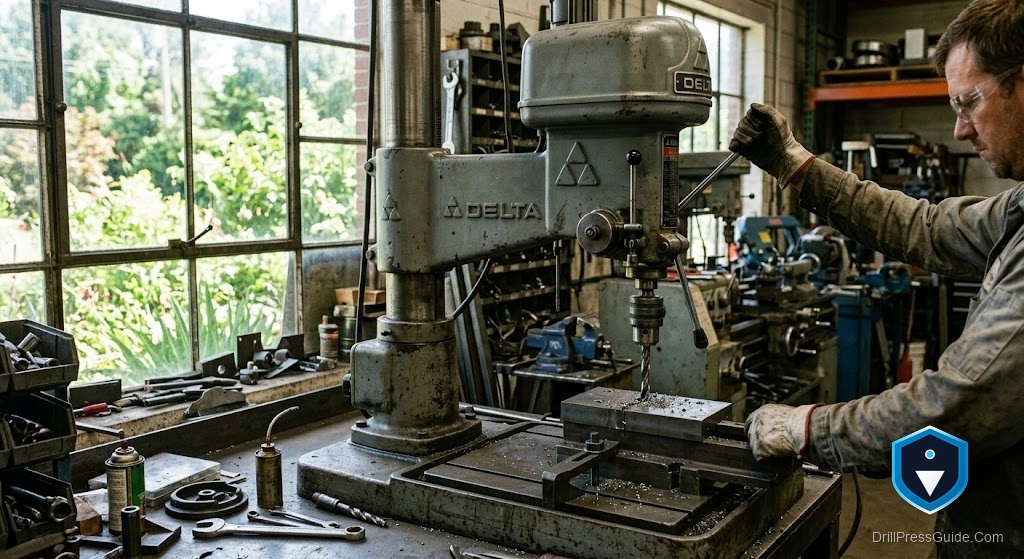
This is a radial drill press — the head rides on a swing arm, letting you reposition the spindle over a stationary workpiece. It’s a different category of tool entirely, and the 11-090 is one of the more frequently discussed examples on the vintage machinery circuit.
What Makes a Radial Drill Press Different
On a standard drill press, the head is fixed directly above the column. You move the workpiece to drill at a different location.
On a radial drill press, the head is mounted on an arm that pivots horizontally around the column. On the Delta 11-090, this arm gives the machine a 32-inch capacity — the distance from the column centerline to maximum spindle outreach. You can drill up to 32 inches from the column without touching the workpiece.
The practical benefit: large workpieces sit flat on the table, and you swing the head over each drilling location. No repositioning, no remeasuring between holes.
Delta 11-090 Specifications
The 11-090 was manufactured by Delta/Rockwell (the same company at different periods of its naming history). The parts diagram was published September 17, 1990.
| Spec | Delta 11-090 |
|---|---|
| Type | Radial (swing-arm) drill press |
| Configuration | Benchtop |
| Radial capacity | 32” from column center |
| Number of speeds | 5 |
| Minimum speed | ~550 RPM |
| Drive | Belt |
| Manufacturer | Delta/Rockwell-Delta |
| Production era | Late 1980s–1990 |
What Makes the 11-090 Valuable on the Used Market
Radial drill presses never caught on the way floor-standing column presses did, partly because of cost and partly because the typical hobbyist shop doesn’t often need wide-reach drilling. But when that need exists, nothing else works as well.
The 11-090 shows up at estate sales and shop liquidations priced below what the capability would cost new. Woodworkers doing large panel work, jig builders, and production shops that run repetitive multi-hole patterns in oversized material are the natural users.
Delta quality in the Rockwell/Delta period is generally regarded highly — heavy castings, solid construction, tolerances maintained carefully.
Honest Limitations
1. Minimum Speed Is Too High for Some Applications
At approximately 550 RPM minimum, the 11-090 isn’t suitable for large Forstner bits (which want 300–400 RPM in hardwood) or fly cutters (which want 200–350 RPM).
2. No Rack-and-Pinion Table Height Adjustment
Raising and lowering the table is purely manual — no crank. Once you add a supplemental table, repositioning requires effort. Many owners use a small hydraulic floor jack as a workaround.
3. Radial Arm Rigidity
At full extension, there is more flex potential than on a fixed column press. For woodworking and light drilling this isn’t an issue. For heavy drilling in thick steel at full arm extension, the 11-090 isn’t the tool.
Used Buying Inspection Checklist
Arm pivot: Should swing smoothly and lock positively at any position. Test the lock with the arm at several positions.
Head travel on the arm: Should be smooth with no binding or looseness. Binding usually means accumulated debris; looseness means worn gibs.
Spindle runout: Under 0.003 inches with a dial indicator on a smooth drill shank.
Belt condition: Open the belt guard and look for cracking, glazing, or fraying.
Motor function: Run through all five speeds. Listen for bearing noise — a steady whine or grinding.
Column and base casting integrity: Look for cracks at stress points around the arm pivot housing and column base.
Parts Sources
eReplacementParts.com — Interactive parts diagram for the 11-090 Type 1. Click individual components to find part numbers. URL: ereplacementparts.com
VintageMachinery.org — Official Delta 11-090 parts diagram (2 pages), free to download. URL: vintagemachinery.org
ToolPartsPro.com — Downloadable schematic PDF for the 11-090 Type 1. URL: toolpartspro.com
Accessories Worth Adding
The 11-090’s swing-arm design means workpiece clamping matters more — you’re moving the spindle to the work, but the work still needs to stay put.
A compact 3-inch drill press vise keeps smaller pieces secured during drilling without interfering with arm travel.
The area under a radial arm can be surprisingly shadowed. A magnetic flexible LED work light attaches to the column or arm and can be repositioned in seconds — exactly what you want when the spindle is moving between positions.
The Honest Verdict
The Delta 11-090 is a specialized tool that does its specific job well. If you regularly need to drill multiple holes in large, heavy workpieces without repositioning the material, it’s genuinely more capable than any standard column press. The 32-inch radial capacity isn’t marketing — it changes how you work.
The limitations are real: minimum speed too high for large cutters, table height adjustment manual-only, arm rigidity finite at full extension. None of these matter if the 11-090 matches your actual work.
Find one in decent shape for a fair price, verify the arm locks solid and the spindle runs true, and you’re looking at a machine that will outlast most of what’s made today.
FAQ
Q: What is the radial capacity of the Delta 11-090? 32 inches from the column centerline to maximum spindle outreach.
Q: What is a radial drill press? The head is mounted on a swing arm that pivots around the column, so you can reposition the spindle over different areas of a stationary workpiece. The opposite of a standard drill press where you move the workpiece.
Q: Where can I find a manual or parts diagram for the Delta 11-090? The official Delta 11-090 parts diagram is free at VintageMachinery.org (publication ID 31808). eReplacementParts.com has an interactive parts diagram for Type 1.
Q: What speeds does the Delta 11-090 have? Five belt-driven speeds with a minimum of approximately 550 RPM.
Q: Is the Delta 11-090 good for metalworking? It can drill metal, but the minimum speed of 550 RPM and arm flex at full extension make it less ideal for heavy-duty metal drilling.
Q: What are the most important things to check when buying a used Delta 11-090? Arm pivot locks solidly, head slides smoothly without binding, spindle runout under 0.003”, belts in good condition, no cracks in arm housing or column base.
Q: How do I raise and lower the table on the Delta 11-090? Manually — no rack-and-pinion crank. Many owners use a small floor jack to assist when a supplemental table is installed.
Q: Where can I buy parts for the Delta 11-090 today? eReplacementParts.com stocks parts for the Type 1. VintageMachinery.org has the factory parts diagram. Belts and return springs are available on Amazon and eBay.
References
- VintageMachinery.org — Delta 11-090 parts diagram: vintagemachinery.org
- eReplacementParts.com — Delta 11-090 Type 1: ereplacementparts.com
- ToolPartsPro.com — Delta 11-090 schematic: toolpartspro.com
- Sawmill Creek forum discussion: sawmillcreek.org
SEO Metadata