Shop Fox W1669 Radial Drill Press Review: The 1/2 HP Benchtop That Reaches Where Others Cannot
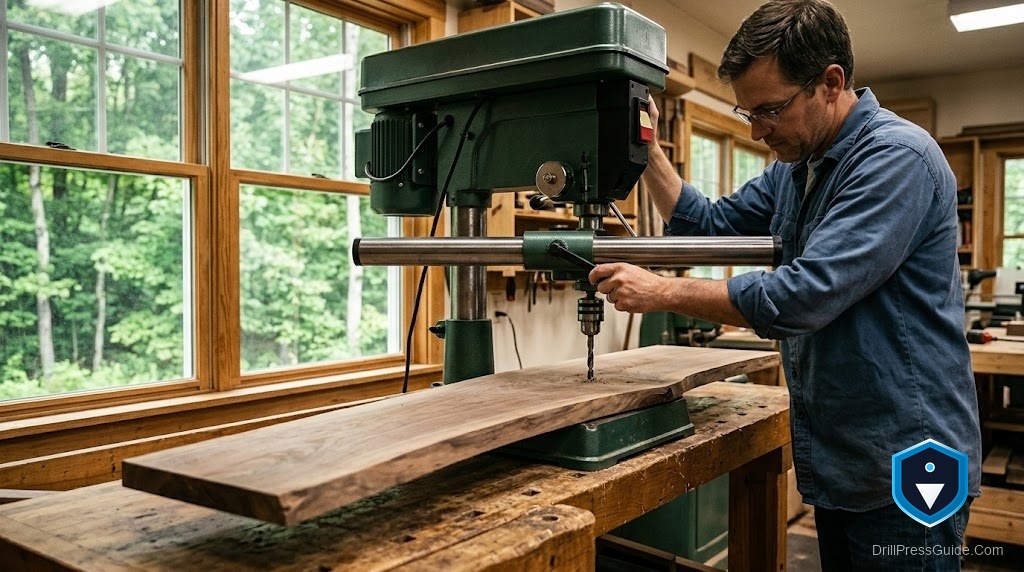
You are staring at a wide cabinet side that needs a row of shelf-pin holes down the middle, and your fixed-column drill press stops you cold because the column hits the panel long before the bit reaches center. That is the exact problem the Shop Fox W1669 1/2 HP benchtop radial drill press was built to solve. I have run this radial press against ordinary fixed-column machines, and the reach it gives you is real, so long as you accept the tradeoff that comes with all those moving joints.
A radial drill press differs from a normal one by putting the head on an arm that slides out, rotates, and tilts, so the spindle can travel out over a large workpiece instead of being locked at a fixed distance from the column. The Shop Fox W1669 is a benchtop version of that design, driven by a 1/2-HP motor with five belt-selected speeds.
Here is the direct answer: buy the W1669 if you regularly drill into the middle of wide panels or need angled and horizontal holes without rebuilding your setup each time; skip it if you want the stiffest, most accurate press you can get for small parts. Per Grizzly’s specifications, the head reaches out to a 34-inch swing, the chuck takes 1/16 to 5/8 inch, the spindle travels 3-1/4 inches, and the five speeds run from 550 to 3000 RPM. The reach is the whole point, and the flex those joints introduce is the tradeoff you accept.
What makes the W1669 a radial drill press?
The radial part is the arm that carries the head, and it changes what you can drill. On a standard press the chuck sits a fixed distance from the column, so the widest hole you can reach is limited by that throat. On the W1669 the headstock slides horizontally along an arm, rotates, and tilts, which moves the chuck-to-column distance from about 17 inches all the way out to 34 inches, according to the Fine Woodworking test report. That means you can drop a line of holes down the center of a wide board, or drill into the edge of a tall piece, without repositioning the work after every hole.
What are the confirmed specs of the Shop Fox W1669?
Here is the machine as the manufacturer documents it, drawn from Grizzly’s spec sheet and the W1669/W1670 owner’s manual.
| Spec | Shop Fox W1669 |
|---|---|
| Motor | 1/2 HP, 110V (about 4.7 amps) |
| Swing (radial reach) | Up to 34 inches |
| Chuck-to-column distance | About 17 to 34 inches |
| Chuck | 1/16 to 5/8 inch |
| Arbor | JT-33 |
| Spindle travel | 3-1/4 inches |
| Speeds | 5, from 550 to 3000 RPM |
| Table | 9-3/4 inch round, tilts 90 degrees left and right, rotates 360 degrees |
| Head tilt | 45 degrees left, 90 degrees right |
| Weight | About 98 pounds |
The 3-1/4-inch spindle travel is generous for a benchtop machine, and the tilting head plus tilting table is what lets you drill compound angles that a fixed press simply cannot.
How well does the W1669 actually drill?
It drills with good power for its size and acceptable accuracy, and that is my verdict: this is a versatile reach-first press, not a precision-first one. In Fine Woodworking’s shop test the W1669 plunged a 2-inch Forstner bit 3/4 inch deep into maple at a steady pace, which matches what I felt pushing large bits through hardwood: the 1/2-HP motor holds up as long as you do not rush the feed. Setting the head out near full reach to bore centered holes in a wide shelf, the arm did the job that no fixed-column press on my bench could.
The honest named flaw is runout and joint flex. Fine Woodworking measured 0.012 inch of runout, which is fine for general woodworking but loose for precision metal drilling, and that number reflects the reality that every extra pivot and slide in a radial design is one more place for small movement to creep in. Push the head out to full extension and you can feel the arm want to deflect under heavy feed. The other real irritation: changing speed means opening the guard and moving the belt between pulleys by hand, which the same testers rated only fair for ease.
Who should skip this: if your work is small parts that fit easily under a normal press and you care most about dead-on accuracy, a rigid fixed-column press will hold tighter tolerances with less fuss. The radial arm is wasted on you.
W1669 vs a fixed-column WEN 4208T: which should you pick?
Pick the Shop Fox W1669 for reach and angles, and pick the WEN 4208T for rigidity and simplicity. The WEN 4208T is a fixed-column 8-inch benchtop press with a 1/2-inch chuck, five speeds from 740 to 3140 RPM, and a solid cast-iron column that does not move. That fixed column is exactly its strength: nothing pivots, so it holds a bit truer and never needs re-squaring.
The head-to-head comes down to what you drill. The W1669 reaches out to 34 inches and tilts in ways the WEN cannot touch, so if you work with wide panels, chair parts, or angled joinery, it opens up jobs the WEN blocks. The WEN, with its immovable column, gives you stiffer, more repeatable holes for small and medium parts and skips the fiddly re-alignment that radial arms demand. Reach or rigidity: that is the whole decision. I keep a fixed press for everyday holes and reach for a radial only when the work is too wide for it.
How is the W1669 different from the W1670?
The W1669 is the benchtop model and the W1670 is the floor-standing version of the same design. They share the head, the 1/2-HP motor, the JT-33 arbor, the 3-1/4-inch travel, and the five-speed range, so the drilling experience is the same. The difference is the base: the W1670 rides a full-height floor column, stands about 64-1/2 inches tall, and weighs roughly 157 pounds, which suits taller work and a dedicated floor spot. Choose the W1669 if you want it on a bench; choose the W1670 if you would rather stand it on the floor and drill taller pieces.
Is a radial benchtop press safe to run?
Yes, with the same discipline any drill press needs, plus attention to the extra joints. Clamp the workpiece to the table, because a radial head reaching over a large panel makes it tempting to hold the work by hand, and a grabbing bit turning a loose part into a spinning hazard is one of the main injuries flagged in the OSHA woodworking eTool. Lock the head, arm, and table positions before you start each hole, remove the chuck key, skip gloves, and set the correct speed for the material as the CCOHS drill press guidance advises.
Conclusion: is the Shop Fox W1669 worth it?
My verdict: the W1669 is worth it for the specific person who needs reach and angles, and a poor choice for the person who just wants a rock-solid press for small holes. The radial arm genuinely does what no fixed press can, and the 1/2-HP motor has enough push for hardwood and light metal. Weigh these points:
- Buy it if you drill wide panels, edges, or compound angles; that reach is the reason it exists.
- Accept about 0.012 inch of runout and hand-changed speeds as part of the radial design.
- Lock every joint before each hole and clamp the work, since the reaching head invites bad habits.
- If you want maximum rigidity for small parts, a fixed-column WEN 4208T is the better tool.
FAQ
What is the difference between a radial and a standard drill press? A standard press keeps the chuck a fixed distance from the column, while a radial press puts the head on an arm that slides, rotates, and tilts. That lets the radial reach out over wide work and drill angled or horizontal holes a fixed press cannot.
How far does the Shop Fox W1669 reach? The head extends to give a swing up to 34 inches, moving the chuck-to-column distance from about 17 inches out to 34 inches. That is enough to reach the center of a wide panel.
What is the runout on the W1669? Fine Woodworking measured about 0.012 inch of runout in its test. That is acceptable for general woodworking but loose if you need precise metal drilling.
How many speeds does it have and how do you change them? It has five speeds from 550 to 3000 RPM. You change speed by opening the guard and moving the belt between pulley steps by hand, so unplug it first.
What chuck and arbor does the W1669 use? It uses a chuck rated from 1/16 to 5/8 inch on a JT-33 arbor. That is a common size, so replacement chucks are easy to match.
Is the W1669 available on Amazon? Yes, the Shop Fox W1669 is a live listing on Amazon: Check on Amazon. You can also buy it through Grizzly, which owns the Shop Fox brand.
How is the W1669 different from the W1670? They are the same head and mechanism, but the W1669 is a benchtop unit and the W1670 is a taller floor-standing model weighing about 157 pounds. Pick based on whether you want it on a bench or the floor.
Can it drill metal? Yes, it is rated for up to 1/2 inch in mild steel. Use a low speed and cutting oil, and lock all the radial joints so the head does not deflect under feed.
References
- Shop Fox W1669 34-inch Benchtop Radial Drill Press, Grizzly Industrial specifications: https://www.grizzly.com/products/shop-fox-34-benchtop-radial-drill-press/w1669
- Shop Fox W1669 and W1670 radial drill press owner’s manual (PDF), Grizzly Industrial: https://cdn0.grizzly.com/manuals/w1670_m.pdf
- Shop Fox W1669 Radial Arm Drill Press review, Fine Woodworking: https://www.finewoodworking.com/2007/06/01/w1669-radial-arm-drill-press-review
- OSHA Woodworking eTool, Drill Press: https://www.osha.gov/etools/woodworking/production/machines-tools/drill-press
- CCOHS, Drill Presses safety: https://www.ccohs.ca/oshanswers/safety_haz/metalworking/drillpresses.html